
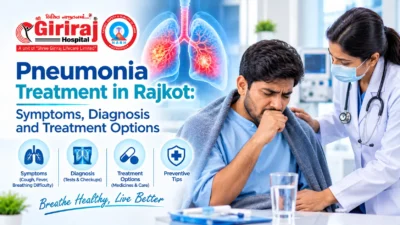


It begins like an ordinary cold. A cough, a little fever, some body ache. Three days later the fever has not gone, the cough is wetter, and every breath feels heavy.
That is how pneumonia often starts. And when someone at home is breathless at night, the search begins: where can I find reliable pneumonia treatment in Rajkot?
Pneumonia is a lung infection that usually responds well to treatment when it is caught early. It becomes dangerous when it is ignored, treated with random antibiotics or found late. Children, older adults and people with other illnesses are most at risk.
This guide explains the symptoms, tests and treatment options in plain words. It tells you when home care is safe and when you need a hospital. It also explains how to choose pneumonia treatment in Rajkot that you can trust, and what Shree Giriraj Multispeciality Hospital offers.
This article follows accepted clinical guidance and is reviewed by the hospital’s clinical team. It is for education only and does not replace an examination by a doctor.
We wrote it so that any family facing pneumonia treatment in Rajkot can follow it step by step.
Quick Takeaways Before You Read On
- Pneumonia treatment in Rajkot depends on the cause, how severe the infection is and your age and health.
- Good care starts with an examination, an oxygen check and usually a chest X-ray, not just a prescription.
- Antibiotics work for bacterial pneumonia, not for viral infections. Never use leftover antibiotics.
- Breathlessness at rest, blue lips, confusion or a very high fever are emergency signs.
- Most healthy adults recover at home, but older adults, children and people with other illnesses often need a hospital.
- Effective pneumonia treatment in Rajkot also includes follow-up and prevention, such as vaccines.
What Is Pneumonia and How Does It Affect the Lungs?
Pneumonia is an infection of the lungs. It inflames the tiny air sacs where oxygen enters the blood. These sacs can fill with fluid or pus, which makes breathing harder and lowers the oxygen in your body.
It can affect one part of one lung or both lungs. It can be mild enough to manage at home, or severe enough to need intensive care.
What Happens Inside the Lungs
Imagine the lungs as a bunch of small balloons at the ends of many branches. In pneumonia, some of those balloons get inflamed and filled with fluid. Air cannot reach them properly, so less oxygen passes into the blood.
That is why people with pneumonia feel short of breath, tired and weak. The body also reacts to the infection with fever, chills and cough.
Types of Pneumonia
- Community-acquired pneumonia (CAP). Caught outside a hospital. This is the most common type.
- Hospital-acquired pneumonia. Develops after 48 hours or more in a hospital. It is often caused by tougher germs.
- Aspiration pneumonia. Happens when food, saliva or stomach contents enter the lungs, often in people with swallowing problems or reduced consciousness.
- Walking pneumonia. A mild form, often caused by atypical germs like Mycoplasma. People feel unwell but can still go about their day.
Your doctor decides which type you have, because it changes the choice of medicine.
Cold, Flu, Bronchitis or Pneumonia?
Many people brush off the first signs as a cold. The table below shows how these illnesses differ.
| Illness | Where it affects | Typical clues | Usual course |
|---|---|---|---|
| Common cold | Nose and throat | Runny nose, sneezing, mild cough | Better in about a week |
| Flu | Whole body, airways | High fever, body ache, tiredness | Better in one to two weeks |
| Bronchitis | Airways | Cough with phlegm, little or no breathlessness | Cough can last weeks |
| Pneumonia | Air sacs in the lungs | Fever, chest pain, fast breathing, breathlessness, wet cough | Needs a doctor. Can last weeks |
If a “cold” gets worse after three to five days instead of better, treat that as a warning and see a doctor.
Causes and Risk Factors
Pneumonia is not caused by cold weather alone. It is caused by germs that reach the lungs. Cold, crowded and polluted environments make it easier for those germs to spread or for lungs to become vulnerable.
Germs That Cause Pneumonia
- Bacteria. The most common cause in adults is Streptococcus pneumoniae. Bacterial pneumonia often needs antibiotics.
- Viruses. Influenza, RSV and the coronavirus can cause pneumonia. Antibiotics do not work against viruses.
- Atypical germs. Organisms like Mycoplasma cause milder, “walking” pneumonia.
- Fungi. These are rare and mostly affect people with weak immunity.
A virus often comes first. It weakens the airway defences, and bacteria then take advantage. That is why pneumonia often follows a cold or flu.
Who Is at Higher Risk
- Babies and young children, and adults over 65
- Smokers and people exposed to heavy smoke, dust or cooking fumes
- People with asthma, COPD, heart disease, kidney disease or diabetes
- Anyone with a weak immune system, including those on steroids or cancer treatment
- People with heavy alcohol use or poor nutrition
- Bedridden patients and those with swallowing problems
- Anyone recovering from a recent flu or viral illness
Having a risk factor does not mean you will get pneumonia. But it does mean you should seek care sooner when symptoms start.
People in these groups should not wait for symptoms to worsen before asking about pneumonia treatment in Rajkot.
Pneumonia Symptoms in Adults, Children and Older People
Pneumonia does not look the same in everyone. A healthy adult may have a classic picture. A baby or an elderly person may show only subtle signs. Knowing the differences can save critical time.
Common Symptoms in Adults
- Fever and chills
- Cough, often with yellow, green or rust-coloured phlegm
- Chest pain that worsens when you breathe in or cough
- Fast or shallow breathing
- Shortness of breath, even when resting
- Tiredness, body ache and loss of appetite
- Sweating and sometimes nausea
Symptoms in Children and Babies
- Fast breathing for their age
- The skin between the ribs or under the ribs pulling in with each breath
- Grunting, wheezing or flaring nostrils
- Poor feeding, vomiting or unusual sleepiness
- Fever, though very young babies may have a low temperature instead
Children can worsen quickly. If you notice fast breathing or chest indrawing, see a doctor immediately.
Symptoms in Older Adults
Older adults may not have a high fever or a strong cough. Instead, they may become confused, unusually drowsy, weak or stop eating. A sudden change in behaviour can be the only sign.
Families should not dismiss this as “just age”. Early medical review can prevent a hospital emergency.
Emergency Warning Signs
Go to an emergency department without delay if you notice any of these:
- Breathlessness at rest or trouble speaking a full sentence
- Blue or grey lips or face
- Confusion, extreme drowsiness or fainting
- A fever that stays very high or does not respond to medicine
- Severe chest pain
- Oxygen reading persistently below 94% on a pulse oximeter, or at or below 90%, which is an urgent sign
These signs need emergency pneumonia treatment in Rajkot at once. Do not drive yourself. Call an ambulance. Shree Giriraj runs 24×7 emergency services in Rajkot and ambulance services. Our emergency hospital guide explains what to do in the first minutes.
When to See a Doctor for Pneumonia Treatment in Rajkot
Most coughs are not pneumonia. But some patterns should never be ignored. Book a visit the same day if you have any of the following.
- Fever that lasts more than three days
- A cough that is getting worse, or brings up coloured or bloody phlegm
- Chest pain or fast breathing
- Feeling much more tired or weak than a normal cold would cause
- A cold or flu that was improving and then suddenly worsened
- Any of the high-risk conditions listed above, even with mild symptoms
The earlier you start pneumonia treatment in Rajkot, the less likely you are to need a hospital stay. A visit takes a short time, and a chest X-ray can answer the question quickly.
Please do not try to manage this at home with leftover antibiotics, cough syrups or home remedies alone. Steam, warm fluids and rest can help you feel better, but they do not treat the infection. Delay is the biggest risk of all in pneumonia treatment in Rajkot or anywhere else.
If you want a specialist, see our guides to the best chest specialist in Rajkot and the best pulmonologist in Rajkot.
How Pneumonia Is Diagnosed
Correct diagnosis is the foundation of good care. Doctors combine your story, an examination and a few tests. A careful assessment is a key part of safe pneumonia treatment in Rajkot, because it separates pneumonia from other causes of cough and breathlessness.
History and Physical Examination
Your doctor will ask when the symptoms began, how they have changed, and whether you have other illnesses, allergies or recent travel. They will check temperature, pulse, breathing rate, blood pressure and oxygen level.
Listening to the chest with a stethoscope can reveal crackles or reduced breath sounds over the affected area. Not all pneumonia can be heard, so tests are important.
Chest X-Ray
A chest X-ray is the main test. It shows which part of the lung is affected, how much, and whether there is fluid around the lung. It is quick, widely available and low in radiation.
Sometimes the X-ray looks normal in the first day or two, so the doctor may repeat it if the picture does not fit.
If you are unsure whether you need an X-ray, ask your doctor. It is a routine step in pneumonia treatment in Rajkot hospitals.
Blood Tests and Sputum Tests
Blood tests such as a complete blood count and inflammation markers (CRP, sometimes procalcitonin) show how strongly the body is reacting. Kidney function and blood sugar help judge severity and guide treatment.
A sputum test can identify the germ. In sicker patients, blood cultures are also taken before antibiotics are given. Doctors may also test for flu, COVID-19 or TB when the story suggests it.
Blood and sputum results often decide which antibiotic is chosen in pneumonia treatment in Rajkot.
CT Scan, Oxygen Tests and Other Investigations
A CT scan of the chest is used when the X-ray is unclear, when the illness is not improving, or when complications such as an abscess or fluid collection are suspected. An arterial blood gas test measures oxygen and carbon dioxide in sicker patients.
If fluid collects around the lung, a doctor may drain a sample for testing. Bronchoscopy is rarely needed, but may be used when pneumonia does not clear or when a blockage is suspected.
How Doctors Judge Severity (CURB-65)
One simple tool doctors use to decide between home care and a hospital is the CURB-65 score. It gives one point for each of these:
| Letter | What is checked |
|---|---|
| C | New confusion |
| U | High blood urea |
| R | Respiratory rate of 30 or more per minute |
| B | Low blood pressure |
| 65 | Age 65 or older |
A score of 0 or 1 usually means treatment at home may be safe. A score of 2 suggests the person should be considered for hospital care. A score of 3 or more points to severe pneumonia, and intensive care may be needed.
This score is only one guide. Doctors also look at oxygen level, other illnesses and whether you can take medicines and fluids. A good centre for pneumonia treatment in Rajkot will explain why it recommends home care or admission in your case.
Pneumonia Treatment in Rajkot: Options Explained
Treatment depends on the germ, the severity, your age and your other health problems. There is no single medicine for every case. Here is how pneumonia treatment in Rajkot usually works, from simple to intensive.
Antibiotics for Bacterial Pneumonia
Antibiotics are the main treatment for bacterial pneumonia. The doctor chooses a medicine based on your age, the likely germ, local patterns, other illnesses and allergies. Common groups include penicillin-type medicines, macrolides, doxycycline and cephalosporins.
Mild cases are treated with tablets at home. More serious cases need intravenous (IV) antibiotics in a hospital, often switched to tablets once you improve. Good pneumonia treatment in Rajkot also means sending the right tests before starting antibiotics in sicker patients.
For uncomplicated community pneumonia, the course is often around five to seven days, but severe or complicated cases need longer. Always follow your doctor’s plan. Stopping early can let the infection return, and taking leftover antibiotics can cause resistance.
That is why a doctor’s prescription, not a pharmacy shelf, should guide pneumonia treatment in Rajkot.
Antivirals and Antifungals
If the cause is influenza, an antiviral such as oseltamivir works best when started early, ideally within the first two days. Other viral pneumonias are mostly managed with supportive care, because antibiotics do not kill viruses.
Fungal pneumonia is uncommon and is treated with antifungal medicines, usually in people with weak immunity. Your doctor will decide based on tests.
Supportive Care
Supportive care helps your body fight the infection while the medicines work. It is a major part of pneumonia treatment in Rajkot homes and hospitals alike.
- Rest as much as you need.
- Drink plenty of fluids to prevent dehydration and thin the mucus.
- Use paracetamol for fever and pain as advised. Avoid mixing several fever medicines.
- Eat small, nutritious meals even if your appetite is low.
- Practise gentle deep breathing as your doctor or physiotherapist advises.
- Do not smoke, and stay away from smoke and dust.
- Use cough syrups only if your doctor suggests them. Coughing helps clear the lungs.
Oxygen and Hospital Treatment
If your oxygen level is low, you need oxygen therapy. This can range from a simple mask to high-flow oxygen. IV fluids, IV antibiotics and close monitoring of breathing, pulse and blood pressure are given in the ward.
A hospital also allows quick adjustment of treatment. If the first antibiotic does not work, tests can guide a change. This is where an organised team makes the difference in pneumonia treatment in Rajkot.
ICU Care for Severe Pneumonia
Severe pneumonia can cause very low oxygen, low blood pressure or organ stress. These patients need intensive care. Support may include non-invasive ventilation through a mask or, when needed, a ventilator.
The ICU team also watches the kidneys, the heart and the blood for signs of sepsis. To understand what to expect, read our guide on what happens inside an ICU and our page on the best critical care doctor in Rajkot.
Home Care or Hospital: Where Should You Be Treated?
This is the question families worry about most. The answer depends on severity and risk, not on how scary the cough sounds. The table below shows the usual thinking behind pneumonia treatment in Rajkot decisions.
| Situation | Usual plan |
|---|---|
| Young or middle-aged, alert, normal oxygen, can eat and drink | Treatment at home with tablets and review in 24 to 48 hours |
| Age 65 or older, or several other illnesses | Closer watch, often a short hospital stay |
| Low oxygen, fast breathing or low blood pressure | Hospital admission with oxygen and IV treatment |
| Confusion, very low oxygen or shock | ICU care |
| Babies, young children or pregnant women with pneumonia | Prompt medical review, often admission |
Your doctor will make the final call. If you are being treated at home, ask for clear instructions on warning signs and when to return. Good pneumonia treatment in Rajkot always includes a review plan.
You Probably Need Admission If
- Your oxygen level is below the safe range
- You are breathing very fast or struggling to breathe
- You are confused or very drowsy
- You cannot keep down fluids or medicines
- You have other serious illnesses such as heart, kidney or lung disease
- You are not improving after 48 to 72 hours of treatment at home
Recovery Timeline: What to Expect After Pneumonia
Recovery varies from person to person. Healthy adults often feel clearly better within a week. Older adults and people with other illnesses may take longer. The pattern below is typical.
- Day 1 to 3. Fever begins to settle after the right treatment starts. If it does not, tell your doctor.
- Week 1. Breathing eases and appetite returns. Cough may continue.
- Weeks 2 to 4. The cough slowly fades. Tiredness is common and can last for a few weeks.
- Weeks 6 to 8. Most people feel back to normal. Some doctors repeat a chest X-ray at this stage, especially in smokers and people over 50.
Be patient with your energy. Return to work and exercise gradually. Keep taking all medicines as prescribed and attend every follow-up. A review is a key part of pneumonia treatment in Rajkot, because it confirms that the lung has healed.
If the shadow on the X-ray does not clear, your doctor may suggest more tests to look for other causes, including TB or, rarely, a lung tumour. Our guide on cancer screening tests explains when screening makes sense.
Complications of Pneumonia
Most people recover fully. But pneumonia can sometimes cause serious problems, particularly when treatment is delayed. Doctors watch for these:
- Pleural effusion and empyema. Fluid or pus collects around the lung. It may need drainage.
- Lung abscess. A pocket of pus forms inside the lung.
- Sepsis. The infection spreads into the blood and affects organs.
- Respiratory failure. The lungs cannot supply enough oxygen.
- Worsening of other illnesses. Heart failure, diabetes and COPD can flare during pneumonia.
These risks are the main reason to start pneumonia treatment in Rajkot early rather than waiting for a cough to “settle”.
Prevention: Vaccines and Healthy Habits
Prevention is easier than treatment. A few simple steps lower your chance of pneumonia and make it milder if it comes.
Vaccines That Protect Against Pneumonia
- Pneumococcal vaccine. Protects against the most common bacterial cause. It is advised for older adults and for people with chronic illness, and children receive it as part of routine immunisation.
- Flu vaccine. Taken every year. Flu often leads to pneumonia.
- COVID-19 vaccine. Follow current guidance for your age group.
- Childhood vaccines. Hib and measles vaccines also protect against pneumonia in children.
Ask your doctor which vaccines suit your age and health. Prevention is part of good pneumonia treatment in Rajkot, not a separate subject.
Everyday Habits
- Wash hands often and cover coughs.
- Quit smoking and avoid second-hand smoke.
- Avoid indoor smoke from cooking fuel and incense where possible.
- Keep diabetes, asthma, COPD and heart conditions well controlled.
- Brush your teeth twice a day. Good oral hygiene lowers aspiration risk.
- Eat a balanced diet and sleep well.
- Avoid close contact with people who are coughing and feverish.
Rajkot Seasons and Triggers
Respiratory infections rise as the weather turns cooler and people spend more time indoors. Smoke and dust from the festival season can irritate the airways and weaken lung defences. Construction dust and heavy traffic add to the load.
On poor-air days, avoid heavy outdoor exercise and wear a well-fitting mask if you have lung disease. Get your flu vaccine early in the season. Families dealing with pneumonia treatment in Rajkot often tell us that the illness began after a viral cold that was ignored.
Pneumonia in Special Groups
Some people need extra care because pneumonia can turn serious faster or look different.
Children
Pneumonia is a major cause of illness in young children. Warning signs are fast breathing, chest indrawing, grunting and poor feeding. As a guide, a calm breathing rate of 50 or more per minute in babies aged 2 to 12 months, or 40 or more in children aged 1 to 5 years, is a warning sign.
Take your child to a paediatrician promptly. Please confirm with the hospital desk whether paediatric pneumonia treatment in Rajkot is available at your chosen centre before you travel.
Older Adults
Older adults can deteriorate quickly and may show only confusion or weakness. Swallowing problems can cause aspiration pneumonia. Vaccines, good oral care and early review are especially important in this group.
Pregnancy
Pneumonia can be more serious during pregnancy. Do not wait. Tell your doctor you are pregnant, because medicines and tests need to be chosen carefully. Early pneumonia treatment in Rajkot protects both mother and baby.
People with Diabetes, Heart or Lung Disease
High blood sugar weakens the body’s defences, and infection can push sugar even higher. Read about diabetes complications to understand the link.
Breathlessness from the heart can look like pneumonia. Our guide to the early signs of heart disease helps you tell them apart. In COPD or asthma, pneumonia can trigger a severe flare, so prompt pneumonia treatment in Rajkot matters even more.
How to Choose Pneumonia Treatment in Rajkot
Not every centre offers the same depth of care. Whether you pick a clinic or a hospital, use the checklist below to judge the quality of pneumonia treatment in Rajkot before you commit.
Your 8-Point Checklist
- Quick diagnosis. Chest X-ray, blood tests and oxygen checks are available on the same day.
- Right doctor. A physician or pulmonologist experienced in chest infections is available.
- Clear admission criteria. The doctor explains why you need home care or admission.
- Oxygen and ICU backup. The hospital has oxygen, a high-dependency area and ICU if you worsen.
- Responsible antibiotic use. The team tests where needed and does not hand out strong antibiotics for every cough.
- Infection control. Wards are clean and visitors are managed sensibly.
- Follow-up plan. You get written instructions and a review date.
- Transparent cost and insurance help. You receive an estimate and support with cashless claims.
A centre that meets these points gives you dependable pneumonia treatment in Rajkot. You can also use our best hospital in Rajkot checklist for general comparison.
Questions to Ask the Doctor
- What type of pneumonia do I have, and how severe is it?
- Do I need to be admitted, or can I recover at home?
- Which tests do I need, and why?
- How long will I take antibiotics, and what should I do if I miss a dose?
- What warning signs mean I should come back at once?
- When is my follow-up, and will I need another X-ray?
A doctor who answers these clearly is a good sign for your pneumonia treatment in Rajkot.
Cost, Insurance and Cashless Pneumonia Treatment
Cost depends on severity. A mild case treated at home costs much less than a stay in the ICU. One insurer website gives an indicative national average of about Rs 60,000 for pneumonia treatment, with larger cities higher. Treat that as a rough guide, not a quote.
What Affects the Cost
- Mild or severe illness
- Home treatment, ward stay or ICU
- Length of stay and room category
- Tests such as X-ray, CT, blood and sputum tests
- Medicines, IV antibiotics and oxygen support
- Ventilator support or procedures like fluid drainage
- Other illnesses that need management at the same time
Always ask for a written estimate before admission and ask what is not included. This is a basic part of honest pneumonia treatment in Rajkot.
Insurance and Cashless Claims
Most health policies cover hospital treatment for pneumonia. Many have an initial waiting period for illnesses, often about 30 days, so check yours. Also check room-rent limits and co-payment.
If your insurer is linked with the hospital, you can get cashless pneumonia treatment in Rajkot. Our guide to cashless health insurance hospitals in Rajkot explains the steps, and our cashless insurance page lists the insurers and TPAs we work with.
Common Myths About Pneumonia
- “Every cough needs an antibiotic.” No. Most coughs are viral. Antibiotics are for bacterial infections and only on a doctor’s advice.
- “I can stop the medicine once I feel better.” No. Finish the course unless your doctor says otherwise.
- “Pneumonia only happens in winter.” It can happen in any season, though it is more common when the weather is cold.
- “Only old people get pneumonia.” Anyone can, though children, older adults and people with other illnesses are at higher risk.
- “Steam or herbal drinks can cure it.” They may soothe, but they do not treat the infection.
- “A sweater is enough protection.” Warm clothes help comfort, but vaccines and hygiene matter more.
Busting these myths early makes pneumonia treatment in Rajkot safer and faster.
Pneumonia Care at Shree Giriraj Superspeciality Hospital
Shree Giriraj Superspeciality Hospital offers medical, emergency and critical care under one roof. You can read about our pulmonology department, our ICCU and our doctors.
Our aim is simple. If you or a family member needs pneumonia treatment in Rajkot, you should get a clear diagnosis, an honest plan and support through recovery. We want you to know why we advise home care or admission.
Whether you need a clinic visit or an admission, we want pneumonia treatment in Rajkot to feel organised and calm for your family.
What Patients Can Expect
- A careful history, examination and oxygen check
- [Confirm in-house tests: chest X-ray, blood tests, sputum culture, CT chest]
- Oxygen therapy, IV treatment and monitoring for patients who need admission
- ICU and critical care support for severe cases
- 24×7 emergency access and ambulance support
- Insurance desk support for cashless and PM-JAY patients
- Follow-up advice and vaccine guidance
Our team works so that pneumonia treatment in Rajkot at Giriraj is planned, explained and costed before you are admitted. If you want to talk to a doctor, you can book an appointment or contact us. If you already have a diagnosis elsewhere, our second opinion service can review it. You can also add a health check-up plan to catch risks early, or read about a master health checkup vs full body checkup.
Frequently Asked Questions About Pneumonia Treatment in Rajkot
What is the treatment for pneumonia?
Treatment depends on the cause and severity. Bacterial pneumonia is treated with antibiotics. Viral pneumonia is mostly treated with supportive care, and sometimes antivirals. Severe cases need oxygen, IV medicines and hospital care.
Where can I get pneumonia treatment in Rajkot?
You can get care at hospitals, chest clinics and physicians across the city. Choose a centre that offers same-day tests, oxygen and ICU backup. Pneumonia treatment in Rajkot at Shree Giriraj Superspeciality Hospital includes 24×7 emergency care and a team that explains each step.
Can pneumonia be treated at home?
Mild pneumonia in healthy adults can often be treated at home with doctor-prescribed antibiotics, fluids and rest. Older adults, young children and people with other illnesses usually need closer care. Your doctor will decide after checking your oxygen and severity.
How long does pneumonia take to heal?
Fever usually settles within a few days of the right treatment. Cough and tiredness can last two to four weeks, and sometimes longer. Full recovery can take up to six to eight weeks.
What are the first signs of pneumonia?
Fever, chills, cough with phlegm, chest pain on breathing, fast breathing and unusual tiredness. In older adults, confusion may be the first sign.
Is pneumonia contagious?
The germs that cause pneumonia can spread through coughs and sneezes, but not everyone exposed develops pneumonia. People with weak immunity are more likely to get sick. Hand hygiene and vaccines help.
How is pneumonia diagnosed?
Doctors use your symptoms, an examination, an oxygen check and usually a chest X-ray. Blood tests and sputum tests help find the cause and judge severity. Reliable pneumonia treatment in Rajkot always starts with a proper diagnosis.
Which antibiotic is best for pneumonia?
There is no single best antibiotic. The right choice depends on the likely germ, your age, other illnesses, allergies and severity. Please do not self-medicate or use leftover antibiotics.
How much does pneumonia treatment in Rajkot cost?
Cost depends on whether you are treated at home, in a ward or in the ICU, and on tests and medicines. One national insurer website cites an indicative average of about Rs 60,000. For pneumonia treatment in Rajkot, ask for a written estimate that lists what is included.
When should I go to the hospital for pneumonia?
Go at once if you have breathlessness at rest, blue lips, confusion, severe chest pain or a persistently low oxygen reading. Also go if you are not improving after two to three days of treatment.
Can pneumonia come back?
Yes, especially in people with weak immunity, lung disease or risk factors such as smoking. Vaccines, good control of other illnesses and early treatment reduce the risk. Repeated pneumonia needs further tests to find the cause.
What is walking pneumonia?
It is a mild form, often caused by Mycoplasma, where people feel unwell but can stay on their feet. It still needs a doctor’s review, and sometimes a specific antibiotic.
Is pneumonia treatment covered by health insurance?
Usually yes, when hospital admission is needed, but check waiting periods, room-rent limits and co-payment. Ask the insurance desk about pneumonia treatment in Rajkot under your policy and whether cashless treatment is available.
Which doctor treats pneumonia?
A general physician or internal medicine specialist can treat many cases. A pulmonologist or chest specialist treats complex, recurring or severe pneumonia. Children should see a paediatrician.
Conclusion: Do Not Wait Out a Cough That Is Getting Worse
Pneumonia is common, and most people recover well when they are treated early. The danger lies in waiting too long, using the wrong medicines or missing warning signs in children and older adults.
If your cough is getting worse, your fever is not settling, or breathing feels heavy, see a doctor the same day. A simple examination and a chest X-ray can tell you what you are dealing with.
Shree Giriraj Superspeciality Hospital is ready to guide you through every step of pneumonia treatment in Rajkot, from the first test to the follow-up review. Our team will explain the diagnosis, the plan and the cost in plain words.
To plan your care, contact our team today. Choosing the right pneumonia treatment in Rajkot is a decision that protects your lungs and your family, and it is worth making calmly and early.
Disclaimer: This article is for general education and does not replace medical advice, diagnosis or treatment. If you or someone else has severe breathlessness, blue lips, confusion or chest pain, seek emergency care immediately.