






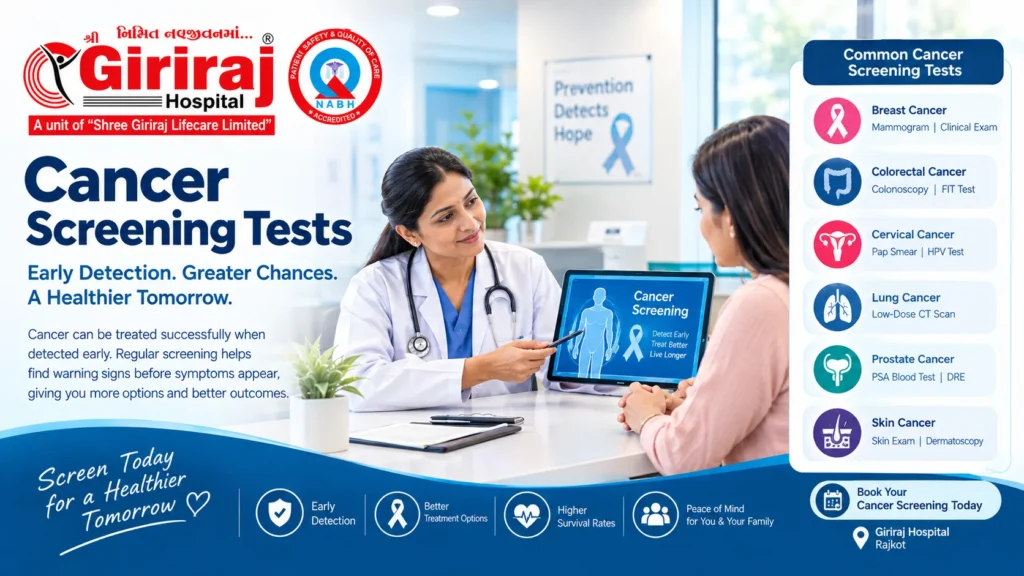
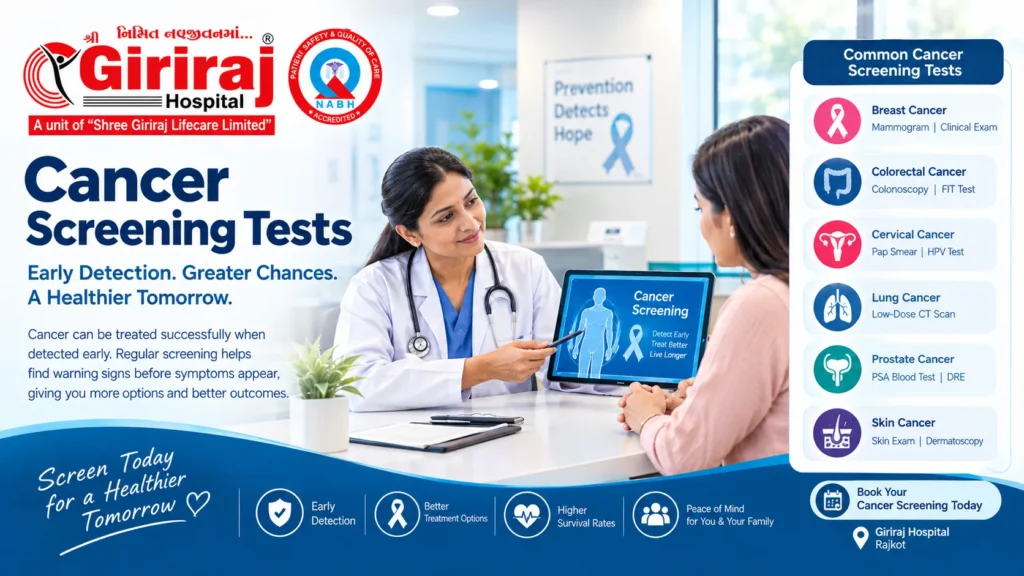
Most cancers cause no symptoms at all in their earliest, most treatable stage. This is exactly why cancer screening tests everyone should know matter so much, they can catch a problem long before you would ever feel unwell. In India, cancer cases are projected to rise from around 1.46 million in 2022 to over 1.57 million by 2025 (National Cancer Registry Programme, ICMR, 2024), yet many of the most common cancers, including breast, cervical, and colorectal cancer, are highly treatable when caught early.
At Shree Giriraj Hospital in Rajkot, screening is built into everyday preventive care through our Internal Medicine department and structured health checkups, not treated as a separate, intimidating errand. This article walks you through what cancer screening actually involves, which tests apply to you based on your age and gender, how results are interpreted, and what happens next if something needs a closer look, including cost and Ayushman Card coverage.
What Is Cancer Screening?
Cancer screening means testing a person who has no symptoms at all, to look for early or pre-cancerous changes before they cause any noticeable problem. This is different from a diagnostic test, which is done after someone already has symptoms or a specific concern.
Screening matters because it can catch a handful of cancers, particularly breast, cervical, and colorectal cancer, at a point when treatment is simpler, less invasive, and far more likely to succeed. It is generally most relevant from your 40s onward, though certain tests, like cervical screening, start much earlier, and anyone with a strong family history may need to begin sooner regardless of age.
| Think of It Like This Think of cancer screening like a smoke detector, not a fire extinguisher. It doesn’t treat anything by itself. It simply gives you an early warning while a problem is still small and manageable, so you and your doctor have far more options and far more time to act. |
Screening is most effective as part of a complete picture of your health, not a single isolated test. Our guide to a full body checkup in Rajkot explains how routine screening fits alongside blood pressure, sugar, and cholesterol checks, all coordinated through our Internal Medicine department.
Warning Signs You Should Never Ignore
Screening is for people without symptoms. But if you notice any of the signs below, they need medical evaluation now, not at your next scheduled screening.
Early Warning Signs
- A new lump or thickening anywhere in the body, especially in the breast or neck
- A sore or mouth ulcer that does not heal within a few weeks
- Persistent, unexplained fatigue that doesn’t improve with rest
- Unexplained weight loss without changes to diet or activity
- A persistent cough or hoarseness lasting more than three weeks
- Changes in bowel or bladder habits that last more than a few weeks
- Unusual bleeding, including between periods or after menopause
- A mole or skin spot that changes in size, shape, or colour
Advanced or Serious Warning Signs
- Sudden, severe, unexplained pain that is new and does not settle
- Coughing up blood
- Blood in the stool or urine
- A rapidly growing lump
- Sudden difficulty swallowing that is getting worse
- Unexplained, significant weight loss over a short period
- Persistent, severe abdominal swelling or bloating
| When to Seek Emergency Care Immediately Coughing up blood, sudden severe pain, or heavy unexplained bleeding should never wait for a routine appointment. Get to the nearest hospital’s emergency department right away, since these signs need urgent evaluation regardless of the underlying cause. |
Our Ambulance Services are available across Rajkot for exactly this kind of urgent situation, while our Internal Medicine team can assess and coordinate the right next steps once you reach us.
Causes and Risk Factors
Common Contributing Factors
Tobacco Use: Smoking and chewing tobacco remain the single largest preventable cause of cancer in India, contributing to oral, lung, and several other cancers.
Family History and Genetics: Having a close relative with certain cancers, particularly breast, ovarian, or colorectal cancer, raises personal risk and may call for earlier or more frequent screening.
Chronic Infections: Persistent HPV infection is linked to cervical cancer, while long-term Hepatitis B or C infection raises liver cancer risk.
Age: Risk for most major cancers rises steadily after age 40, which is why screening guidelines generally start around this age for average-risk individuals.
Diet and Lifestyle: Diets low in fibre, fruits, and vegetables, along with prolonged inactivity and obesity, are linked to higher risk for several cancers, including colorectal cancer.
Prolonged Sun or Chemical Exposure: Excessive unprotected sun exposure and long-term exposure to certain industrial chemicals raise skin and other cancer risks.
Who Should Consider Earlier or More Frequent Screening
- People with a first-degree relative (parent, sibling, child) diagnosed with cancer
- Anyone with a known genetic mutation linked to cancer, such as BRCA1 or BRCA2
- Current or former heavy smokers, particularly for lung cancer screening
- Women who have never been screened for cervical cancer despite being sexually active
- People with chronic Hepatitis B or C infection
- Anyone with persistent, unexplained symptoms, regardless of age
None of these risk factors mean cancer is guaranteed, and many people with several risk factors never develop cancer at all. If you’re managing a related chronic condition, our Internal Medicine department can help build a personal risk profile, and our article on diabetes complications and treatment covers how metabolic conditions can factor into overall risk.
Cancer Screening Tests by Age and Gender
The right screening tests depend heavily on your age, gender, and personal risk factors. This table summarises the widely-followed general guidelines for average-risk adults.
| Cancer Type | Who | Recommended Starting Age | Typical Test |
|---|---|---|---|
| Breast | Women | 40 | Mammogram every 1–2 years |
| Cervical | Women | 21 | Pap smear every 3 years, or Pap + HPV co-test every 5 years from 30 |
| Colorectal | All genders | 45 | Colonoscopy every 10 years, or annual stool-based test |
| Lung | Heavy smokers | 50 | Low-dose CT scan, based on smoking history |
| Prostate | Men | 50 (45 if higher risk) | PSA blood test, discussed with your doctor |
Why These Ages Matter
These starting ages reflect the point at which, for most people, the benefit of finding a cancer early clearly outweighs the small risks of the test itself. Anyone with a strong family history or known genetic risk may need to start meaningfully earlier, which is a conversation worth having directly with a doctor rather than guessing.
| Clinical Insight Screening guidelines describe average risk. If two or more close relatives have had the same or related cancers, or if a cancer occurred in a relative at an unusually young age, that pattern matters more than any standard age cutoff and deserves a dedicated risk conversation. |
Colorectal screening pathways in particular are supported locally through our Gastroenterology department, which performs and interprets colonoscopy directly.
How Are These Tests Actually Done?
Blood Tests
- PSA (Prostate-Specific Antigen): a simple blood draw measuring a protein linked to prostate activity
- Complete Blood Count (CBC): can flag abnormalities linked to certain blood cancers
- Tumour Marker Tests (e.g. CA-125): used selectively, usually alongside imaging, not as a stand-alone screen
Imaging Tests
- Mammogram: a low-dose breast X-ray, the standard breast cancer screening test
- Low-Dose CT Scan: a quick lung scan used specifically for high-risk current or former smokers
- Ultrasound: sometimes used to follow up an unclear finding from another test
Other Diagnostic Procedures
- Colonoscopy: a camera-guided examination of the entire colon that can remove polyps during the same procedure
- Pap Smear and HPV Test: cell and virus testing done during a routine gynaecological visit
- Clinical Physical Examination: a doctor’s hands-on check for lumps or other physical changes
Results are rarely a simple yes-or-no. Many findings need a second, more specific test before anything is confirmed, which is why screening is best done as part of a coordinated checkup rather than a single isolated test. Our Health Check-up Plans, including the Non-Invasive Cardiology & Radiology Package, bundle relevant screening components together so nothing falls through the cracks.
An unclear lung scan finding is reviewed alongside our Pulmonology department, and samples for blood-based screening tests are handled through our Collection of Laboratory Samples service, which can also come to you at home if a visit isn’t convenient.
What Happens After a Screening Test? Next Steps Explained
What happens next depends entirely on your result. Most screening results are normal and simply confirm that no follow-up is needed until your next scheduled test. A small number need a closer look, and an even smaller number lead to a confirmed diagnosis.
If Your Result Is Normal
You continue with routine screening on the recommended schedule. Our Internal Medicine team will note when your next test is due so you don’t have to track it yourself.
If a Result Needs a Closer Look
Many unclear results are resolved with a repeat test or a more specific follow-up test, not an immediate cancer diagnosis. Where a colonoscopy finds a polyp, our Gastroenterology and Gastrointestinal & Laparoscopic Surgery teams can often remove it during the same procedure, well before it has any chance to become cancerous.
If a Diagnosis Is Confirmed
Shree Giriraj Hospital does not operate a dedicated oncology treatment centre, and we believe in being upfront about that rather than overpromising. What we do offer is a clear, supported starting point: your results, imaging, and history are organised and explained to you clearly, and our Second Opinion & Teleconsultation service can help coordinate a smooth referral to a specialist oncology centre, so you are never simply handed a report and left to figure out the next step alone.
Consultations and eligible diagnostic follow-up related to a screening finding are covered under the Ayushman Bharat PM-JAY scheme for eligible families; our detailed PM-JAY guide explains exactly how the cashless process works.
Colonoscopy – What to Expect, Step by Step
Colonoscopy is the one screening test on this list that is an actual in-hospital procedure, so here is exactly what it involves.
Preparing for a Colonoscopy
- You’ll be given a special diet and a bowel-cleansing preparation to take the evening before and morning of the procedure
- Arrange for someone to drive you home afterward, since sedation is used
- Wear comfortable clothing and avoid heavy meals on the day of the procedure
During the Procedure
- You’ll be given sedation so the procedure is comfortable and you’re unlikely to remember much of it.
- A thin, flexible tube with a camera is gently guided through the colon, which takes approximately 20 to 40 minutes.
- If a polyp is found, it can usually be removed immediately during the same procedure.
- You’ll be moved to a recovery area to wake up from sedation, typically within 30 to 60 minutes.
Immediately After – Recovery
Most patients go home the same day, within 1 to 2 hours of the procedure ending. Mild bloating or cramping is common and usually settles within a few hours.
Our nursing and internal medicine teams monitor recovery closely before discharge, and our Ambulance Services remain available should any unexpected complication arise. You are looked after by the same experienced care team from preparation through to recovery.
Living Proactively: Your Screening Follow-Up Plan
The First Week
Do rest as needed if you had a procedure like a colonoscopy, and note any instructions about diet or activity. Don’t ignore a scheduled follow-up call about your results, even if you’re feeling completely fine.
Weeks 2 to 4
This is typically when any follow-up test results are finalised and discussed. If a repeat test or specialist referral was recommended, this is the window to schedule it rather than letting it slip.
Month 2 to 3
Most people are back to their normal routine well before this point, with their next screening date noted for the future. If a referral to an oncology specialist was made, this is often when the first specialist consultation and treatment planning happens.
Long-Term: Staying on Schedule
The biggest long-term risk isn’t a single screening test, it’s letting years pass without any. Keeping to a regular screening schedule, alongside general health checkups and coordinated patient care, is what actually catches problems early.
| A Patient’s Story One of our patients, a 52-year-old shopkeeper from Rajkot, came in for a routine health checkup with no symptoms at all. A colonoscopy found and removed two polyps during the same visit, well before either had a chance to develop further. He now returns for a scheduled follow-up colonoscopy as advised. Every case is different, but his experience shows why screening while you feel completely fine is worth doing. |
For ongoing risk-factor management, our Cardiology and Internal Medicine teams often work together, and our article on early signs of heart disease covers a related area worth understanding as part of overall preventive health.
Cost and Insurance / Ayushman Card Coverage
The cost of cancer screening in India depends heavily on which tests are included, whether they’re bundled into a broader health checkup, and whether any follow-up imaging is needed. We do not publish fixed prices here, since every screening plan is different; our billing desk can provide a written estimate once your specific tests are confirmed.
Factors that affect total cost include which cancers are being screened for, whether imaging like a mammogram or CT scan is included, and whether a procedure like colonoscopy is part of the plan.
Is this covered under PM-JAY? Partially, depending on the service. Diagnostic consultations and eligible hospital-based procedures, such as a colonoscopy when clinically indicated, are covered under the Ayushman Bharat PM-JAY scheme for eligible families. Routine preventive screening packages taken purely as a wellness choice are typically outside PM-JAY’s scope, similar to most preventive health checkups nationally.
Our on-site Ayushman Mitra desk can confirm exactly what applies to your situation. For a full walkthrough of eligibility and the cashless process, read our Ayushman Bharat Health Card / PM-JAY guide. If you would like to discuss your specific situation, speak to our team and we will guide you through the next steps.
Do’s and Don’ts Around Cancer Screening
| Do This | Don’t Do This |
|---|---|
| Start screening at the recommended age, even without symptoms | Don’t wait for symptoms to appear before considering screening |
| Mention your family cancer history to your doctor clearly | Don’t assume family history doesn’t matter if it’s from an aunt or grandparent |
| Follow the bowel-prep instructions exactly before a colonoscopy | Don’t skip or shorten the prep, since it affects how clearly the colon can be seen |
| Keep a simple record of when each screening test is due | Don’t rely on memory alone for tests that are years apart |
| Ask your doctor to explain an unclear result in plain language | Don’t assume an unclear result automatically means cancer |
| Eat a fibre-rich, home-style Indian diet to support colon health | Don’t rely heavily on processed or fried foods as a daily habit |
| Get age-appropriate cervical and breast screening even if you feel well | Don’t delay a Pap smear or mammogram simply due to discomfort or nerves |
| Ask about cost and PM-JAY coverage before your appointment | Don’t avoid screening due to assumed cost without checking first |
Building screening into a regular health check-up routine is the simplest way to make sure it actually happens on schedule, rather than becoming a separate task that keeps getting postponed.
Common Myths About Cancer Screening
| Myth | Fact |
|---|---|
| If I feel completely healthy, I don’t need screening | Most early-stage cancers cause no symptoms at all, which is exactly why screening exists |
| A screening test that finds something means I have cancer | Most unclear or abnormal screening results turn out not to be cancer once a follow-up test is done |
| Cancer screening is always painful or invasive | Many screening tests, like a blood draw or mammogram, involve only mild, brief discomfort |
| Screening is only necessary if cancer runs in my family | Most cancers occur in people with no known family history at all |
| Younger adults don’t need to think about cancer screening | Certain screenings, like cervical cancer screening, are recommended starting in your 20s |
| Once I’ve had one normal result, I don’t need to test again | Screening is only effective when repeated on schedule, not as a one-time event |
| A colonoscopy is a major surgery with a long recovery | It’s a same-day procedure, and most people go home within a couple of hours |
| For proper cancer screening you need to travel to a big city | Shree Giriraj Hospital provides this care to the same standard as top hospitals in larger cities, right here in Rajkot |
Why Choose Shree Giriraj Hospital for Cancer Screening?
Deciding where to get screened is a decision worth making thoughtfully, not just booking the first available slot. You can read more about our hospital here, but the points below focus on what matters most for screening specifically.
Screening Bundled Into a Complete Health Picture
Rather than a stand-alone test, screening here is coordinated through our Internal Medicine department as part of a broader health check, so risk factors like blood pressure and blood sugar are reviewed alongside cancer-specific tests.
In-House Colonoscopy and Follow-Up Care
Colorectal screening doesn’t stop at the test. Our Gastroenterology and Gastrointestinal & Laparoscopic Surgery teams can remove polyps found during the procedure itself, avoiding a separate visit.
Local Access to Gender-Specific Screening
Cervical screening is supported through our High-Risk Gynaecology & Obstetrics department, while prostate-related concerns are evaluated by our Urology & Andrology team, both available locally in Rajkot.
Honest Referral When Specialist Oncology Care Is Needed
We don’t operate a dedicated cancer-treatment centre, and we won’t pretend otherwise. When a diagnosis is confirmed, our Second Opinion & Teleconsultation service helps coordinate a clear, well-organised referral, so you’re never left holding a report with no next step.
Transparent, Cashless Ayushman Bharat / PM-JAY Coverage
Eligible consultations and diagnostic follow-up are covered under the PM-JAY scheme, and our Ayushman Mitra desk manages verification and cashless processing directly. Read more in our PM-JAY guide.
You don’t have to navigate screening decisions alone. Our experienced doctors are ready to help you build a screening plan that fits your age, risk factors, and family history, at our Rajkot Main and Kuvadava campus locations. If you’d like a broader view of what to look for in a hospital, our guide on the best hospital in Rajkot covers the key factors worth considering.
Book a consultation with our Internal Medicine team today to find out which screening tests are right for you.
Frequently Asked Questions
What is the first sign of cancer I should watch for?
There is no single universal first sign, since cancer varies widely by type and location. Common early clues include an unexplained lump, persistent unusual bleeding, unexplained weight loss, or a sore that doesn’t heal, but many early cancers cause no noticeable signs at all, which is why screening matters.
At what age should cancer screening start?
It depends on the specific cancer. Cervical screening typically starts around age 21, breast screening around 40, and colorectal, lung, and prostate screening generally begin between ages 45 and 50, though a strong family history can move these ages earlier.
Is cancer screening painful?
Most screening tests involve only mild, brief discomfort. A blood test feels like a routine draw, a mammogram involves brief compression, and a colonoscopy is done under sedation so most patients feel little to nothing during the procedure.
Is cancer screening covered under Ayushman Card?
Diagnostic consultations and eligible procedures like colonoscopy are typically covered under the PM-JAY scheme for eligible families, though purely elective wellness screening packages are usually outside its scope. See our full Ayushman Bharat / PM-JAY guide for details.
Does Shree Giriraj Hospital offer cancer treatment?
We do not operate a dedicated oncology treatment centre. What we offer is thorough screening, diagnosis, and follow-up through our Internal Medicine and Gastroenterology departments, plus coordinated referral to specialist oncology centres when a diagnosis is confirmed.
How do I book a cancer screening appointment?
You can book an appointment online for a screening consultation, where our Internal Medicine team will help identify which tests are right for your age and risk profile.
Which cancer test is best for a general full body checkup?
There isn’t one single best test, since different cancers need different screening methods. A well-rounded checkup typically includes a physical exam, relevant blood work, and imaging or procedures matched to your age and gender, rather than one catch-all test.
Do I need a doctor’s referral to get screened?
Usually not for routine tests like a mammogram or Pap smear, though a consultation helps confirm which tests are actually appropriate for you rather than testing without a clear plan.
Can cancer screening detect all types of cancer?
No. Reliable, widely-recommended screening currently exists mainly for breast, cervical, colorectal, lung, and prostate cancer. Many other cancer types don’t have a standard screening test and are usually found only once symptoms appear.
What happens if my screening result comes back abnormal?
An abnormal result usually leads to a follow-up test, not an immediate diagnosis. Many abnormal results turn out to be unrelated to cancer once that follow-up test is complete, so it’s worth staying calm and following through on the next step.
Conclusion and Next Steps
Knowing the cancer screening tests everyone should know, and actually following through on them, remains one of the most effective things you can do for your long-term health. Most results are normal, and the ones that aren’t are usually caught early enough to matter.
If you’re due for screening or simply unsure where to start, don’t wait. Contact our Internal Medicine department in Rajkot for a preventive health consultation, or book an appointment to plan your screening schedule.
Get in touch with our team with any questions about cost or PM-JAY coverage. Our staff are ready to help you take this simple, proactive step.