
A medical emergency should never force a family to choose between treatment and debt. Yet for decades, that was the reality for millions of Indian households, where a single major hospitalisation could wipe out years of savings. The Ayushman Bharat Pradhan Mantri Jan Arogya Yojana (PM-JAY) was launched to break that cycle. As of early 2026, the National Health Authority reports that over 43.5 crore Ayushman Cards have been issued across the country, with more than 11.69 crore hospital admissions already authorised under the scheme – making PM-JAY the largest government-funded health assurance programme in the world.
Whether you live in a village near Kuvadva or in the heart of Rajkot city, if you hold a valid Ayushman Card you are entitled to cashless treatment worth up to ₹10 lakh per family every year at any empanelled hospital in India. Shree Giriraj Hospital is proud to be empanelled under PM-JAY at both its Rajkot Main and Kuvadva campuses, offering cardiac care, orthopedics, neurosurgery, nephrology, critical care, and more under the scheme. In this guide, we walk you through everything – from what PM-JAY is and who qualifies, to the exact treatments covered and how to use your card on the day you need it most.
What Is Ayushman Bharat PM-JAY?
Ayushman Bharat is the Government of India’s flagship healthcare mission, built on two pillars. The first is a network of Health and Wellness Centres (HWCs) that deliver primary care, screening, and preventive services close to home. The second – and the one most families know best – is Pradhan Mantri Jan Arogya Yojana (PM-JAY), a health assurance scheme that pays for secondary and tertiary care hospitalisation.
Launched on 23 September 2018, PM-JAY provides cover of ₹5 lakh per family per year for hospital admissions, with no cap on family size, age, or gender. There is no premium for beneficiaries to pay; the entire cost is funded jointly by the central and state governments. Unlike a typical private insurance policy, PM-JAY does not require you to pay first and claim later – treatment is cashless and paperless at the point of care, across both public and private empanelled hospitals.
In Gujarat, PM-JAY operates jointly with the state’s own Mukhyamantri Amrutam (MA) Yojana, integrated since 2019. This means many Gujarati families already covered under MA or MA Vatsalya cards continue to receive the same ₹5 lakh benefit seamlessly through PM-JAY-empanelled hospitals such as Shree Giriraj Hospital.
Why the Government Started PM-JAY
Before PM-JAY, out-of-pocket spending on healthcare was one of the leading causes of impoverishment in India. National surveys consistently showed that a large share of hospitalisation costs was paid directly by families – often through borrowed money or the sale of assets – a phenomenon health economists call catastrophic health expenditure. Rural households without health insurance and urban informal-sector workers were especially vulnerable, since a single accident or major illness could erase years of income in a matter of days.
The National Health Policy 2017 recommended a publicly financed health assurance scheme to address this gap, and PM-JAY was designed in direct response. It replaced and significantly expanded on the earlier Rashtriya Swasthya Bima Yojana (RSBY), raising the cover per family from roughly ₹30,000 to ₹10 lakh, and widening eligibility from the below-poverty-line population to the bottom 40% of India’s population, as identified through the Socio-Economic Caste Census (SECC) 2011.
Objectives of the Scheme
PM-JAY was designed around a clear set of goals:
- Reduce catastrophic out-of-pocket health expenditure for poor and vulnerable families
- Provide cashless and paperless access to quality secondary and tertiary hospitalisation
- Improve health-seeking behaviour, particularly in rural and underserved regions
- Strengthen the public-private partnership model in healthcare delivery
- Move India closer to the Sustainable Development Goal of Universal Health Coverage (UHC)
- Standardise treatment costs nationwide through fixed package rates under the Health Benefit Package (HBP)
Importance of the Ayushman Card
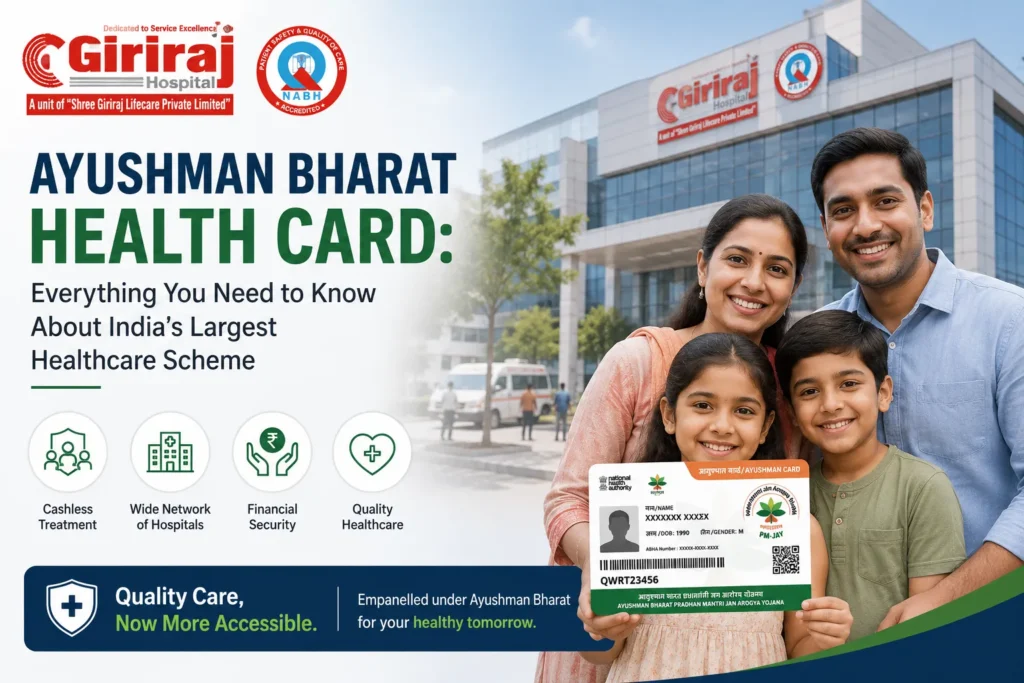
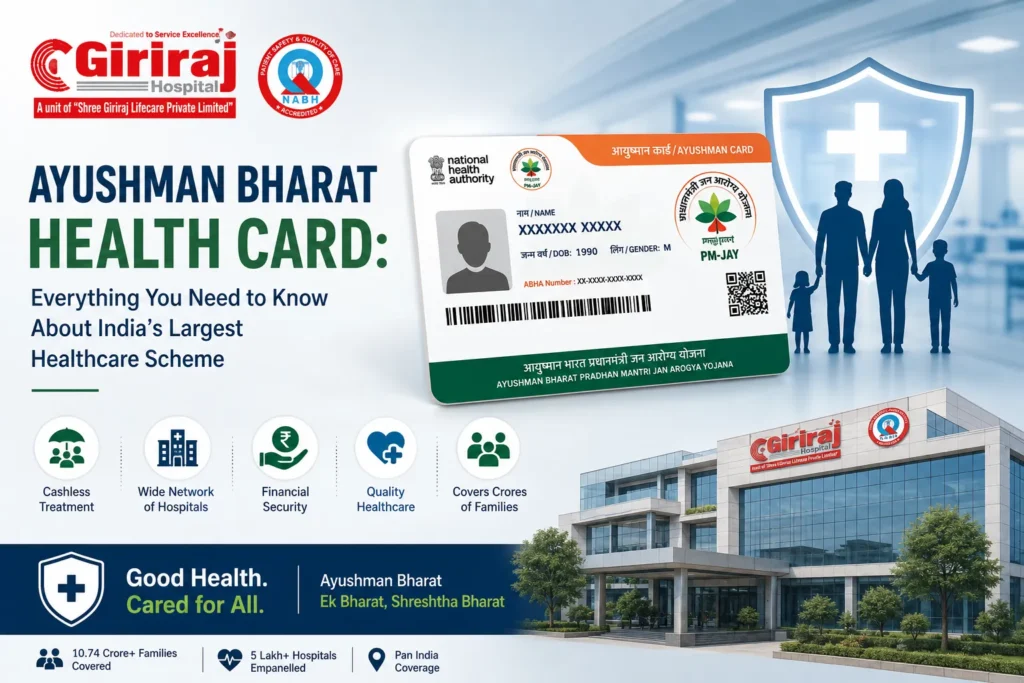
The Ayushman Card is the single document that turns scheme eligibility into actual hospital access. Once issued, it carries a unique PM-JAY ID linked to Aadhaar, and any listed family member can use it independently – a child, a grandparent, or a working adult – without needing separate cards or policies. For rural citizens who may never have held private health insurance, and for senior citizens who often face the highest medical costs, the card is frequently the difference between delaying treatment and getting it on time.
Since October 2024, citizens aged 70 and above receive their own Ayushman Vay Vandana Card, with cover available irrespective of income or existing insurance status. Over 1.14 crore such cards had already been issued to senior citizens by early 2026, reflecting just how central this card has become to family healthcare planning across India.
Benefits of PM-JAY
- Cashless and paperless hospitalisation at empanelled government and private hospitals
- Family floater cover with no restriction on family size or age
- Coverage for pre-existing diseases from day one, with no waiting period
- Pre-hospitalisation expenses (up to 3 days) and post-hospitalisation expenses (up to 15 days) included in the package
- Nationwide portability – use your card at any empanelled hospital in any state
- Nearly 1,900 standardised treatment packages spanning around 27 medical specialities
- No enrolment fee or annual premium for beneficiaries
₹5 Lakh Coverage Details
The ₹5 lakh sum insured is a family floater, meaning it is shared across every member listed on the card rather than allocated per person. The limit renews every financial year, and treatment is paid out at fixed package rates defined under the National Health Benefit Package (HBP 2.2) – so if a procedure costs less than its package rate, the remaining balance stays available for other admissions in the same family during that year.
Senior citizens aged 70 and above receive an additional, independent top-up of ₹5 lakh through the Ayushman Vay Vandana Card – over and above any existing family cover – recognising that older patients often need more frequent or more complex hospital care.
Cashless Treatment Process
PM-JAY is designed so that no money changes hands between the patient and the hospital for a covered treatment. At the hospital, a dedicated Ayushman Mitra (PM-JAY help desk executive) verifies the patient’s identity through Aadhaar-based e-KYC, checks the diagnosis against the Health Benefit Package list, and – where required – raises a pre-authorisation request through the government’s Transaction Management System (TMS) portal. Once approved, the hospital admits and treats the patient and bills the government directly at the fixed package rate. The patient walks out without paying for anything covered under that package.
Eligibility Criteria
Eligibility under PM-JAY is determined primarily by the SECC 2011 database, with separate criteria for rural and urban households, plus newer categories added over time.
Rural Households
A rural household automatically qualifies if it meets at least one of the following deprivation criteria:
- Living in a household with only one room and kucha walls and roof
- No adult member between the ages of 16 and 59
- Female-headed household with no adult male member aged 16–59
- A disabled member in the household with no able-bodied adult
- Belonging to a Scheduled Caste or Scheduled Tribe household
- Landless households deriving a major part of their income from manual casual labour
Urban Households
Urban eligibility is based on occupational categories rather than housing conditions, and covers workers such as rag pickers, street vendors, domestic help, construction labourers, sanitation workers, home-based artisans, and similar informal-sector occupations.
Additional Categories
All Indian citizens aged 70 years and above are eligible under the Ayushman Vay Vandana Card, regardless of income or social category, since October 2024. In Gujarat, families already enrolled under the MA or MA Vatsalya Yojana with annual income within the defined state threshold also continue to receive PM-JAY benefits without a fresh application.
How to Check Eligibility
Before visiting a hospital, you can confirm whether your family is already eligible:
- Visit the official Mera PMJAY website or download the Ayushman App
- Enter your registered mobile number and verify with the OTP sent to it
- Select your state and search using your name, ration card number, or RSBY URN
- Call the 24×7 toll-free PM-JAY helpline at 14555 for assistance in your local language
- Visit the nearest Common Service Centre (CSC) or the Ayushman Mitra desk at the Giriraj Hospital reception
How to Apply for Ayushman Card
If your family is found eligible but does not yet have a card, the application process is straightforward:
- Check your eligibility on the Ayushman App, the PM-JAY portal, or via the helpline
- Visit the nearest Common Service Centre, empanelled hospital, or government facility with an Ayushman Mitra
- Provide your Aadhaar number to begin e-KYC verification
- Complete face or biometric authentication as guided by the operator
- Once verified, your digital Ayushman Card is generated and can be downloaded or printed immediately
Documents Required
Keep the following documents ready when checking eligibility or applying for your card:
- Aadhaar Card (mandatory for e-KYC verification)
- Ration Card or Family ID, where applicable
- A working mobile number for OTP verification
- A recent passport-size photograph
- Income or category certificate, if applying through a state-extended income-based category
- Age proof, for senior citizens applying for the Ayushman Vay Vandana Card
Diseases Covered
PM-JAY covers hospitalisation for a wide spectrum of medical conditions, including cardiovascular disease, cancers, kidney disease, neurological disorders, orthopedic injuries and degenerative conditions, respiratory illness, gastrointestinal disease, burns and trauma, infectious diseases requiring admission, high-risk pregnancy complications, and newborn and pediatric illnesses, among many others – all governed by the official Health Benefit Package list maintained by the National Health Authority.
Surgeries Covered
More than 1,900 standardised surgical and medical packages are listed under PM-JAY, spanning general and laparoscopic surgery, cardiac surgery, neurosurgery, orthopedic and joint-replacement surgery, urology, gynaecological surgery, ENT surgery, and reconstructive procedures for burns and trauma. Each package has a fixed, pre-negotiated rate, which keeps costs transparent for both patients and hospitals.
Cancer Treatment Coverage
PM-JAY covers a defined set of oncology packages, including surgical removal of tumours, chemotherapy cycles, and radiotherapy sessions, based on the cancer type and stage. As with all packages, the treatment plan must match an approved Health Benefit Package code, and pre-existing cancer diagnoses are covered from day one with no waiting period.
Cardiac Surgeries Coverage
Heart conditions are among the most resource-intensive admissions, and PM-JAY includes packages for coronary artery bypass grafting (CABG), angioplasty and stenting, and select valve-replacement procedures. At Giriraj Hospital, these are managed through our dedicated Cardiology and Cardiothoracic & Vascular Surgery departments.
Joint Replacement Surgery Coverage
Fracture fixation, trauma surgery, and joint-replacement procedures such as hip and knee replacement are covered under defined orthopedic packages. Our Ortho & Trauma and Joint Replacement teams handle these cases regularly under PM-JAY at both our Rajkot and Kuvadva locations.
ENT General Surgery
Brain tumour removal, hemorrhage evacuation, spine surgery, and select stroke-related neurosurgical interventions fall under PM-JAY’s neurosurgery packages. Patients can access this care through our Neurosurgery & Spine Surgery department.
Kidney Treatment Coverage
Dialysis sessions, kidney stone removal, and management of chronic kidney disease are covered under nephrology and urology packages, with limited support for kidney transplantation available at select centres nationally. Our Nephrology and Urology & Andrology specialists manage these cases at Giriraj Hospital.
What Is Not Covered
PM-JAY is built around hospitalisation for serious illness, not routine or elective care. The following are generally excluded:
- Outpatient (OPD) consultations, routine check-ups, and stand-alone diagnostic tests that do not lead to admission
- Cosmetic and aesthetic procedures, such as facelifts or elective body-contouring surgery
- Fertility treatments, including IVF
- Routine dental treatment such as fillings, root canals, and dental implants (trauma-related dental treatment may be covered)
- Drug and substance-abuse rehabilitation
- Routine vaccination and immunisation
- Treatment availed at hospitals that are not empanelled under the scheme
Common Myths About Ayushman Card
| Myth | Fact |
| Only families below the poverty line qualify. | Eligibility also includes specific rural deprivation categories, urban occupational categories, state-extended income groups, and every citizen aged 70+. |
| Any hospital will accept the Ayushman Card. | Only hospitals formally empanelled under PM-JAY – like Giriraj Hospital – can offer cashless treatment under the scheme. |
| Free treatment means lower-quality care. | Empanelled hospitals use the same doctors, operation theatres, and equipment for PM-JAY and paying patients; only the billing rate differs. |
| One card can be used by only one person. | PM-JAY is a family floater – any listed family member can use the same card independently. |
| You must pay first and claim reimbursement later. | Treatment under a covered package is fully cashless at the point of care; there is no reimbursement process for the patient. |
| Pre-existing diseases are excluded, like private insurance. | PM-JAY covers pre-existing conditions from day one, with no waiting period. |
How to Use Your Card at the Hospital
- Visit the Ayushman Mitra / PM-JAY help desk at the empanelled hospital on arrival
- Present your Ayushman Card (or PM-JAY ID) and Aadhaar for e-KYC verification
- The hospital raises a pre-authorisation request for the diagnosed treatment package, where required
- Once approved, admission and treatment proceed with no advance payment from the family
- The hospital settles the bill directly with the government at the fixed package rate
Why Choose Giriraj Hospital for PM-JAY Treatment
Shree Giriraj Hospital is empanelled under Ayushman Bharat PM-JAY at both its Rajkot Main and Kuvadva campuses, giving families across the city and the surrounding rural belt direct access to cashless, super-speciality care without travelling to a distant metro city.
Patients choosing Giriraj Hospital for PM-JAY treatment benefit from:
- A dedicated Ayushman Mitra desk that handles e-KYC, eligibility checks, and pre-authorisation on your behalf
- Wide-ranging super-speciality departments – cardiology, cardiothoracic & vascular surgery, nephrology, urology, Joint Replacement
- An experienced team of specialist doctors supported by a fully equipped ICCU and modern operation theatres
- 24×7 ambulance and emergency support for time-critical conditions such as heart attack, stroke, and major trauma
- Two accessible locations in Rajkot, so urban and rural PM-JAY beneficiaries alike can reach quality care without long travel
If you would like to confirm your eligibility or plan a PM-JAY admission, you can contact our team or book an appointment directly with our hospital.
Frequently Asked Questions
Who is eligible for Ayushman Bharat PM-JAY in Gujarat?
Families identified under the SECC 2011 rural deprivation or urban occupational criteria are eligible, along with families already enrolled in Gujarat’s MA / MA Vatsalya Yojana within the defined income threshold, and every citizen aged 70 and above under the Ayushman Vay Vandana Card.
How much treatment cost does PM-JAY cover?
PM-JAY covers up to ₹10 lakh per family per year for secondary and tertiary care hospitalisation, calculated at fixed government package rates rather than actual hospital billing.
Can I use my Ayushman Card at any private hospital?
No. The card can only be used at hospitals formally empanelled under PM-JAY for the relevant speciality. Giriraj Hospital is empanelled across multiple specialities at both its Rajkot and Kuvadva campuses.
Is OPD treatment covered under PM-JAY?
No. PM-JAY covers inpatient hospitalisation only. Outpatient consultations, routine check-ups, and stand-alone diagnostic tests are not covered unless they form part of an approved hospitalisation package.
How do I find out if Giriraj Hospital is empanelled for my treatment?
You can call our Ayushman Mitra desk or contact us directly, and our team will confirm empanelment for your specific diagnosis and treatment package before your visit.
How long does it take to get the Ayushman Card?
Once eligibility is confirmed and Aadhaar e-KYC is completed, the digital Ayushman Card is typically generated the same day at a Common Service Centre, empanelled hospital, or through the Ayushman App.
Conclusion
Ayushman Bharat PM-JAY has fundamentally changed what a medical emergency means for millions of Indian families – turning a potential financial crisis into a manageable, cashless hospital visit. With nationwide portability, coverage for pre-existing conditions, and an ever-expanding network of empanelled hospitals, the scheme continues to bring quality secondary and tertiary care within reach of rural and urban citizens alike.
At Shree Giriraj Hospital, we are committed to making that promise real for the families of Rajkot and the surrounding region. Whether you need cardiac care, orthopedic surgery, neurosurgery, kidney treatment, critical care, or maternity services, our PM-JAY-empanelled team at both our Rajkot Main and Kuvadva locations is ready to help.
Have an Ayushman Card and need treatment?
Book an appointment with Shree Giriraj Hospital today, or contact our Ayushman Mitra desk to check your eligibility and start cashless treatment under PM-JAY.