






Your cardiologist has just told you that you have blocked coronary arteries, and now you’re facing a decision that feels enormous: angioplasty or bypass surgery. This comparison of Angioplasty vs Bypass Surgery exists to walk you through exactly how these two treatments differ, so you can have a genuinely informed conversation with your cardiac team rather than feeling like you’re choosing blind.
We’re writing this because most comparisons online either oversimplify the decision into “which one is better” – when the honest answer is almost always “it depends on your specific case” – or they bury the actual decision-making factors under too much medical jargon. This guide on Angioplasty vs Bypass Surgery is meant to give you the real picture, in plain language, so you know what questions to ask and what to expect either way.
Coronary artery disease remains one of the leading health concerns across India, and the good news is that both treatment paths have improved dramatically over the past two decades. Stents used in angioplasty are far more advanced than they were even ten years ago, and surgical techniques for bypass surgery have become considerably more refined, with better outcomes and, in many cases, less invasive approaches available than in the past. Whichever way your Angioplasty vs Bypass Surgery decision goes, you’re benefiting from decades of clinical research behind both options.
What Is Angioplasty?
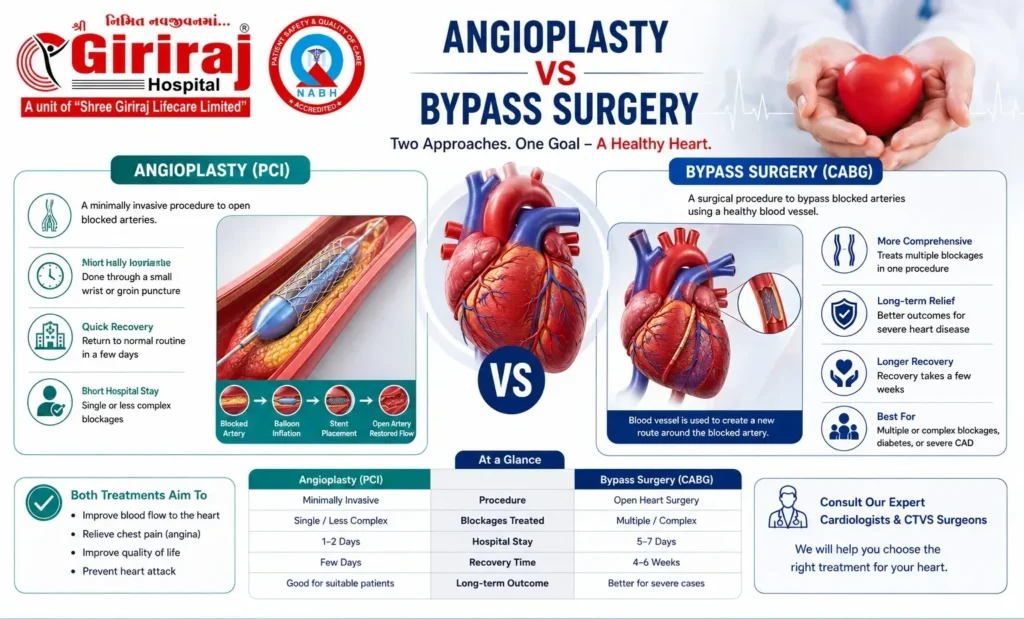
Angioplasty, also called Percutaneous Coronary Intervention (PCI), is a minimally invasive procedure used to open a blocked or narrowed coronary artery. A cardiologist threads a thin catheter with a small balloon at its tip through a blood vessel, usually entering through the wrist or groin, and guides it to the site of the blockage using live X-ray imaging. Once in position, the balloon is inflated to compress the plaque against the artery wall, restoring blood flow. In most cases, a stent – a small mesh tube – is left behind to keep the artery propped open.
Angioplasty is generally performed under local anaesthesia with sedation, meaning the patient stays conscious throughout, and the entire procedure typically takes one to two hours. Because there’s no large incision involved, recovery is considerably faster than surgical alternatives – this speed and simplicity is a major factor in the Angioplasty vs Bypass Surgery decision for many patients.
What Is Bypass Surgery?
Bypass surgery, medically known as Coronary Artery Bypass Grafting (CABG), is a major open-heart operation. Rather than opening the blocked artery from within, the surgeon creates an entirely new route for blood to flow around the blockage. A healthy blood vessel is taken from elsewhere in the body – commonly the leg, chest wall, or arm – and grafted onto the heart, above and below the blocked section, redirecting blood flow through the new pathway instead.
This is a significantly bigger undertaking than angioplasty. Bypass surgery generally requires general anaesthesia, takes three to six hours, and often involves a heart-lung bypass machine to keep circulation going while the surgeon operates. When weighing Angioplasty vs Bypass Surgery, this is the procedure reserved for more complex or extensive blockages that a stent alone can’t adequately address.
Angioplasty vs Bypass Surgery: The Core Differences
Understanding the fundamental differences between these two treatments makes the rest of this decision far easier to follow. Here’s how Angioplasty vs Bypass Surgery compares across the factors that matter most to patients:
| Factor | Angioplasty (PCI) | Bypass Surgery (CABG) |
| Invasiveness | Minimally invasive, catheter-based | Major open-heart surgery |
| Anaesthesia | Local, with sedation | General anaesthesia |
| Procedure time | 1-2 hours | 3-6 hours |
| Hospital stay | 1-2 days | 7-10 days |
| Recovery time | About 1 week for light activity | 6-8 weeks |
| Best suited for | Single or limited blockages | Multiple or complex blockages |
| Left main artery disease | Generally not first choice | Often the preferred approach |
| Diabetic patients with multi-vessel disease | Less durable long-term | Better long-term outcomes |
| Long-term durability | Good, but re-narrowing is possible | Excellent, particularly with arterial grafts |
| Repeat procedure risk | 15-20% may eventually need further treatment | Lower likelihood of repeat intervention |
This table captures the broad strokes of Angioplasty vs Bypass Surgery, but your specific case – the number of blockages, their exact location, and your overall health – is what ultimately determines which path your cardiologist recommends.
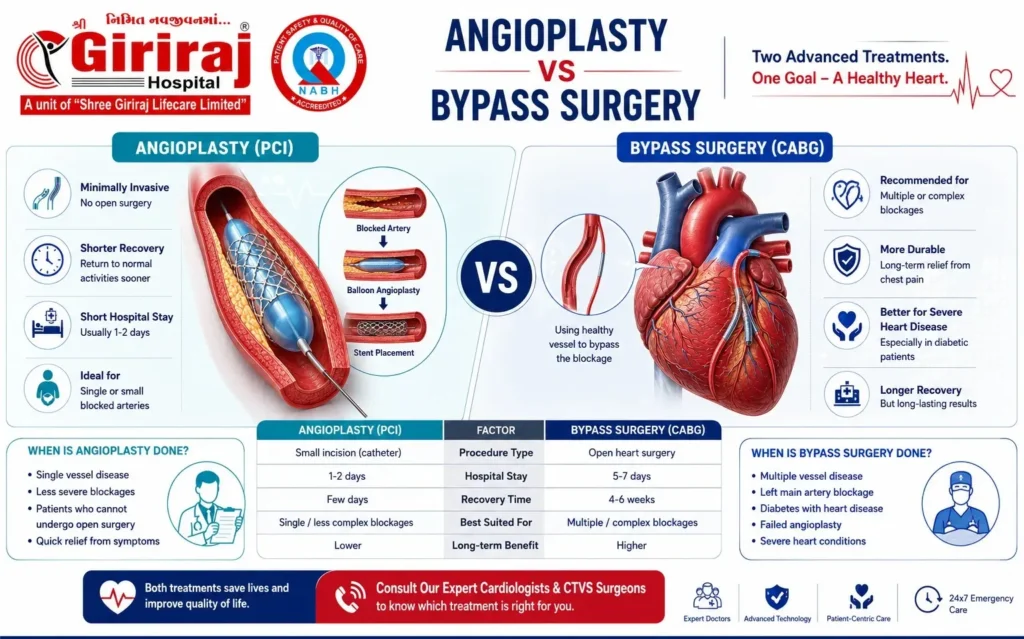
When Is Angioplasty the Better Choice?
Angioplasty tends to be the preferred option in the following situations:
- Single or limited blockages – when only one or two coronary arteries are affected, rather than widespread disease
- Emergency heart attack treatment – angioplasty is often the fastest way to restore blood flow during an acute event
- Simpler blockages – where the narrowing is accessible and not near a critical branch point
- Patients wanting faster recovery – particularly those who need to return to work or daily responsibilities quickly
- Patients who are poor candidates for major surgery – such as elderly or medically frail individuals who may not tolerate open-heart surgery well
- Failed medication and lifestyle changes – when these haven’t sufficiently controlled symptoms, but the blockage pattern is still straightforward
In the Angioplasty vs Bypass Surgery decision, angioplasty generally wins out when the disease is less extensive and the patient’s priority is a quicker, less invasive path back to normal life.
When Is Bypass Surgery the Better Choice?
Bypass surgery tends to be recommended over angioplasty in these situations:
- Multiple blocked arteries – particularly triple-vessel disease, where several coronary arteries are significantly narrowed
- Left main coronary artery blockage – this artery supplies a large portion of the heart, and surgery generally offers better long-term outcomes here
- Diabetic patients with multi-vessel disease – research consistently shows bypass surgery offers better survival outcomes for this specific group
- Complex blockage anatomy – where the artery is too small, too calcified, or shaped in a way that isn’t suitable for a stent
- Reduced heart pumping function – combined with significant blockages, surgery is often the safer long-term option
- Failed or re-narrowed previous stents – when angioplasty has already been tried and hasn’t held
When it comes to Angioplasty vs Bypass Surgery for these more complex cases, surgery generally offers a more durable, long-term solution, even though it demands a significantly longer recovery.
Signs That Might Lead to This Decision in the First Place
Understanding why this Angioplasty vs Bypass Surgery decision comes up at all adds useful context. Most patients arrive at this crossroads after experiencing symptoms that prompted a cardiology evaluation, or after an abnormal finding on a routine check-up. Common warning signs include:
- Chest pain or tightness (angina) during exertion that eases with rest
- Breathlessness during everyday activities like climbing stairs
- Unexplained fatigue that doesn’t match your activity level
- Pain radiating to the jaw, neck, back, or left arm
- A previous heart attack with ongoing symptoms
- Abnormal findings on an ECG, TMT, or echocardiogram
If any of these sound familiar, the next step is typically a coronary angiography, which gives your cardiologist the detailed picture needed to actually make the Angioplasty vs Bypass Surgery recommendation in the first place, rather than guessing based on symptoms alone. Don’t wait out persistent symptoms hoping they’ll resolve on their own – an early evaluation almost always leads to more treatment options and a smoother path forward than waiting until a crisis forces the issue.
How Coronary Angiography Guides the Decision
Coronary angiography is the diagnostic test that makes the Angioplasty vs Bypass Surgery conversation possible in any meaningful way. During this procedure, a contrast dye is injected into the coronary arteries, and X-ray imaging captures exactly where blockages are located, how severe they are, and how complex their shape is.
This imaging is what allows your cardiologist to move from “you have blocked arteries” to a specific, evidence-based recommendation. Without it, any discussion of Angioplasty vs Bypass Surgery would be little more than guesswork – which is exactly why this test is considered non-negotiable before either treatment path is finalised.
Success Rates and Long-Term Outcomes
Both procedures have strong track records when performed by experienced teams, but they differ meaningfully in what “success” looks like over time. Angioplasty restores blood flow quickly and effectively, but it doesn’t address the underlying disease process driving plaque buildup – which is why roughly 15 to 20% of angioplasty patients may eventually develop re-narrowing (restenosis) and require a repeat procedure or, in some cases, bypass surgery down the line.
Bypass surgery, by contrast, tends to offer more durable results, particularly when arterial grafts like the internal mammary artery are used, which can remain functional for well over a decade. This durability advantage is a significant factor in the Angioplasty vs Bypass Surgery discussion for patients with extensive disease, since a second major surgery is considerably more taxing than a repeat angioplasty would be. That said, neither procedure is a permanent cure – both require ongoing lifestyle changes, medication, and risk factor management to protect long-term heart health.
It’s also worth noting that large clinical studies comparing outcomes have generally found that for patients with more advanced, multi-vessel coronary artery disease, bypass surgery tends to show a modest survival advantage over angioplasty at the five- and ten-year mark, though this gap has narrowed as stent technology and post-procedure medications have improved. For patients with simpler, single-vessel disease, studies have generally found comparable long-term outcomes between the two approaches, reinforcing why the Angioplasty vs Bypass Surgery decision really does hinge on individual disease severity rather than a blanket rule favouring one treatment over the other.
Emergency Situations: When There’s No Time to Choose
Not every Angioplasty vs Bypass Surgery decision unfolds as a calm, planned conversation. During an acute heart attack, angioplasty is typically the fastest way to restore blood flow, and cardiac teams are often trained to perform it within a critical window of time from when symptoms begin – commonly referred to as “door-to-balloon time” in emergency cardiology. In this setting, angioplasty is generally the default emergency response, with bypass surgery reserved for cases where the blockage pattern makes stenting impractical or where angioplasty alone doesn’t fully resolve the emergency.
This is worth understanding because it explains why some patients undergo angioplasty first, even if their overall disease pattern might otherwise have pointed toward bypass surgery in a planned, non-emergency setting. Once the immediate crisis is stabilised, your cardiac team will reassess and determine whether further treatment – including bypass surgery – is needed for any remaining blockages.
Combined Approaches: When Both Are Used Together
It’s worth knowing that the Angioplasty vs Bypass Surgery decision isn’t always strictly either-or. In certain cases, a patient might undergo angioplasty for one or two more accessible blockages while bypass surgery addresses a more complex blockage elsewhere, particularly if surgery is already planned for other reasons such as a valve procedure happening at the same time. This hybrid approach is less common than choosing one treatment exclusively, but it’s a genuine option your cardiac team may discuss for particularly complex cases.
Similarly, some patients who’ve previously had bypass surgery may later need angioplasty if a graft narrows over time, since a repeat bypass operation carries higher risk than a first surgery. This is one more reason the Angioplasty vs Bypass Surgery conversation often continues over a patient’s lifetime, rather than being a single, one-time decision, and why ongoing cardiology follow-up remains important long after either procedure is behind you.
Psychological and Lifestyle Considerations
Beyond the clinical factors, it’s worth acknowledging that the Angioplasty vs Bypass Surgery decision carries a real psychological weight that pure statistics don’t capture. Some patients feel considerably more comfortable with the idea of a catheter-based procedure they’ll be awake for, while others prefer the sense of a “complete fix” that major surgery seems to offer, even knowing it demands a longer recovery.
Neither instinct is wrong, and a good cardiologist will factor this into the conversation, particularly in genuinely borderline cases where either option is clinically reasonable. Being honest with your cardiac team about your own risk tolerance, work situation, family responsibilities, and recovery preferences is a legitimate part of making this decision well, not a distraction from the “real” medical facts.
Preparing for Either Procedure
Whichever way your Angioplasty vs Bypass Surgery decision goes, some preparation steps apply to both paths:
- Complete all pre-procedure tests – angiography, blood work, ECG, and any additional imaging your cardiac team requests
- Share your complete medication list, including supplements, since some blood thinners need to be paused beforehand
- Arrange support – even angioplasty patients typically need someone to drive them home and help for the first day or two
- Ask about fasting instructions – both procedures typically require fasting for several hours beforehand
- Plan your logistics – for bypass surgery specifically, arrange a caregiver for the weeks of recovery at home, and pack accordingly for a longer hospital stay
- Write down your questions – bring a list of anything you want clarified about your specific Angioplasty vs Bypass Surgery recommendation before the day of the procedure
Good preparation reduces anxiety considerably, regardless of which path your cardiac team recommends. It also tends to make the actual admission day go far more smoothly, since paperwork, insurance verification, and pre-procedure checks are all faster when the groundwork has already been done in advance rather than scrambled together at the last minute.
Recovery Comparison: Angioplasty vs Bypass Surgery
Recovery is often the single biggest practical factor patients weigh when comparing Angioplasty vs Bypass Surgery, since it directly affects work, family responsibilities, and daily life.
Angioplasty Recovery:
- Hospital stay: typically 1-2 days
- Return to light activity: within a few days to a week
- Return to work: often within a week, depending on job demands
- Driving restrictions: usually brief, a few days
- Full recovery: generally within two weeks
Bypass Surgery Recovery:
- Hospital stay: typically 7-10 days, including ICU monitoring
- Return to light activity: gradual, over six weeks
- Return to work: usually six to eight weeks, longer for physically demanding jobs
- Driving restrictions: typically six weeks while the breastbone heals
- Full recovery, including cardiac rehabilitation: around three months
This gap in recovery time is one of the clearest, most tangible differences in Angioplasty vs Bypass Surgery, and for many patients weighing otherwise similar clinical options, it becomes a deciding factor.
Cost Comparison: Angioplasty vs Bypass Surgery
Cost is a genuine consideration for most families, and it’s one more area where Angioplasty vs Bypass Surgery diverge meaningfully. Angioplasty generally has a lower upfront cost, largely because it involves a shorter procedure, a much shorter hospital stay, and no major surgical recovery infrastructure. Bypass surgery involves a higher initial cost, reflecting the longer operating time, extended ICU and hospital stay, and the surgical team required.
However, cost comparisons aren’t always as simple as looking at the initial bill. Because a meaningful percentage of angioplasty patients eventually need a repeat procedure, the cumulative cost over several years can sometimes narrow the gap between the two options. This is worth discussing directly with your cardiologist and hospital’s insurance desk as part of your overall Angioplasty vs Bypass Surgery decision, rather than focusing purely on the upfront number.
It’s also worth factoring in indirect costs when weighing Angioplasty vs Bypass Surgery financially – lost work income during recovery, caregiver support, transport for follow-up visits, and any home-care needs during the healing period. Angioplasty’s shorter recovery window generally means less disruption to household income, while bypass surgery’s longer recovery can mean a more significant indirect cost even when the medical bill itself might be similar after accounting for insurance coverage. Most private insurance policies and the Ayushman Bharat (PM-JAY) scheme cover both procedures when medically indicated, so it’s worth confirming your specific coverage for either path before the cost difference becomes a deciding factor on its own.
Risks Associated With Each Procedure
Every cardiac procedure carries some risk, and understanding these honestly is part of making a genuinely informed choice between Angioplasty vs Bypass Surgery.
Risks of Angioplasty:
- Re-narrowing (restenosis) of the treated artery over time
- Blood clot formation at the stent site
- Bleeding or bruising at the catheter insertion point
- Rare risk of artery damage during the procedure
- Allergic reaction to contrast dye used during imaging
Risks of Bypass Surgery:
- Infection at the incision site
- Bleeding requiring transfusion
- Irregular heart rhythms during recovery
- Blood clots
- Rare risk of stroke or heart attack during or shortly after surgery
- Longer, more demanding recovery with associated risks of complications during that window
Neither list is meant to alarm you – both procedures are performed safely, thousands of times a year, at experienced cardiac centres. But an honest look at Angioplasty vs Bypass Surgery risk profiles helps set realistic expectations for either path.
What genuinely reduces risk in either case isn’t the choice between angioplasty and bypass surgery itself, but the quality of the pre-operative evaluation, the experience of the team performing the procedure, and the standard of post-procedure monitoring, particularly in the cardiac ICU following bypass surgery. A well-prepared, thoroughly evaluated patient undergoing either treatment at an experienced centre generally faces meaningfully lower risk than the raw statistics for either procedure might suggest in isolation, which is exactly why choosing the right hospital and cardiac team matters as much as the Angioplasty vs Bypass Surgery decision itself.
How Your Cardiologist Decides Between Angioplasty vs Bypass Surgery
The choice isn’t arbitrary – cardiologists and cardiac surgeons use established clinical scoring systems and guidelines to evaluate each patient’s coronary angiography results and overall health. Several factors feed into this Angioplasty vs Bypass Surgery decision:
- Number and location of blockages – single-vessel disease favours angioplasty; multi-vessel or left main disease often favours surgery
- Complexity of the blockage – calcification, artery size, and blockage shape all affect stent suitability
- Overall heart function – reduced pumping capacity can shift the recommendation toward surgery
- Diabetes status – a significant factor favouring bypass surgery in multi-vessel disease
- Age and general fitness for major surgery – very elderly or frail patients may not tolerate open-heart surgery well
- Patient preference and lifestyle factors – recovery time and personal risk tolerance are genuinely part of the conversation
In many cases, especially borderline ones, this decision is made collaboratively between a cardiologist, a cardiac surgeon, and the patient – sometimes referred to as a “Heart Team” approach – precisely because Angioplasty vs Bypass Surgery isn’t always a clear-cut clinical call. This kind of joint evaluation is considered good clinical practice internationally, and it’s worth asking your hospital directly whether your case has been reviewed by both specialities before a final recommendation is made.
Angioplasty vs Bypass Surgery at Giriraj Hospital
At Giriraj Hospital, patients facing this decision have access to both Cardiology and Cardiothoracic & Vascular Surgery departments under one roof, which means the Angioplasty vs Bypass Surgery conversation happens with both specialities involved from the start, rather than requiring a referral to another hospital entirely. Here’s what that looks like in practice:
- Comprehensive Diagnostic Work-Up – coronary angiography and supporting tests to map your blockages precisely before any recommendation is made
- Collaborative Decision-Making – our cardiology and cardiac surgery teams review complex or borderline cases together
- Both Treatment Pathways Available On-Site – whether angioplasty or bypass surgery is recommended, treatment doesn’t require transferring to another facility
- Transparent Cost Estimates – a clear breakdown of costs for either pathway, discussed before you commit to a treatment plan
- Dedicated Cardiac ICU – critical for safe recovery, particularly following bypass surgery
- Cashless Insurance & Ayushman Bharat (PM-JAY) Support – assistance with documentation and pre-authorisation for either procedure
If you’ve been told you need treatment for blocked arteries and aren’t sure which path applies to you, our cardiac team is available for a detailed consultation to review your angiography and walk you through your specific Angioplasty vs Bypass Surgery options.
Can You Choose Between Angioplasty and Bypass Surgery Yourself?
To some extent, yes – patient preference is a genuine factor in borderline cases. If your blockage pattern is one where either approach is clinically reasonable, your cardiologist will likely present both options and talk through the trade-offs with you directly. However, in cases with clear-cut findings – such as extensive triple-vessel disease or significant left main artery blockage – the clinical evidence strongly favours one option, and your cardiac team will explain why deviating from that recommendation could carry meaningfully higher risk.
The most productive approach to the Angioplasty vs Bypass Surgery decision is an open conversation with your cardiologist about exactly where your case falls on that spectrum – clearly one option, or a genuine judgment call where your priorities matter.
Life After Treatment: What Stays the Same
Regardless of which path you take in the Angioplasty vs Bypass Surgery decision, certain long-term responsibilities don’t change. Both angioplasty and bypass surgery treat the existing blockages, but neither cures the underlying coronary artery disease that caused them. Protecting your heart long-term means:
- Taking prescribed medications consistently, including blood thinners or cholesterol-lowering drugs
- Following a heart-healthy, low-sodium, low-fat diet
- Quitting smoking completely
- Staying physically active within guidance from your cardiac team
- Managing blood pressure, blood sugar, and cholesterol levels
- Attending all scheduled follow-up appointments
This shared long-term responsibility is worth remembering when weighing Angioplasty vs Bypass Surgery purely on procedure-day factors – the lifestyle commitment afterward matters just as much for protecting your heart, whichever treatment you choose.
Common Terms Explained: A Quick Glossary
If some of the terminology around Angioplasty vs Bypass Surgery feels overwhelming, here’s a plain-language glossary to keep handy:
- PCI (Percutaneous Coronary Intervention) – the medical term for angioplasty
- CABG (Coronary Artery Bypass Grafting) – the medical term for bypass surgery
- Stent – a small mesh tube placed to keep a treated artery open after angioplasty
- Restenosis – re-narrowing of an artery after angioplasty
- Graft – the healthy blood vessel used to create a bypass route during CABG
- Coronary Angiography – the imaging test used to map blockages and guide the Angioplasty vs Bypass Surgery decision
- Left Main Coronary Artery – a critical artery whose blockage often favours bypass surgery over angioplasty
- Triple-Vessel Disease – significant blockage in three coronary arteries, typically favouring surgery
Understanding this vocabulary makes conversations with your cardiac team considerably easier when navigating your own Angioplasty vs Bypass Surgery decision.
Questions to Ask Your Cardiologist
Before agreeing to either treatment path, consider asking your cardiac team these specific questions:
- Based on my angiography, is my case a clear recommendation, or a genuine judgment call between the two options?
- What are the specific risks of each approach given my age and health conditions?
- How many blockages do I have, and where exactly are they located?
- If I choose angioplasty, what’s my realistic likelihood of needing a repeat procedure?
- If I choose bypass surgery, what recovery timeline should I expect given my job and lifestyle?
- What would you personally recommend if this were your own family member?
A cardiac team confident in their recommendation will welcome these questions and explain their reasoning clearly, rather than rushing you toward a decision.
Frequently Asked Questions About Angioplasty vs Bypass Surgery
Which is safer: Angioplasty vs Bypass Surgery?
Angioplasty carries lower short-term procedural risk since it’s minimally invasive, while bypass surgery, though a bigger operation, often provides more durable long-term protection for complex, multi-vessel disease. “Safer” depends heavily on your specific blockage pattern, which is why this decision should always be made with your cardiologist.
Is angioplasty as effective as bypass surgery?
For single or limited blockages, angioplasty is highly effective and often the preferred first choice. For extensive multi-vessel disease or left main artery blockage, bypass surgery generally offers better long-term outcomes, particularly for diabetic patients.
How do doctors decide between Angioplasty vs Bypass Surgery?
Cardiologists and cardiac surgeons evaluate the number, location, and complexity of blockages from your coronary angiography, along with your overall health, diabetes status, and heart function, often using established clinical scoring systems to guide the recommendation.
Which recovers faster: angioplasty or bypass surgery?
Angioplasty recovery is significantly faster – most patients resume light activity within a week, compared to six to eight weeks for bypass surgery, since angioplasty doesn’t involve a major surgical incision or breastbone healing.
Can angioplasty be done instead of bypass surgery for multiple blockages?
In some cases, yes, particularly if the blockages are individually straightforward to treat with stents. However, for triple-vessel disease or left main artery blockage, bypass surgery generally offers better long-term outcomes and is usually the recommended approach.
Does insurance cover both angioplasty and bypass surgery?
Most health insurance policies and the Ayushman Bharat (PM-JAY) scheme cover both procedures when medically necessary, though coverage specifics vary by policy. It’s best to confirm your exact coverage with your insurer or the hospital’s insurance desk before your procedure.
Which hospital offers both angioplasty and bypass surgery in Rajkot?
Look for a hospital with both a dedicated Cardiology department and a Cardiothoracic & Vascular Surgery department under one roof, so your Angioplasty vs Bypass Surgery decision can be made collaboratively without needing a referral elsewhere. Giriraj Hospital offers both specialities on-site.
Can I need bypass surgery after already having angioplasty?
Yes, this happens in roughly 15 to 20% of angioplasty patients over time, if the treated artery re-narrows or new blockages develop elsewhere. This is one reason your cardiologist carefully weighs long-term durability when discussing Angioplasty vs Bypass Surgery for your specific case.
Final Thoughts
There’s no universally “better” choice in the Angioplasty vs Bypass Surgery decision – only the option that’s clinically right for your specific blockage pattern, health profile, and personal circumstances. What matters most is a thorough diagnostic work-up, an honest conversation with a cardiac team you trust, and a clear understanding of both the immediate procedure and the long-term commitment either path involves.
If you or a family member is facing this decision, the cardiology and cardiothoracic surgery teams at Giriraj Hospital are available to review your case together and walk you through exactly what Angioplasty vs Bypass Surgery would mean for you personally. Book a consultation or contact us today to get a clear, personalised recommendation for your heart health.
Whatever you decide, try not to let the decision itself become a source of prolonged anxiety. Both treatments have decades of clinical evidence behind them, both are performed routinely and safely at experienced cardiac centres, and both give patients a genuine path back to a fuller, more active life. The goal of this guide was never to tell you which one is “right” in the abstract – it was to make sure that whichever way your Angioplasty vs Bypass Surgery conversation goes, you walk into it informed, prepared, and ready to ask the questions that actually matter for your specific heart.