






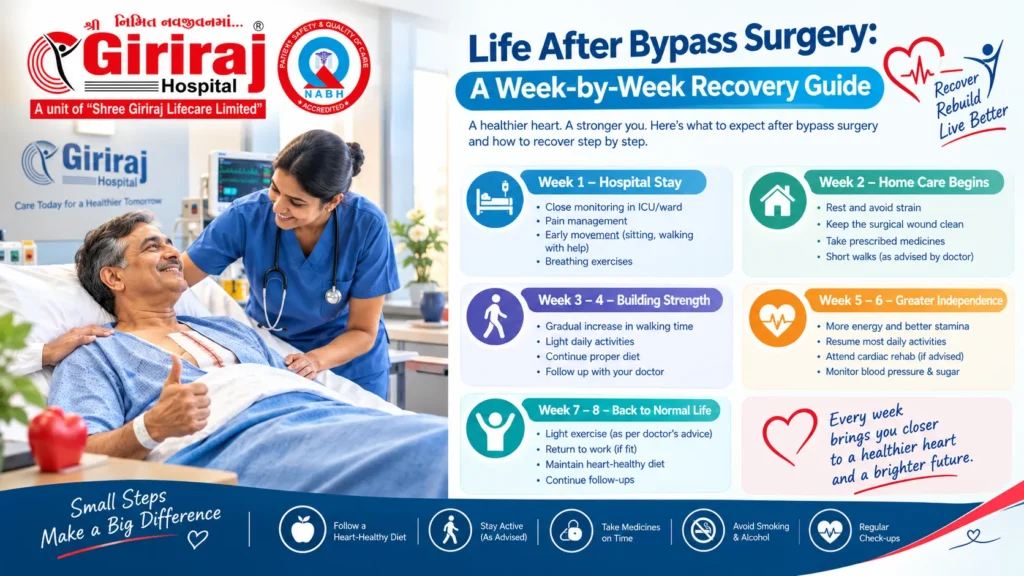
The surgery is over. The relief is real, but so is the uncertainty – what actually happens now? Life after bypass surgery doesn’t arrive all at once. It unfolds in stages, week by week, as your chest heals, your energy returns, and your daily routine slowly starts to feel normal again.
This guide walks through that timeline honestly, week by week, from the hospital bed to the three-month mark and beyond – what to expect, what to avoid, and when to worry. It’s written for patients recovering in Rajkot and the wider Saurashtra region, with practical notes on rehab access, insurance, and follow-up care available locally.
Understanding What Bypass Surgery Actually Changes
Coronary artery bypass grafting (CABG) reroutes blood flow around a blocked artery using a healthy vessel taken from your chest, leg, or arm. It doesn’t remove the underlying disease – it restores blood flow so your heart can work properly again. That distinction matters for recovery: life after bypass surgery is as much about protecting the new graft and managing the disease that caused the blockage as it is about healing the incision itself.
How is bypass surgery recovery different from angioplasty recovery?
Angioplasty and stenting involve a small puncture, usually in the wrist or groin, with recovery measured in days. Bypass surgery involves opening the chest and, in most cases, dividing the breastbone (sternum), which needs six to eight weeks to heal properly. This is the single biggest reason bypass recovery takes longer and follows a more structured timeline than a stent procedure.
What Recovery Depends On: Setting Realistic Expectations
Before walking through the week-by-week timeline, it helps to understand why no two recovery journeys look identical. Life after bypass surgery unfolds differently for a 45-year-old with no other health conditions than for a 70-year-old managing diabetes and kidney disease, and both are entirely normal.
- Age and baseline fitness before surgery
- Number of grafts performed and whether the surgery was planned or emergency
- Existing conditions like diabetes, obesity, or kidney disease, which can slow tissue healing
- Whether the surgery was on-pump or off-pump (beating-heart)
- How consistently you follow activity guidelines, medication schedules, and rehab recommendations
- The strength of your support system at home during the early weeks
The timeline below reflects typical milestones seen across most patients, but your own surgical team’s specific instructions should always take priority over any general guide, including this one.
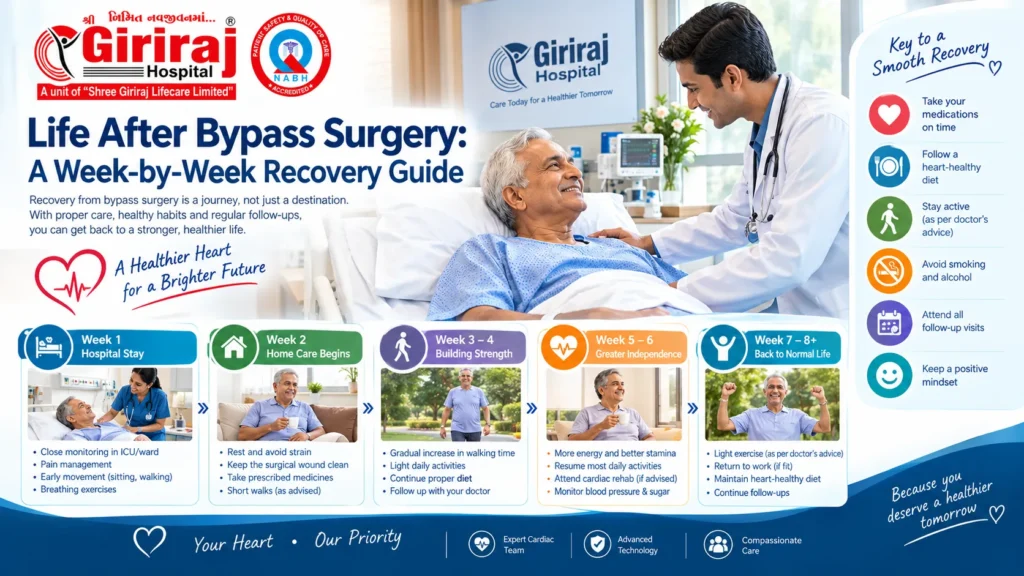
Week 1: The Hospital Stay and First Days Home
Most patients spend five to seven days in the hospital, including a day or two in the ICU for close monitoring. You’ll be encouraged to sit up and take a few short, supported steps within a day of surgery – early movement genuinely helps prevent complications like blood clots and lung infections.
By the time you’re discharged, you should be able to walk short distances, manage basic self-care with some help, and understand your medication schedule. Life after bypass surgery starts here, in these first uncertain days at home, and the goal isn’t to feel normal yet – it’s simply to rest, protect your incision, and follow instructions closely.
What’s normal in the first week at home?
- Fatigue that feels disproportionate to how little you’re doing
- Mild swelling around the ankles, which usually settles within a few weeks
- Some appetite loss and a strange or metallic taste, both temporary
- Occasional low mood or tearfulness – this is common and usually eases with time
- Discomfort, tightness, or itching along the incision as it begins to heal
Contact your surgical team immediately if you notice fever, spreading redness, drainage from the incision, sudden severe breathlessness, or new chest pain – these are not part of a normal first week and need prompt attention.
Preparing to Leave the Hospital: A Discharge Checklist
A well-prepared discharge sets the tone for everything that follows. Before you leave the hospital, make sure you and your family clearly understand the following:
- Your full medication list, including names, doses, timing, and what each one is for
- How to care for your incision, including what normal healing looks like versus a warning sign
- Activity restrictions specific to your surgery – lifting limits, driving, and sternal precautions
- Your first follow-up appointment date, ideally scheduled before you leave
- A direct contact number for questions or concerns after hours
- Diet guidance for the first few weeks, particularly around sodium and fluid intake if you also have heart failure
Asking for this information in writing, not just verbally, makes a real difference once you’re home, tired, and trying to remember details from a conversation that happened while you were still recovering from anesthesia.
The Role of Family and Caregivers in Early Recovery
Life after bypass surgery is rarely a solo journey, especially in the first few weeks. Having someone available to help with meals, transportation to follow-up visits, and simply keeping an eye out for warning signs takes real pressure off a patient who is still healing.
- Encourage short walks without pushing beyond what the patient reports feeling comfortable with
- Help track medications, especially in the first few confusing days after discharge
- Watch for signs of low mood or withdrawal, which are common but worth mentioning to the care team if they persist
- Support dietary changes by adjusting household meals together, rather than treating it as the patient’s problem alone
- Be patient with the pace of recovery – frustration from family members, even well-meaning, can add pressure at a time when patience matters most
Week 2: Settling Into a Rhythm
The second week is usually less about big milestones and more about consistency. Short walks around the house become short walks outside. Sleep is often still disrupted, particularly if you’re getting used to sleeping on your back to protect your healing sternum. Most surgical teams recommend this position for the first four to six weeks.
Sternal precautions: what to avoid in weeks 1-2
- No lifting anything heavier than about 2-3 kg (roughly a full kettle)
- No pushing, pulling, or reaching both arms overhead at once
- No driving until your surgeon specifically clears you
- Avoid using your arms to push yourself up from a chair – use your legs instead
These restrictions exist for a real reason: the sternum is essentially a healing bone, and putting strain on it too early can affect how well it fuses back together.
Weeks 3-4: Early Independence Returns
By the third and fourth week, most patients notice a genuine shift. Energy improves, short walks get a little longer, and everyday tasks like light cooking or dressing without assistance become manageable. This is often when people start asking about life after bypass surgery in more concrete terms – when can I drive, when can I go back to work, when will I feel like myself again?
When can I drive after bypass surgery?
Most surgeons clear driving around four to six weeks post-surgery, once you can comfortably perform an emergency stop and turn the wheel without chest discomfort. This varies by individual healing and should always be confirmed with your surgeon rather than assumed from a general timeline.
When can I go back to work?
Desk-based or low-physical jobs often allow a return around four to six weeks. Physically demanding work – lifting, manual labor, prolonged standing – usually needs eight to twelve weeks or more, depending on sternal healing and your surgeon’s assessment.
Weeks 5-6: The Sternum Reaches a Turning Point
Around the five-to-six week mark, many patients are cleared to gradually relax some of the early restrictions, though this decision always belongs to your surgical team, not a general calendar. Household activities expand, walking distances increase, and for many, this is when cardiac rehabilitation formally begins if it hasn’t already.
What is cardiac rehabilitation, and is it really necessary?
Cardiac rehab is a supervised program combining structured exercise, dietary counselling, and education on managing risk factors like blood pressure and cholesterol. It is one of the most consistently evidence-backed interventions in cardiac recovery – patients who complete a rehab program show measurably better long-term outcomes, fewer readmissions, and improved quality of life. If your hospital offers it, treat it as a core part of treatment, not an optional add-on.
Giriraj Hospital’s physiotherapy and rehabilitation services in Rajkot support structured post-cardiac recovery for patients who want supervised guidance rather than figuring out exercise progression alone.
Weeks 7-8: From Healing to Rebuilding
This is often the point where recovery shifts in character. The first six weeks are primarily about healing; from week seven onward, the focus moves toward rebuilding strength and stamina. Many patients describe this stage as the first time daily life starts to feel routine again rather than like a recovery project.
Can I sleep on my side yet?
Many surgical teams clear side-sleeping around six weeks, once sternal healing is far enough along, though a pillow across the chest for support during the transition is a common and helpful comfort measure. Confirm the specific timing with your own surgeon.
When is it safe to resume sexual activity?
A commonly used general guideline is that if you can comfortably climb two flights of stairs without chest pain or significant breathlessness, you are usually fit enough for sexual activity – typically around four to six weeks post-surgery. This is a reasonable topic to raise directly with your cardiologist or surgeon rather than guessing, since individual healing varies.
Simple exercises for weeks 3-6 (with your care team’s approval)
- Gentle, gradually increasing daily walks, ideally at the same time each day to build routine
- Seated marching or ankle circles for circulation on days when walking feels harder
- Deep breathing exercises to support lung recovery, particularly if you had any fluid buildup after surgery
- Light stretching that avoids pulling on the chest or shoulders
These should always be guided by what your surgical or rehab team has specifically cleared – pushing ahead of approved activity levels is one of the more common ways patients slow down their own healing.
Understanding the Phases of Cardiac Rehabilitation
Cardiac rehab isn’t a single program – it typically unfolds in phases, and knowing what each one involves helps set realistic expectations for how life after bypass surgery progresses week by week.
Phase 1: In-hospital rehab
This begins before you even leave the hospital – early walking, breathing exercises, and basic education on your condition and medications, usually guided by hospital physiotherapy staff.
Phase 2: Supervised outpatient rehab
Typically starting a few weeks after discharge, this phase involves structured, monitored exercise sessions along with dietary counselling and risk-factor education, often over a period of six to twelve weeks.
Phase 3: Maintenance and independence
As supervised sessions taper off, patients transition to self-directed exercise routines built on the habits and confidence developed during Phase 2, ideally continuing indefinitely as part of ongoing heart-healthy living.
Not every patient needs all three phases in a formal setting, but understanding this structure helps explain why recovery timelines that look similar on paper can feel quite different depending on how much structured support a patient has access to.
A Realistic Day in the Life: Around Week 6
To make the general guidance more concrete, here’s what a typical day might look like for a patient roughly six weeks post-surgery who is progressing normally, is on light activity restrictions, and has started outpatient rehab.
- Morning: light breakfast, morning medications, a 20-30 minute supervised or independent walk
- Midday: light household tasks, a heart-healthy lunch, rest period if needed
- Afternoon: a short rehab session or light stretching, time for hobbies or reading
- Evening: a light dinner well before bedtime, wind-down routine, consistent sleep schedule
This is illustrative, not a prescription – your own pace, restrictions, and rehab schedule should come directly from your care team, but it gives a realistic sense of how full and manageable daily life can feel by this stage, even while several precautions are still in place.
Months 2-3: Building Real Endurance
By the second and third month, structured cardiac rehab (if you’re enrolled) becomes more progressive – longer sessions, added resistance work, and closer tracking of how your heart responds to exertion. Most patients report substantially improved energy and stamina compared to even a month earlier.
When does full recovery happen?
Most published guidance places full recovery, meaning complete sternal healing and a return to normal activity levels, at around three months post-surgery, though the benefits of the surgery itself continue to build for months after that as fitness and heart function improve further. Life after bypass surgery, at this stage, increasingly resembles life before the blockage – often with more energy than patients had in the months leading up to surgery, once symptoms like chest pain and breathlessness are gone.
Life After Bypass Surgery: What Changes Long-Term
Beyond the physical recovery timeline, life after bypass surgery usually involves some lasting adjustments – not restrictions so much as a genuinely different relationship with your own heart health.
Diet and nutrition
- Lower saturated fat and trans fat intake, with an emphasis on whole grains, vegetables, and lean protein
- Reduced sodium to help manage blood pressure
- A Mediterranean-style eating pattern is frequently recommended and well-supported by cardiac research
- Portion control and weight management, particularly for patients with diabetes or a history of obesity
In practical, everyday terms for an Indian household, this often means shifting toward more dals, vegetables, and whole grains like jowar and bajra, using less oil and ghee in daily cooking, cutting back on fried snacks and papad, and being mindful of the hidden sodium in pickles and packaged foods. A dietitian familiar with regional food habits can help translate general cardiac guidelines into a realistic weekly meal plan rather than a generic list that doesn’t fit how your household actually cooks.
Medications
Most patients continue on some combination of blood thinners, cholesterol-lowering medication (statins), and blood pressure medication long-term. These aren’t a sign that surgery failed – bypass surgery treats the blockage, not the underlying disease process that caused it, and medication is what keeps that process controlled going forward.
Exercise
Regular, moderate exercise – most commonly brisk walking – becomes a long-term habit rather than a recovery phase. Patients who stay consistently active after cardiac rehab ends generally maintain the gains rehab helped them build.
Emotional adjustment
It’s genuinely common to feel low, anxious, or unusually emotional in the weeks after major heart surgery – this isn’t weakness, and it isn’t rare. Most patients find this eases naturally as strength returns and daily life normalizes. If low mood persists beyond a few weeks or starts affecting sleep, appetite, or motivation significantly, it’s worth mentioning to your care team; this is a treatable part of recovery, not something to push through alone.
Life After Bypass Surgery: Beyond the First Year
Recovery guides often stop at three months, but life after bypass surgery continues to evolve well beyond that. Grafts, particularly the internal mammary artery graft commonly used in CABG, are associated with strong long-term durability – often functioning well for well over a decade with good self-care. Regular cardiology follow-up, typically annual once you’re stable, tracks how the graft and overall heart function are holding up over time.
Many patients describe a noticeable shift in mindset a year or more out from surgery: heart health moves from being a recovery project to simply being part of ordinary life – medication taken as routine, exercise as habit, and follow-up visits as maintenance rather than monitoring for a crisis. That shift is, in many ways, the real long-term marker of successful recovery.
How Giriraj Hospital Supports Post-Bypass Recovery
Recovery doesn’t end when you leave the operating theatre – it continues through follow-up visits, rehab, and ongoing cardiac monitoring. Giriraj Hospital’s cardiothoracic and vascular surgery team, which includes specialists such as Dr. Bahul Vekaria, stays involved through this full arc rather than handing patients off after discharge.
You can review the department’s full range of services on the cardiothoracic and vascular surgery page, including pre- and post-operative care.
For patients from Rajkot, Junagadh, Jamnagar, and the wider Saurashtra region, having this continuity available locally – rather than needing to travel back to a distant city for every follow-up – makes the months of recovery considerably easier to manage.
Returning to Hobbies, Social Life, and Light Activity
Beyond the clinical milestones, patients often want a simpler answer: when do things go back to feeling like life again? Light hobbies like reading, gentle gardening (without heavy lifting or bending awkwardly), and short social visits are usually fine within the first few weeks, as long as they don’t involve heavy lifting or high exertion.
- Gardening: light tasks only for the first six weeks; avoid digging, heavy pots, or prolonged bending
- Household chores: light tasks like folding laundry are fine early; vacuuming or mopping usually waits until sternal precautions are lifted
- Social visits: welcomed early on, but keep visits short in the first couple of weeks if fatigue is still significant
- Light sports like walking-based golf or gentle swimming: often possible from around eight to twelve weeks, with clearance
- Grandchildren and pets: joyful, but avoid being picked up on or jumped on until the chest has properly healed
There’s no need to give up the things that make daily life enjoyable – it’s simply a matter of sequencing them appropriately as healing progresses.
Common Setbacks During Recovery and How to Handle Them
Not every week of recovery moves in a straight line, and that’s worth normalizing. A day of unusual fatigue after doing slightly more than usual, a brief dip in motivation around week three or four, or frustration at how slowly things seem to be progressing are all common and don’t necessarily signal a problem.
- Overdoing it on a good day – ease back rather than pushing through, and resume gradual progress the next day
- Sleep disruption – try consistent bedtimes, and mention persistent insomnia to your care team rather than assuming it will resolve on its own
- Loss of appetite lasting more than two to three weeks – worth flagging at a follow-up visit
- Frustration with the pace of recovery – this is genuinely common and usually eases as visible progress builds week over week
The difference between a normal setback and a warning sign usually comes down to severity and direction: mild and improving is typically fine; anything severe, sudden, or steadily worsening warrants a call to your care team.
Common Myths About Life After Bypass Surgery
Myth: You’ll never be as active as before
For most patients, the opposite is true – with the blockage bypassed and symptoms like chest pain and breathlessness resolved, many people find they can be more active after recovery than they were in the months leading up to surgery.
Myth: Bypass surgery is a permanent fix, so lifestyle changes don’t matter
Bypass surgery treats blocked arteries; it doesn’t cure the coronary artery disease that caused the blockage in the first place. Without ongoing lifestyle changes and medication, new blockages can develop over time. Life after bypass surgery works best as an active partnership between the surgery’s benefits and your own ongoing effort.
Myth: A second bypass or heart problem is inevitable
It isn’t. Bypass grafts, particularly arterial grafts, can function well for many years – often over a decade – especially when combined with rehab, medication adherence, and risk factor control. Long-term outcomes depend heavily on how the recovery and lifestyle phase is managed, not just on the surgery itself.
Warning Signs During Recovery: When to Seek Help Immediately
Recovery has a normal range of discomfort, and it’s worth knowing where that range ends. Contact your surgical team or go to the nearest emergency department if you notice any of the following at any point during recovery:
- New or worsening chest pain, pressure, or tightness
- Fever above 100.4°F (38°C), or spreading redness, warmth, or discharge at the incision
- Sudden shortness of breath, especially at rest or while lying flat
- A rapid, irregular, or unusually slow heartbeat
- Significant swelling, redness, or pain in one leg, which can signal a blood clot
- Persistent dizziness, fainting, or confusion
If any of these occur, don’t wait it out – Giriraj Hospital’s 24×7 emergency services in Rajkot are built for exactly this kind of urgent, time-sensitive concern during recovery.
Insurance, Follow-Up Care, and Cost Considerations
Recovery isn’t only physical – it also involves ongoing follow-up visits, cardiac rehab sessions, and ongoing medication, all of which carry cost. Confirming coverage early avoids financial stress layered on top of physical recovery.
Most patients recovering under insurance or Ayushman Bharat / PM-JAY coverage can check their cashless insurance eligibility directly with the hospital’s insurance desk before scheduling follow-up visits, which keeps out-of-pocket surprises to a minimum.
It’s worth budgeting for periodic follow-up echocardiograms, blood tests to monitor cholesterol and clotting parameters, and, where recommended, a structured cardiac rehab program – these aren’t optional extras but a core part of what makes life after bypass surgery genuinely successful in the long run.
Questions to Ask at Your Follow-Up Visits
- Is my incision and sternum healing on schedule?
- Based on my progress, when can I resume driving, work, or specific activities?
- Are my current medications and dosages still appropriate?
- Am I a good candidate for structured cardiac rehab, and where can I access it?
- What symptoms should prompt an urgent call rather than waiting for my next appointment?
Bringing a written list to each follow-up ensures nothing gets missed in a short appointment window – and gives your surgical team a clear picture of how your specific recovery is progressing.
Frequently Asked Questions
How long does it take to recover from bypass surgery?
Most patients spend five to seven days in the hospital, then six to eight weeks for the sternum to heal, with full recovery and return to normal activity generally reached around three months. Individual timelines vary based on age, overall health, and how closely rehab and medical guidance are followed.
Is life after bypass surgery normal, or will I always feel limited?
For the large majority of patients, life after bypass surgery is not just normal but often better than the months before surgery, since the symptoms that led to the operation – chest pain, breathlessness, fatigue – are typically resolved. Some ongoing lifestyle adjustments are expected, but they support a fuller life, not a restricted one.
Can I climb stairs after bypass surgery?
Yes, gradually. Most patients can manage a few steps within the first week and build up steadily; by around six weeks, climbing a flight or two of stairs without significant breathlessness is a commonly used marker of good recovery progress.
What foods should I avoid after bypass surgery?
Heavily fried foods, high-sodium processed foods, and foods high in saturated or trans fats are generally discouraged. Your care team or a dietitian can give you a personalized plan, especially if you also manage diabetes or high cholesterol.
Can bypass surgery fail or need to be repeated?
Bypass grafts can narrow or block over time, particularly without proper lifestyle management, but this is not the typical outcome. Well-managed recovery, medication adherence, and rehab participation are strongly associated with grafts remaining functional for many years.
How soon after bypass surgery can I travel or fly?
Short journeys are often possible within a few weeks once basic mobility is restored, but air travel is usually deferred for four to six weeks, and always with your surgeon’s specific clearance, given cabin pressure changes and the importance of mobility during longer flights.
Will I need to take medication for life after bypass surgery?
Most patients do continue long-term medication, typically including a statin for cholesterol, a blood thinner, and blood pressure medication if needed. This is standard practice, not a sign that the surgery didn’t work – the medication manages the underlying disease process that the surgery itself doesn’t cure.
Is it normal to feel depressed after bypass surgery?
Yes, temporary low mood, tearfulness, or anxiety are common in the weeks following major heart surgery and are considered a normal part of the recovery process for many patients. If these feelings are severe, persist beyond several weeks, or start affecting sleep, appetite, or daily functioning, it’s worth discussing with your care team – this is treatable and shouldn’t be ignored.
A Realistic Recovery Story: Illustrative Example
To make this concrete, here’s an illustrative (not an individual patient’s actual case) example of a typical recovery arc. A 54-year-old patient underwent CABG for triple-vessel disease and spent six days in hospital, including one night in the ICU. The first two weeks at home were dominated by fatigue and short, careful walks. By week four, driving resumed with the surgeon’s clearance, and by week six, structured cardiac rehab began, gradually building stamina over the following two months.
By the three-month mark, the patient was walking briskly for 30 minutes most days, back to full-time desk work, and reported noticeably more energy than in the year leading up to surgery, when undiagnosed blockages had been quietly limiting daily activity. This kind of arc – steady, week-by-week, occasionally slower than expected but ultimately successful – is a realistic picture of what life after bypass surgery looks like for most patients who follow their care team’s guidance.
Managing Existing Conditions Alongside Recovery
For patients also managing diabetes, kidney disease, or high blood pressure, life after bypass surgery involves an extra layer of coordination. These conditions can affect wound healing, medication choices, and how quickly activity levels can safely increase, so recovery guidance often needs to be tailored rather than followed generically.
- Diabetes: blood sugar control directly affects wound healing speed and infection risk, making consistent monitoring especially important in the first few weeks
- Kidney disease: certain medications and contrast dyes used in follow-up testing may need dose adjustments
- High blood pressure: needs careful management post-surgery, since both too-high and too-low readings can complicate healing
If you manage any of these conditions, make sure your cardiothoracic team is coordinating directly with your endocrinologist, nephrologist, or physician, rather than treating your recovery in isolation from your other ongoing care.
Final Thoughts
Life after bypass surgery is rarely a straight line, and it isn’t meant to be. Healing happens in stages – the hospital stay, the cautious first weeks at home, the gradual return of independence, and the longer arc of rebuilding strength through rehab and lifestyle change. What matters most is following your own surgical team’s specific guidance rather than comparing your timeline to anyone else’s, and reaching out promptly if something feels genuinely wrong rather than waiting it out.
If you or a family member is recovering from bypass surgery and want a follow-up consultation, you can book an appointment with Giriraj Hospital’s cardiothoracic and vascular surgery team for a review of your recovery progress and next steps.
Related reading: for more on the surgery itself and choosing the right surgical team, see our guide on the best cardiothoracic and vascular surgery options in Rajkot, and for early warning signs that can lead to a bypass recommendation, see our guide on the signs of a heart attack you shouldn’t ignore.