


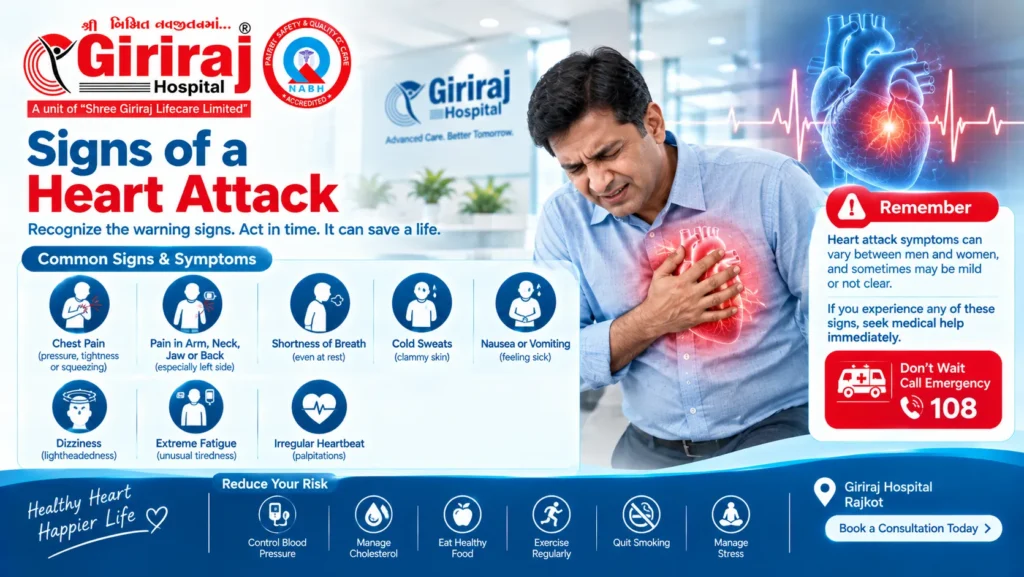
Recognising the signs of a heart attack quickly is one of the most important things anyone can learn – because unlike many medical emergencies, a heart attack often gives warning signs in the moments and hours before it fully develops, and acting on them can genuinely save a life. Many people delay seeking help, mistaking heart attack symptoms for something as ordinary as acidity or muscle strain.
Heart attacks remain one of the leading causes of death in India, and the first hour after symptoms begin – often called the “golden hour” – is critical for effective treatment (Source: ICMR, 2024). At Shree Giriraj Hospital’s Cardiology department in Rajkot, doctors emphasise that recognising these 12 warning signs, and acting immediately, dramatically improves the chances of survival and recovery. This article walks through exactly what to watch for.
What Happens During a Heart Attack?
A heart attack occurs when blood flow to part of the heart muscle is suddenly blocked, usually by a clot forming at the site of a narrowed artery. Without blood flow, that part of the heart muscle begins to be damaged within minutes, which is why recognising symptoms immediately and seeking emergency care changes outcomes so significantly.
Think of the heart muscle like a garden that depends entirely on a network of pipes for water. If one of those pipes suddenly gets blocked, the section of garden it feeds begins to wilt almost immediately. Restoring that water flow quickly can save most of the garden – but the longer the blockage continues, the more permanent the damage becomes. A heart attack works the same way, with time directly determining how much heart muscle can be saved.
This matters to nearly everyone because a heart attack can happen suddenly, sometimes with little prior warning, though many people experience recognisable signs beforehand. Knowing exactly what to watch for – and not dismissing it as something minor – is often the single biggest factor in surviving a heart attack with minimal lasting damage.
The 12 Warning Signs of a Heart Attack
Recognising these signs, individually or in combination, means it’s time to seek emergency care immediately rather than waiting to see if they pass.
- Chest pain, pressure, tightness, or squeezing sensation
- Pain spreading to the arm, particularly the left arm
- Pain or discomfort in the jaw, neck, or back
- Shortness of breath, with or without chest discomfort
- Cold sweats appearing suddenly
- Nausea or vomiting
- Lightheadedness or sudden dizziness
- Unusual, extreme fatigue, sometimes days before the event
- A feeling of indigestion or heartburn that feels different from usual
- Anxiety or a sense of impending doom
- Irregular heartbeat or noticeable palpitations
- Sudden collapse or loss of consciousness (a sign of cardiac arrest, requiring immediate CPR and emergency help)
Signs That Appear Gradually
Extreme fatigue, mild breathlessness, or vague chest discomfort can sometimes appear hours or even days before a heart attack, particularly in women, who often experience less classic symptoms than men.
Signs That Signal an Emergency Right Now
Sudden, severe chest pain with sweating and breathlessness, or sudden collapse, mean it’s time to call for emergency help immediately, without waiting.
When to call an ambulance immediately: Any combination of chest pain, breathlessness, cold sweats, or pain spreading to the arm or jaw needs an emergency response right away. Call for help immediately rather than driving yourself or waiting to see if it passes.
A commonly missed sign is unusual fatigue in the days leading up to a heart attack – many patients, especially women, describe feeling “off” or unusually tired well before more classic chest pain appears.
Heart Attack vs. Acidity: How to Tell the Difference
One of the most common and dangerous mistakes is dismissing heart attack symptoms as acidity or indigestion. Understanding the key differences can help you recognise when something is more serious.
| Feature | Acidity / Indigestion | Possible Heart Attack |
|---|---|---|
| Location | Typically upper abdomen, may rise to chest | Central chest, often spreading to arm, jaw, or back |
| Trigger | Often related to eating, spicy food, or lying down | Can occur with or without exertion, often unrelated to food |
| Relief | Often improves with antacids within minutes | Does not improve with antacids or resting |
| Accompanying Symptoms | Burning sensation, bloating | Sweating, breathlessness, nausea, or a sense of dread |
| Duration | Usually resolves within 30–60 minutes | Persists or worsens over time |
When in doubt, treat symptoms as a possible heart attack rather than assuming acidity – seeking emergency evaluation costs little time if it turns out to be indigestion, but delaying care for a true heart attack can cost significantly more.
Common Causes and Risk Factors for Heart Attack
Understanding what increases heart attack risk helps you recognise your own vulnerability and take preventive steps.
Common Causes
- A blood clot blocking a narrowed coronary artery
- Long-term plaque buildup in the arteries (atherosclerosis)
- Sudden artery spasm, less common but possible even without significant blockage
- Severe physical or emotional stress in vulnerable individuals
Risk Factors
- High blood pressure and high cholesterol
- Diabetes
- Smoking and tobacco use
- Family history of heart disease
- Obesity and sedentary lifestyle
Diabetes and high blood pressure are especially prevalent across Gujarat, making regular cardiac risk screening particularly important for patients managing either condition.
Heart Attack vs. Cardiac Arrest: Understanding the Difference
These terms are often used interchangeably, but they describe different, though related, events.
| Condition | What Happens | What It Means for You |
|---|---|---|
| Heart Attack | Blood flow to part of the heart is blocked, but the heart continues beating | Requires urgent treatment to restore blood flow and limit damage |
| Cardiac Arrest | The heart suddenly stops beating effectively | A life-threatening emergency requiring immediate CPR and emergency shock treatment |
A heart attack can sometimes lead to cardiac arrest if untreated, which is why recognising heart attack symptoms early – before they progress – is so critical.
How Is a Heart Attack Diagnosed?
Emergency teams use rapid testing to confirm a heart attack and guide immediate treatment decisions.
ECG (Electrocardiogram)
An ECG is usually the first test performed, often within minutes of arrival, and can quickly reveal patterns consistent with a heart attack.
Blood Tests
Blood tests measure specific markers released when heart muscle is damaged, helping confirm the diagnosis and its severity.
What the Results Mean
Clear ECG changes combined with elevated cardiac markers confirm a heart attack and guide the emergency team toward immediate treatment, often within the same hour.
This diagnostic process typically happens within the first 10–20 minutes of arrival in a well-equipped emergency department, reflecting just how time-sensitive heart attack care is.
Treatment for a Heart Attack
Treatment focuses entirely on restoring blood flow to the heart as quickly as possible. Your doctor will recommend the appropriate approach based on your specific case and how quickly you arrive for treatment.
Emergency Procedural Treatment
Angioplasty, often with stenting, is commonly used to open the blocked artery quickly and restore blood flow, especially when performed within the critical early window.
Medication
Clot-dissolving medication may be used in certain cases, alongside other medications to stabilise heart function and prevent further complications.
Ongoing Cardiac Care
Following the emergency phase, ongoing cardiology follow-up, medication, and lifestyle changes become central to recovery and preventing a future event.
Shree Giriraj Hospital’s Cardiology and Critical Care teams are equipped to move quickly from diagnosis to treatment, recognising that every minute directly affects outcomes.
What Happens When You Arrive with Suspected Heart Attack Symptoms
Understanding the typical sequence can help reduce anxiety during an already frightening situation.
- Immediate triage and ECG performed within minutes of arrival
- Blood tests drawn to confirm cardiac markers
- Rapid specialist consultation, often with a cardiologist on call
- Emergency treatment, such as angioplasty, initiated as quickly as possible
- Transfer to ICU or critical care for close monitoring following treatment
Team Involved
.Our emergency cardiac response team is led by highly experienced heart specialists, including Dr. Mandip Tilara and Dr. Ankur Thummar, alongside Dr. Bahul Vekaria (CTVS Surgeon). From immediate triage and ECG interpretation to advanced catheterization or surgical intervention, our team coordinates seamlessly to deliver immediate, life-saving care
Recovery After a Heart Attack
Recovery focuses on both physical healing and reducing the risk of a future event.
- First 24–48 hours: Close monitoring in ICU or critical care
- First week: Gradual increase in activity under medical guidance
- Weeks 2–6: Cardiac rehabilitation and lifestyle changes begin in earnest
- Long-term: Ongoing medication, regular cardiology follow-up, and lifestyle management
Patient story: A 50-year-old shop owner from Rajkot experienced sudden chest tightness and sweating while at work. His family recognised the signs and rushed him to Shree Giriraj Hospital, where rapid angioplasty restored blood flow within the critical window. He has since returned to work with ongoing cardiac follow-up.
Recognising the signs quickly, as this family did, often makes the single biggest difference in how well someone recovers after a heart attack.
Cost and Ayushman Card Coverage for Heart Attack Treatment
We understand that cost is a significant concern for families, especially during an emergency.
Emergency stabilisation is prioritised immediately, with cost and payment details addressed once the patient is stable. Costs for heart attack treatment vary depending on the specific intervention needed, such as angioplasty, and length of ICU stay.
Ayushman Bharat (PM-JAY) covers emergency heart attack treatment, including angioplasty, for eligible patients. Shree Giriraj Hospital’s Ayushman Mitra desk assists families with eligibility and the cashless process, even during emergency admissions.
Speak to our team for guidance on coverage as soon as your situation allows.
Do’s and Don’ts If You Suspect a Heart Attack
| Do This | Don’t Do This |
|---|---|
| Call for an ambulance immediately if you notice warning signs | Wait to see if symptoms pass on their own |
| Chew an aspirin if advised by emergency responders and not allergic | Take random medications without guidance |
| Stay calm and sit or lie down while waiting for help | Attempt to drive yourself to the hospital |
| Begin CPR immediately if the person becomes unresponsive | Assume nothing can be done if someone collapses |
| Note when symptoms started | Delay calling for help to “monitor” the situation |
| Share existing medical history with emergency responders | Withhold information about medications or prior heart conditions |
Acting within minutes, not hours, gives heart attack patients the best possible chance at a full recovery with minimal lasting damage.
Common Myths About Heart Attack Symptoms
| Myth | Fact |
|---|---|
| Heart attacks always cause sudden, dramatic chest pain | Some heart attacks, particularly in women and diabetics, present with subtler symptoms like fatigue, nausea, or breathlessness rather than classic chest pain. |
| If antacids help, it can’t be a heart attack | Some heart attack symptoms can feel similar to indigestion, so relief from antacids alone shouldn’t be used to rule out a heart attack, especially with other warning signs present. |
| Young, fit people don’t need to worry about heart attacks | While risk increases with age, heart attacks increasingly affect younger adults, particularly with risk factors like smoking, diabetes, or family history. |
| Patients from Rajkot or Saurashtra need to travel to Ahmedabad for emergency cardiac care | Shree Giriraj Hospital’s Cardiology and Critical Care teams in Rajkot are equipped to treat heart attacks rapidly, without the need to travel. |
| You should wait a while to see if chest pain improves before calling for help | Time is critical with a heart attack – call for emergency help immediately rather than waiting to see if symptoms resolve. |
If you have heard something about heart attack symptoms that concerns you, ask our specialist team – clearing up misinformation early could help you respond faster in a real emergency.
Why Choose Shree Giriraj Hospital for Heart Attack Emergency Care in Rajkot?
When every minute counts, having a hospital equipped for rapid heart attack diagnosis and treatment changes what’s possible – and that shapes how Shree Giriraj Hospital’s Cardiology and Emergency teams are built.
Rapid-Response Cardiology Team
Shree Giriraj Hospital’s Cardiology department, supported by on-call specialists, ensures suspected heart attacks are evaluated and treated without delay, day or night.
On-Site Catheterisation and Angioplasty Facilities
Emergency angioplasty can be performed on-site, avoiding the delays of transfer to another facility during a critical window.
24×7 Emergency and Critical Care Support
Our Emergency Services and Critical Care units work directly with our cardiology team for seamless, rapid care.
Dedicated Ambulance Response
Our ambulance service supports rapid transport, with trained staff able to begin stabilising care en route to the hospital.
Insurance and Ayushman Support
Shree Giriraj Hospital is empanelled under PM-JAY / Ayushman Bharat, and our team assists with cashless processing for eligible emergency cardiac treatment.
Our Cardiology and Emergency teams are ready around the clock – contact us immediately if you suspect a heart attack.
Frequently Asked Questions
હૃદયરોગના હુમલાના લક્ષણો કયા છે? (What are the symptoms of a heart attack?)
છાતીમાં દુખાવો, શ્વાસ લેવામાં તકલીફ અને પરસેવો થવો એ હૃદયરોગના હુમલાના મુખ્ય લક્ષણો છે.
Chest pain, breathlessness, and sweating are among the main symptoms of a heart attack, along with pain spreading to the arm or jaw.
How can I tell if chest pain is a heart attack or just acidity?
Heart attack pain often spreads to the arm, jaw, or back, and doesn’t improve with antacids, while acidity typically responds to antacids within minutes. When in doubt, seek emergency evaluation rather than assuming it’s minor.
What should I do immediately if I suspect a heart attack?
Call for emergency help immediately, stay calm, and if advised by emergency responders, chew an aspirin if not allergic. Do not attempt to drive yourself to the hospital.
Can women experience different heart attack symptoms than men?
Yes, women often experience subtler symptoms like fatigue, nausea, or breathlessness, sometimes without the classic chest pain more commonly reported by men.
Is heart attack treatment covered under Ayushman Card?
Yes, emergency heart attack treatment, including angioplasty, is covered under PM-JAY for eligible patients. Our Ayushman Mitra desk can confirm your specific eligibility.
What is the difference between a heart attack and cardiac arrest?
A heart attack involves blocked blood flow to the heart while it continues beating, whereas cardiac arrest means the heart has stopped beating effectively – a heart attack can sometimes lead to cardiac arrest if untreated.
How quickly should I get to a hospital if I suspect a heart attack?
Immediately. Every minute matters – the sooner blood flow is restored, the more heart muscle can be saved.
Can I bring a suspected heart attack patient to Shree Giriraj Hospital directly?
Yes. Bring the patient directly to our Emergency Department as quickly as possible, or call ahead if coordinating an ambulance transfer.
Every Minute Matters – Know the Signs Today
Recognising the signs of a heart attack quickly, and acting immediately rather than waiting them out, genuinely saves lives. Share these 12 warning signs with your family today, so everyone knows exactly what to watch for and how to respond.
Our Cardiology and Emergency teams at both our Rajkot Main and Kuvadva campuses are ready around the clock. Save our emergency contact details today, or reach out to us to learn more.
Explore more: Early Signs of Heart Disease You Should Never Ignore | Angioplasty in Rajkot: Procedure, Recovery, and What to Expect