




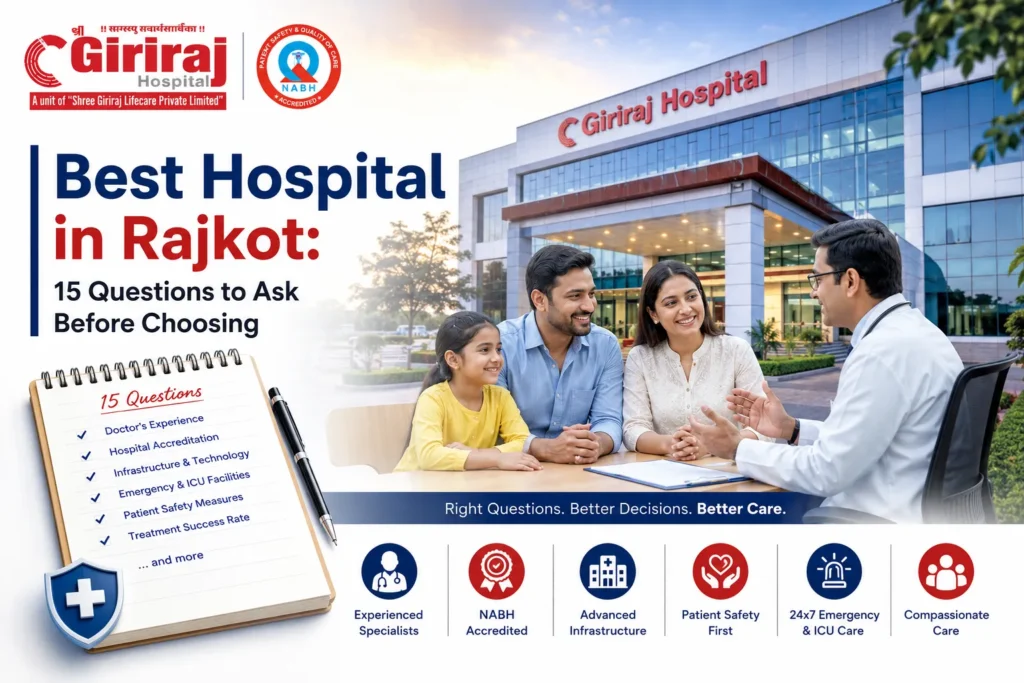
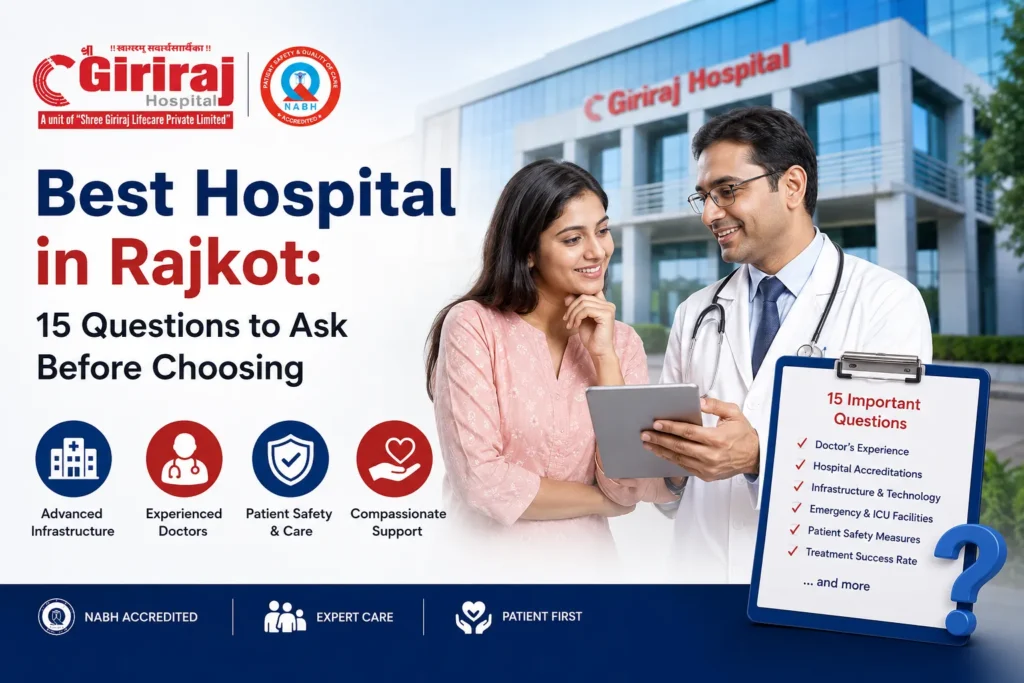
Finding the best hospital in Rajkot isn’t about picking the biggest building or the one with the flashiest advertisement – it’s about asking the right questions before you need care, not during an emergency. Whether you’re planning a routine check-up, a major surgery, or simply want to know where to go if something goes wrong, a hospital that looks good on the outside doesn’t always deliver on the things that actually matter for patient safety and outcomes.
Patients across Rajkot and Saurashtra often make this decision under pressure, during a health scare, without time to research properly. This article gives you a practical, question-based checklist – the kind a well-informed family member would ask – so you can evaluate any hospital confidently, including our own.
What Actually Makes a Hospital “The Best”?
“Best” is a subjective word, and different families weigh different things – some prioritise proximity, others prioritise a specific specialist, and others weigh cost above all else. What holds true across all these priorities is that a genuinely good hospital performs consistently well across a defined set of measurable factors: accreditation, specialist availability, emergency readiness, technology, transparency, and patient experience.
Think of choosing a hospital like choosing a pilot for a flight. You’re not just looking at how confident they sound – you want to know their training, their track record, and whether the aircraft itself is properly equipped and maintained. A hospital deserves the same kind of scrutiny, because the stakes are just as real.
This matters to every family in Rajkot because health decisions are rarely made with unlimited time to research. Having a clear checklist ready in advance means you can evaluate a hospital quickly and confidently, whenever the need arises.
Red Flags to Watch For When Evaluating a Hospital
Recognising warning signs early helps you avoid choosing a hospital that may not be equipped to handle your needs.
Signs a hospital may not be the right fit:
- No visible accreditation or certification information
- Vague or evasive answers about doctor qualifications
- No clear emergency or ICU facilities on-site
- Reluctance to provide cost estimates in advance
- Poor communication or long unexplained delays
- No support for insurance or government health scheme processing
Early Signs
Vague answers to simple questions, like a doctor’s specific qualifications or the hospital’s accreditation status, are early signs worth taking seriously.
Advanced or Serious Signs
A complete absence of emergency infrastructure, unclear billing practices, or an inability to explain a treatment plan clearly are more serious signs that should prompt you to look elsewhere.
A good hospital welcomes questions. If a hospital seems reluctant to answer clear, reasonable questions about doctors, equipment, or costs, that reluctance itself is valuable information.
A commonly overlooked red flag is the absence of a clear emergency protocol – many patients only discover this gap during an actual emergency, when it’s too late to choose differently.
Why These Questions Matter: Understanding the Reasoning
Understanding why each factor matters helps you weigh your own priorities more effectively.
Why Accreditation Matters
Accreditation, such as NABH certification, reflects that a hospital has been independently assessed against defined safety and quality standards, not just self-reported claims.
Why Doctor Experience Matters
A specialist’s years of experience and specific case volume in your condition often correlates directly with outcomes, particularly for complex procedures.
Why Local Access Matters
For patients in Saurashtra, having a fully equipped hospital nearby means faster access during emergencies and easier follow-up visits without long travel.
Weighing these factors together, rather than focusing on just one, gives a far more complete picture than relying on reputation or advertising alone.
The 15 Questions to Ask Before Choosing a Hospital
This is the core checklist – the questions worth asking any hospital you’re considering, organised by category.
| Category | Question to Ask |
|---|---|
| Accreditation | Is the hospital NABH accredited or similarly certified? |
| Specialities | Does it offer the specific speciality you need, in-house? |
| Doctor Experience | How many years of experience does the treating doctor have in this specific condition? |
| Emergency Care | Is there a 24×7 emergency department and ICU on-site? |
| Diagnostics | Are imaging and lab tests available on-site, or outsourced? |
| Technology | What surgical or diagnostic technology does the hospital use? |
| Insurance Support | Is the hospital empanelled under PM-JAY / Ayushman Bharat and major insurers? |
| Transparency | Will the hospital provide a clear, written cost estimate in advance? |
| Second Opinions | Is the hospital open to patients seeking a second opinion? |
| Post-Treatment Support | What follow-up care and physiotherapy support is available? |
| Ambulance Access | Does the hospital have its own ambulance service? |
| Multiple Campuses | Are there multiple locations for easier access? |
| Patient Reviews | What do verified patient reviews say about their experience? |
| Communication | Do doctors explain conditions and options in plain language? |
| Facility Standards | Is the hospital clean, well-maintained, and properly staffed? |
Most patients only think to ask two or three of these questions, usually related to cost and specialist availability. Asking the fuller list gives a far more complete, reliable picture.
How to Actually Verify a Hospital’s Claims
Knowing what to ask is only half the process – knowing how to verify the answers matters just as much.
Checking Accreditation
NABH accreditation status can be verified directly through the National Accreditation Board for Hospitals website, rather than relying solely on the hospital’s own claims.
Checking Doctor Credentials
Doctor qualifications and registration can typically be verified through the Medical Council of India or respective state medical council records.
What the Results Mean
A hospital that is accredited, transparent about costs, and staffed by verifiably qualified doctors is generally a strong, safe choice for both routine and complex care.
This verification process takes only a few minutes but provides significant peace of mind before committing to a hospital for an important treatment.
What Services the Best Hospitals Typically Offer
A well-rounded hospital offers more than just consultation rooms – it supports patients through the full journey of diagnosis, treatment, and recovery.
Comprehensive Speciality Coverage
Leading hospitals offer multiple specialities under one roof, from Cardiology and Nephrology to Orthopaedics and Critical Care, reducing the need to visit multiple facilities.
Integrated Diagnostic Support
On-site labs and imaging mean faster diagnosis and treatment, without delays caused by external referrals.
Coordinated Emergency and Critical Care
A strong hospital connects its emergency department directly with ICU and specialist teams, ensuring seamless care during urgent situations.
Your doctor and hospital’s overall infrastructure work together – even the best specialist benefits from strong diagnostic and emergency support around them.
What to Expect During Your First Hospital Visit
Understanding what a good first visit should look like helps you evaluate a hospital in practice, not just on paper.
- Clear, prompt registration process without excessive wait times
- A doctor who reviews your history and listens to your concerns thoroughly
- Clear explanation of any recommended tests, with reasoning
- A written or verbal cost estimate before major tests or procedures
- A clear next-steps plan, whether that’s further tests, treatment, or follow-up
What This Reveals
How a hospital handles your very first visit is often a strong indicator of how it will handle more complex care later.
A hospital that communicates clearly and respects your time from the first visit is generally a good sign of the overall patient experience you can expect.
What Ongoing Support Should Look Like
Choosing a hospital isn’t just about the first visit – ongoing care and follow-up matter just as much for long-term health outcomes.
- Immediately after treatment: Clear discharge instructions and medication guidance
- First follow-up visit: A scheduled check-in to confirm recovery is on track
- Ongoing management: Accessible follow-up for chronic conditions like diabetes or high blood pressure
- Long-term relationship: A hospital that remains a consistent, trusted resource for your family’s health needs
A hospital worth choosing is one your family can return to confidently for years, not just for a single treatment.
Patient perspective: Many families in Rajkot say the deciding factor in choosing a hospital wasn’t the building or advertising – it was how clearly the doctors explained things and how confident they felt asking questions without being rushed.
The best hospitals build long-term trust through consistency, not through a single positive experience.
Cost Transparency and Ayushman Card Support
We understand that cost is one of the most important factors families weigh when choosing a hospital.
A trustworthy hospital provides clear cost estimates before major tests or procedures, rather than surprising patients with unexpected charges. Costs naturally vary based on the specific treatment, but transparency about the process itself should never be in question.
Ayushman Bharat (PM-JAY) empanelment is an important factor to check, as it significantly reduces out-of-pocket costs for eligible patients and families. A hospital’s Ayushman Mitra desk, where available, should be able to clearly explain eligibility and the cashless process.
Speak to any hospital’s team directly for a personalised cost estimate before committing to treatment.
Do’s and Don’ts When Choosing a Hospital
| Do This | Don’t Do This |
|---|---|
| Ask about accreditation and doctor experience directly | Assume a hospital is good based on advertising alone |
| Request a written cost estimate before major procedures | Proceed with major treatment without understanding costs |
| Check if your insurance or Ayushman Card is accepted | Assume all hospitals accept the same insurance schemes |
| Visit the hospital in person if possible before a planned procedure | Choose a hospital solely based on online reviews |
| Ask how emergencies are handled, even for routine visits | Overlook emergency readiness because you feel healthy now |
| Trust your comfort level with how doctors communicate | Ignore feeling rushed or unheard during a consultation |
Taking the time to ask these questions in advance saves significant stress and uncertainty later, especially during an actual health emergency.
Common Myths About Choosing a Hospital
| Myth | Fact |
|---|---|
| The biggest hospital is always the best choice | Facility size doesn’t guarantee quality of care – accreditation, doctor experience, and outcomes matter far more. |
| Private hospitals never accept Ayushman Card patients | Many empanelled private hospitals, including Giriraj Hospital, accept PM-JAY / Ayushman Card patients for eligible treatments. |
| A hospital with more advertisements must be more trustworthy | Marketing visibility has no direct connection to clinical quality or patient safety standards. |
| Patients from Rajkot or Saurashtra need to travel to Ahmedabad for reliable, high-quality care | Several NABH-accredited, well-equipped hospitals, including Giriraj Hospital, offer comprehensive multispeciality care within Rajkot. |
| Cheaper treatment always means lower quality | Cost and quality don’t always correlate directly – transparent, accredited hospitals can offer fair pricing without compromising standards. |
If you’ve heard claims about a hospital that seem too good – or too concerning – to be true, verify them directly rather than relying on word of mouth alone.
Why Giriraj Hospital Meets This Checklist
Applying this exact checklist to our own hospital is the fairest way to show you what we offer – and why families across Rajkot and Saurashtra choose us.
NABH-Aligned Standards and Multispeciality Care
Giriraj Hospital brings together Critical Care, Cardiology, Nephrology, Neurosurgery, Orthopaedics, and several other specialities under one roof at both our Rajkot Main and Kuvadva campuses.
24×7 Emergency and Critical Care Readiness
Our Emergency Services and Critical Care units operate around the clock, supported by a dedicated ambulance service.
Transparent Cost Estimates
Our team provides clear cost estimates before major procedures, so families can plan with confidence rather than uncertainty.
PM-JAY / Ayushman Bharat Empanelment
Giriraj Hospital is empanelled under Ayushman Bharat, with a dedicated Ayushman Mitra desk to guide eligible patients through cashless treatment.
Experienced, Accessible Specialist Team
Our doctors are available for consultations and second opinions, with a strong focus on clear, patient-friendly communication.
Ready to see how we measure up in person? Book a consultation today.
Frequently Asked Questions
What is the most important factor in choosing a hospital?
There isn’t a single most important factor – accreditation, doctor experience, emergency readiness, and cost transparency should all be weighed together based on your specific needs.
How can I check if a hospital is NABH accredited?
NABH accreditation status can be verified through the National Accreditation Board for Hospitals’ official records, in addition to asking the hospital directly.
Does a multispeciality hospital cost more than a smaller clinic?
Not necessarily. Costs depend on the specific treatment and hospital’s pricing structure, and multispeciality hospitals often reduce overall costs by avoiding the need for multiple referrals.
Is it normal to ask a hospital for a cost estimate in advance?
Yes, this is a completely reasonable and common request. A trustworthy hospital will provide a clear estimate before major tests or procedures.
Can I get a second opinion before committing to treatment at a hospital?
Yes, and any reputable hospital, including Giriraj Hospital, should be comfortable with patients seeking a second opinion for significant treatment decisions.
Is Giriraj Hospital covered under Ayushman Card?
Yes, Giriraj Hospital is empanelled under PM-JAY / Ayushman Bharat. Our Ayushman Mitra desk can confirm your specific eligibility.
How do I know if a hospital has good emergency readiness?
Ask directly about 24×7 emergency department availability, on-site ICU facilities, and ambulance services – a confident, clear answer is a good sign.
Can I visit Giriraj Hospital before deciding on a planned treatment?
Yes. We welcome patients to visit, ask questions, and understand our facilities and team before making treatment decisions.
Choose With Confidence, Not Just Convenience
Choosing the best hospital in Rajkot doesn’t require guesswork – it requires asking the right questions and verifying the answers before you need care. A hospital that welcomes this kind of scrutiny is one worth trusting with your family’s health.
Our team at both our Rajkot Main and Kuvadva campuses is ready to answer every question on this checklist. Book an appointment or contact us to see how we measure up.
Explore more: Ayushman Bharat Health Card: Everything You Need to Know | 24-Hour Emergency Hospital in Rajkot