



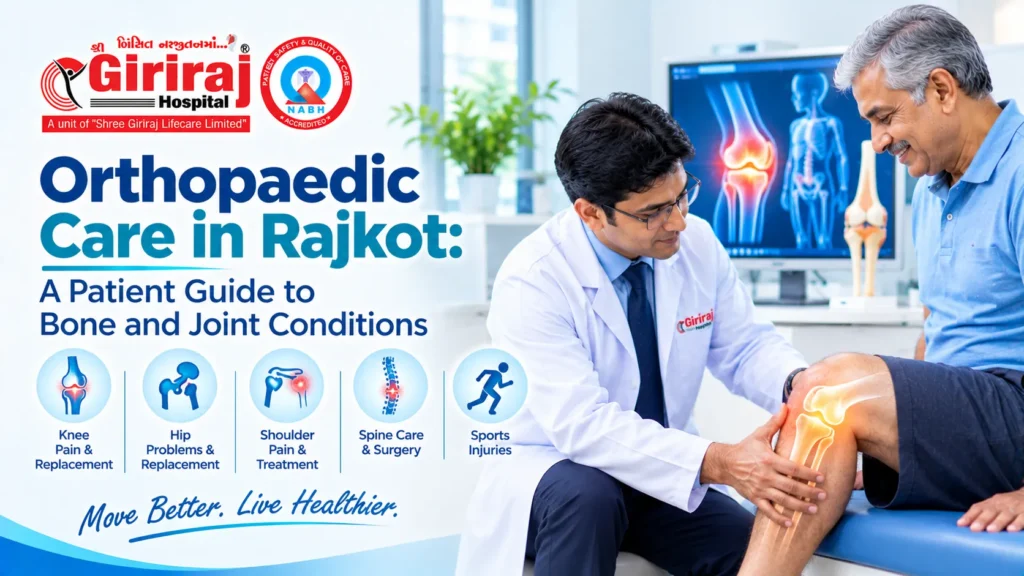
Knee pain that will not go away, a fracture from a fall, or a parent who struggles to climb stairs because of hip pain: these are the moments that send many people looking for an orthopaedic doctor. This guide explains what orthopaedic care covers, which qualifications to look for, and how to prepare for a consultation with any orthopaedic doctor.
It also describes the Ortho & Trauma department at Shree Giriraj Hospital, Rajkot. The guide is general information for patients and families. It does not replace an examination by a doctor.
What Does Orthopaedic Care Cover?
Orthopaedics is the branch of medicine that deals with the musculoskeletal system: bones, joints, ligaments, tendons and muscles. Orthopaedic doctors typically evaluate and treat:
- Joint replacement surgery: hip, knee and shoulder replacement for severe arthritis or joint damage
- Fracture and trauma care: broken bones from falls, accidents or sports injuries
- Sports injuries: ligament tears, tendon injuries and cartilage damage
- Spine conditions: disc problems, spinal stenosis and related back and neck conditions, often together with spine surgeons
- Arthritis: surgical and non-surgical management of joint degeneration
- Paediatric orthopaedics: bone and joint conditions in growing children
- Arthroscopic procedures: camera-guided, minimally invasive joint procedures for diagnosis and treatment
Because the specialty is broad, some doctors focus on particular areas, such as joints, spine, sports injuries or trauma. Most orthopaedic surgeons are trained across the whole specialty.
Orthopaedic Doctor, Rheumatologist, Physiotherapist or General Physician?
Patients are not always sure whom to see first. In general:
| Professional | Role |
|---|---|
| General physician | Makes the first assessment and refers to a specialist when needed |
| Orthopaedic doctor | Diagnoses and treats bone, joint, ligament and muscle conditions, including by surgery when needed |
| Rheumatologist | Manages inflammatory and autoimmune joint conditions, mainly with medicine |
| Physiotherapist | Provides exercise-based rehabilitation and non-surgical management; does not perform surgery |
For a fracture, persistent joint pain or a suspected ligament injury, a consultation with an orthopaedic doctor, directly or on referral from a general physician, is usually the most direct route.
Signs You Should See an Orthopaedic Doctor
Many people delay seeing a doctor because they are unsure whether symptoms are serious enough. Consider a consultation if you have:
- Joint pain that lasts more than a few weeks, especially if it worsens with activity
- Swelling, stiffness or reduced movement in a joint
- A fracture, dislocation or injury after a fall or accident
- Difficulty walking, climbing stairs or standing for long periods
- Chronic back or neck pain, particularly with numbness or tingling in the limbs
- A sports injury that has not improved with rest
- Joint pain that disturbs sleep or daily activities
None of these automatically means surgery. They are signs that deserve a proper evaluation rather than being dismissed as ordinary wear and tear.
Orthopaedic emergencies: seek care immediately
- An open fracture, where the bone breaks through the skin
- Sudden inability to move or bear weight on a limb after an injury
- Visible deformity of a limb or joint after a fall or accident
- Severe swelling, numbness or loss of circulation after an injury
- Signs of a spinal injury, such as numbness, weakness or loss of bladder control after trauma
| In an emergency Keep the injured part as still as possible and do not move a person with a suspected spinal injury unless they are in danger. Call for help. The hospital’s emergency line is +91 99099 71130 . See the Emergency Services page. Orthopaedic and trauma emergency care: 24/7 |
What Happens at a First Visit
A first consultation usually begins with a discussion of your symptoms, how the injury or pain started and your medical history. This is followed by a physical examination of movement, strength, tenderness and swelling.
Depending on what is suspected, the doctor may advise imaging. An X-ray is commonly used for fractures or joint degeneration, and an MRI may be used for a more detailed look at ligaments or cartilage. The doctor should explain why each test is being advised and what it is looking for.
When results are available, the doctor should explain the findings, the treatment options if any are needed, and what to expect in terms of timeline and next steps, whether that is physiotherapy, medicine or a surgical recommendation.
Preparing for your consultation
- Gather your medical history, including earlier injuries, surgeries and any family history of joint or bone conditions
- List your current medicines and supplements, since some affect bone healing and surgical planning
- Bring any imaging or test results, even from other hospitals, to avoid repeating tests unnecessarily
- Write down your symptoms: when they started, what makes them better or worse, and how they have changed
- Prepare your questions in advance, using the list later in this guide as a starting point
Qualifications in Orthopaedics
Doctors who treat bone and joint conditions have different training backgrounds. You can ask any doctor about their qualification and registration number, and check it with the medical council.
| Qualification | What it generally means |
|---|---|
| MS (Orthopaedics) or DNB (Orthopaedics) | Postgraduate specialist qualifications in orthopaedic surgery in India |
| Diploma in Orthopaedics (D.Ortho) | A postgraduate diploma in orthopaedics. Its duration and scope differ from the MS or DNB degrees. |
| Fellowship training | Additional training after a postgraduate qualification, for example in joint replacement, spine surgery or sports medicine |
| MBBS | Basic medical degree. An MBBS doctor typically makes a first assessment and refers when a specialist is needed. |
The Doctors page lists the hospital’s consultants with their qualifications.
Orthopaedic Sub-Specialities
Some conditions are handled by doctors who focus on a particular area. Common areas include:
- Joint replacement: replacing damaged knee, hip or shoulder joints with implants in advanced arthritis or severe cartilage loss
- Spine: disc herniation, spinal stenosis and related conditions, often managed with the spine surgery team
- Sports medicine: ligament and tendon injuries and arthroscopic procedures
- Trauma: complex fractures, often managed within a hospital’s emergency and trauma services
- Paediatric orthopaedics: bone and joint conditions in growing children, who need a different approach from adults
For spine conditions, see our guide to spine surgery and the Neurosurgery and Spine Surgery department page.
Questions to Consider When Choosing a Doctor
A qualification is a starting point. These points are useful when choosing any orthopaedic doctor or hospital.
- Qualification and registration: confirm the doctor’s qualification and registration number.
- Experience with your condition: ask how often the doctor treats conditions like yours.
- Range of options: ask whether non-surgical options, such as physiotherapy and medicine, are suitable for you before surgery is considered.
- Facilities: find out which imaging, operation theatre and rehabilitation facilities are available.
- Emergency arrangements: for injuries, find out what emergency and trauma care is available and when.
- Communication: the doctor should explain the diagnosis, options and expected recovery in plain language.
- Coordinated care: if you have other health conditions, ask how the hospital coordinates with other departments.
- Costs and insurance: ask for an estimate and what it includes.
Questions to ask your orthopaedic doctor
- What is your qualification, and do you have training relevant to my condition?
- What are my treatment options, and why are you recommending this one?
- What happens if I delay treatment or try non-surgical management first?
- What are the risks specific to my case, given my age and general health?
- What does recovery usually involve, and what physiotherapy support is available?
- Is cashless insurance or PM-JAY available at this hospital?
- What does the cost estimate include?
Getting a second opinion
For any significant diagnosis, especially one involving major surgery such as joint replacement, a second opinion is a reasonable step and does not signal distrust. Bring your existing imaging and reports so that tests need not be repeated. The hospital’s Second Opinion & Teleconsultation page explains how to discuss a diagnosis or earlier report with a specialist remotely.
A note on online ratings
Star ratings and review counts are one input among several. They may reflect waiting time or front-desk experience as much as clinical care, and they cannot tell you whether a particular treatment is right for you. Verified qualifications, a clear explanation from the doctor and advice from your family physician are also useful.
Common Orthopaedic Conditions
Osteoarthritis
Osteoarthritis is the gradual wearing down of joint cartilage, most commonly in the knees and hips. Management may include lifestyle changes, medicine and physiotherapy, and joint replacement surgery in advanced cases.
Fractures
Fractures are broken bones from falls, accidents or sports injuries. Depending on severity and location, treatment may involve a cast, a splint or surgical fixation.
Ligament injuries
Ligament injuries include ACL tears, common in sports. Some are treated with arthroscopic reconstruction followed by structured rehabilitation, while others are managed without surgery. The doctor will advise based on the injury and your activity needs.
Frozen shoulder
Frozen shoulder causes stiffness and pain that restrict shoulder movement. It is usually managed with physiotherapy and medicine, and sometimes with a minor procedure.
Spine-related conditions
Disc herniation and spinal stenosis can cause back or neck pain, sometimes with numbness or weakness in the limbs. They are often evaluated jointly by orthopaedic and spine surgery teams.
Joint Replacement Surgery: What to Know
Joint replacement involves replacing a damaged joint, most often the knee or hip, with an implant made of metal, plastic or ceramic components. It is considered when advanced arthritis or joint damage causes significant pain and disability that medicine, physiotherapy and lifestyle changes have not adequately relieved.
Recovery generally involves a hospital stay, followed by a period of structured physiotherapy to restore strength and movement. The length of stay and the recovery timeline differ from person to person, and your surgeon will advise you. It is reasonable to ask the surgeon about their experience with the specific procedure you need and about the rehabilitation support available.
Treatment Options
Treatment depends on the diagnosis, its severity, your age and your daily activities. Many bone and joint conditions are first managed without surgery.
- Non-surgical: rest, medicine, physiotherapy, bracing, and lifestyle and weight management
- Procedures: arthroscopy and other minimally invasive techniques, where suitable
- Surgery: fracture fixation, ligament reconstruction and joint replacement, when a doctor finds it clinically necessary
Surgical techniques, implants and rehabilitation protocols have changed over the years. Your doctor can explain what is suitable in your case, including the risks and the alternatives.
Recovery and Rehabilitation
Recovery and rehabilitation are an important part of treatment after joint replacement, fracture treatment or ligament reconstruction. Structured, supervised physiotherapy, clear guidance on activity during healing and regular follow-up are all part of a complete plan. The hospital’s Physiotherapy page describes the services available.
When you compare options, ask about physiotherapy and rehabilitation support as well as the procedure itself.
Preventing Bone and Joint Problems
- Maintain a healthy weight, which reduces strain on the knees and hips
- Stay physically active with regular, low-impact exercise
- Practise good posture and body mechanics, particularly to reduce back and neck strain
- Warm up before sports or exercise
- Eat a balanced diet with adequate calcium and vitamin D, and ask your doctor about supplements
- Use proper safety equipment during sports, work or activities with a fall risk
None of these steps removes risk entirely. A health check-up can include relevant tests; the Health Check-Up Plan page lists what each package contains.
Age-Specific Considerations
- Children: growing bones behave differently from adult bones, so children with bone or joint concerns need a doctor comfortable with paediatric orthopaedics.
- Active adults: sports injuries may need a doctor experienced in sports injuries and arthroscopy.
- Older adults: arthritis, osteoporosis, diabetes and heart conditions often overlap. Ask how the doctor and hospital coordinate care across these conditions.
Cost and Insurance
The cost of orthopaedic care depends on the condition and the treatment. A fracture managed with a cast, physiotherapy, arthroscopy and joint replacement involve different tests, procedures, hospital stays and rehabilitation. The most reliable way to understand cost is a consultation, after which an itemised estimate can be given covering tests, the procedure, hospital stay and physiotherapy.
Coverage under private insurance policies and PM-JAY depends on the policy or scheme rules, the procedure and eligibility. The hospital’s cashless insurance page lists the empanelled insurers and TPAs, and our Ayushman Bharat (PM-JAY) guide explains eligibility and the cashless process. For questions before your visit, use the Contact Us page.
Orthopaedic Services at Shree Giriraj Hospital
The points below describe services at the hospital. Please confirm current availability by calling the hospital or visiting the Contact Us page.
- Ortho & Trauma department: evaluation and treatment of bone, joint and injury conditions. See the Ortho & Trauma page.
- Surgical services: fracture fixation and joint replacement surgery [confirm the list of procedures actually performed, and at which unit].
- Trauma and emergency care: 24×7 available
- Diagnostics: X-ray, MRI and CT imaging
- Rehabilitation: physiotherapy support. See the Physiotherapy page.
- Insurance support: assistance with documentation and pre-authorisation for cashless claims and PM-JAY patients
- Doctors: the Doctors page lists consultants with qualifications and OPD timings.
- Appointments: use the Book an Appointment page, or call the numbers on the Contact Us page.
Glossary
- Orthopaedics: the branch of medicine dealing with bones, joints, ligaments, tendons and muscles
- Arthroscopy: a minimally invasive procedure using a small camera to diagnose and treat joint problems
- Osteoarthritis: degeneration of joint cartilage, commonly affecting the knees and hips
- Fracture fixation: surgical stabilisation of a broken bone using plates, screws or rods
- ACL reconstruction: surgical repair of a torn anterior cruciate ligament in the knee
- MS (Ortho) / DNB (Ortho): postgraduate specialist qualifications in orthopaedic surgery in India
- Physiotherapy: supervised exercise and rehabilitation supporting recovery after injury or surgery
Frequently Asked Questions
How do I choose an orthopaedic doctor?
Check the doctor’s qualification and registration number, ask about experience with your condition, find out what facilities and rehabilitation support are available, and make sure the diagnosis and options are explained clearly.
What qualifications do orthopaedic doctors hold?
The standard postgraduate qualifications in orthopaedic surgery in India are MS and DNB. Some doctors also have a diploma (D.Ortho) or additional fellowship training. Ask any doctor for their registered qualifications.
When should I see an orthopaedic doctor instead of a general physician?
Consider a specialist consultation for persistent joint pain, fractures or injuries from a fall or accident, chronic back or neck pain, or any symptom that has not improved with rest and has not been diagnosed.
How much does orthopaedic treatment cost?
Cost depends on the condition, the tests, the type of treatment, the hospital stay and rehabilitation. A consultation is the only reliable way to get an estimate for your case.
Does insurance cover orthopaedic surgery?
Coverage depends on the policy or scheme rules, the procedure and eligibility. Check with your insurer or the hospital’s insurance desk before the procedure, and see our Ayushman Bharat (PM-JAY) guide for PM-JAY.
What is the difference between an orthopaedic doctor and a physiotherapist?
An orthopaedic doctor diagnoses and treats bone and joint conditions, including by surgery when needed. A physiotherapist provides exercise-based rehabilitation and non-surgical management, often alongside the orthopaedic doctor’s plan.
Can orthopaedic doctors treat sports injuries?
Yes. Sports injuries such as ligament tears and tendon injuries fall within orthopaedics. Some surgeons have additional training in sports medicine.
Does the hospital provide emergency orthopaedic and trauma care?
Yes. The Ortho & Trauma department and Emergency Services handle fractures, dislocations and other injuries.
Conclusion
Choosing an orthopaedic doctor is easier when you understand the qualifications, ask clear questions and know what to expect from the consultation. Take your reports, ask about your options and consider a second opinion for any major decision.
For information about the Ortho & Trauma department at Shree Giriraj Hospital, Rajkot, see its department page. For appointments, see Book an Appointment, or use Contact Us for questions before your visit.
Related reading: guide to spine surgery | Ayushman Bharat / PM-JAY Guide | All articles
| Disclaimer This article is for patient information only. It is not a substitute for consultation with a registered medical practitioner and does not constitute diagnosis or treatment advice. In an emergency, seek care immediately. Shree Giriraj Lifecare Private Limited, Rajkot. |