






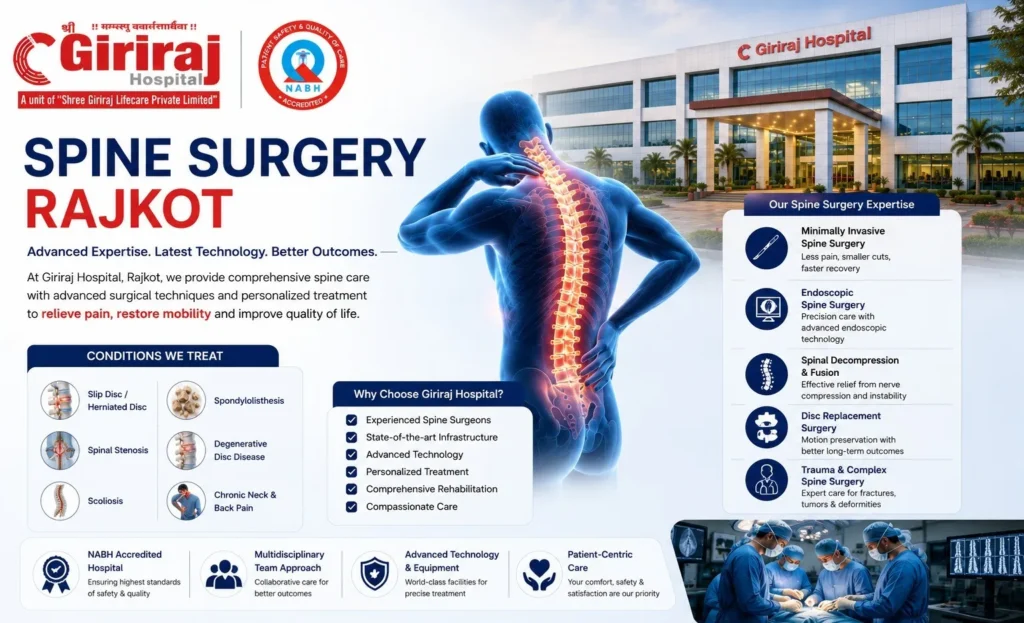
Persistent back or neck pain that refuses to improve with rest is one of the most common reasons patients search for spine surgery Rajkot, and Saurashtra residents no longer need to travel to Ahmedabad or Mumbai for advanced spine care. Low back pain is among the leading causes of years lived with disability worldwide, affecting an estimated 619 million people globally, with that number projected to rise to 843 million by 2050 (World Health Organization, 2023).
A separate global review found that roughly 80% of adults experience at least one significant episode of back pain during their lifetime (National Institute of Neurological Disorders, 2022). At the Shree Giriraj Hospital Neurosurgery and Spine Surgery department, a multidisciplinary team combines modern diagnostics with both non-surgical and surgical treatment to manage everything from a simple slipped disc to complex spinal deformity. You can read more about the hospital’s patient-first philosophy on the About Us page.
This guide walks you through the warning signs you should never ignore, the causes and types of spinal conditions, how doctors diagnose them, the treatments available, what recovery actually looks like week by week, and how cost and insurance coverage works – so you can make an informed decision at every step of your spine care journey.
What Is Spine Surgery?
Spine surgery is a group of surgical procedures used to treat problems affecting the vertebrae (the small bones stacked to form your backbone), the soft discs that cushion them, the spinal cord, or the nerves that branch out from it. Doctors recommend it when pain, weakness, or numbness caused by a spinal problem does not improve with medication, physiotherapy, or rest, or when there is a risk of permanent nerve damage.
Spinal conditions can affect anyone – from a teenager with a curved spine to an office worker with a herniated disc to an elderly patient with age-related spinal narrowing. The goal of treatment at every stage is the same: relieve pressure on the nerves, stabilise the spine, and restore the patient’s ability to sit, stand, walk, and sleep without pain. The Neurosurgery and Spine Surgery department at Shree Giriraj Hospital works closely with the Ortho & Trauma team so that patients are guided to the right specialist from the very first consultation.
| Think of it this way Your spine is like the load-bearing pillar of a building. A small crack or a shifted brick doesn’t always bring the building down, but left unaddressed, it can compromise everything the pillar supports. Spine treatment – surgical or not – is about reinforcing that pillar before it affects the rest of the structure. |
Warning Signs You Should Never Ignore
Not every backache needs a surgeon, but certain symptoms signal that the spine or the nerves around it may be under real pressure. Knowing the difference helps you seek the right care at the right time.
Early Warning Signs
- Dull, persistent back or neck pain that lasts more than two to three weeks
- Pain that worsens after sitting for long hours or standing for a while
- Stiffness in the morning that improves slightly with movement
- Occasional tingling or a pins-and-needles sensation in the arms or legs
- Pain that radiates from the lower back down one leg (commonly called sciatica)
- Reduced flexibility when bending forward or twisting the torso
- Muscle spasms in the back that come and go
Advanced or Serious Warning Signs
- Weakness in the legs or arms that makes walking or gripping objects difficult
- Numbness spreading below the knee or into the groin area
- Loss of bladder or bowel control
- Pain that wakes you up at night or does not ease with rest
- Visible curvature or deformity of the spine
- Unexplained weight loss along with back pain
| When to Seek Emergency Care Immediately Sudden loss of bladder or bowel control, rapidly worsening leg weakness, or numbness in the groin area after an injury can indicate a surgical emergency called cauda equina syndrome. Do not wait – reach the nearest emergency department right away or call the hospital’s Ambulance Service for immediate transport. |
Symptoms that overlap with neurological warning signs – such as sudden weakness on one side of the body – deserve urgent attention as well. Our related article on stroke symptoms everyone should know explains how to tell neurological emergencies apart from routine spinal pain, and why acting within the first hour matters.
Causes and Risk Factors
Spinal problems rarely have a single cause. Most patients develop symptoms from a combination of ageing, daily habits, and sometimes genetics – it is not usually the result of one bad decision, and there is no benefit in blaming yourself for how you sit or work.
Common Causes
- Degenerative disc disease: the discs between vertebrae lose water content and cushioning with age, which can lead to stiffness and nerve compression over time.
- Herniated or slipped disc: the soft inner material of a disc pushes through its outer layer and presses on a nearby nerve, often from repetitive lifting or a sudden strain.
- Spinal stenosis: the space around the spinal cord narrows, usually with age, gradually squeezing the nerves that pass through it.
- Trauma and accidents: road traffic accidents, falls, and sports injuries can fracture or dislocate the vertebrae and require urgent evaluation.
- Infections and tumours: though less common, infections of the spine or growths pressing on the spinal cord can cause persistent, unexplained pain.
Who Is at Risk
- Adults over 45, as natural disc wear accelerates with age
- People with desk jobs or long commutes involving prolonged sitting
- Manual labourers who lift heavy loads regularly, common across Rajkot’s textile, engineering, and agricultural sectors
- Individuals with a family history of spinal deformity or disc disease
- People carrying excess body weight, which adds pressure on the lower spine
- Smokers, since smoking reduces blood supply to spinal discs
Because several of these risk factors overlap with metabolic and lifestyle conditions, doctors at Shree Giriraj Hospital often coordinate spine evaluation with the Internal Medicine department, particularly for patients managing diabetes or thyroid conditions alongside back pain.
Types, Stages, and Classification of Spinal Conditions
Spinal problems are broadly grouped by the structure they affect and how far they have progressed. Understanding where your condition falls helps set realistic expectations for treatment through the Neurosurgery and Spine Surgery department.
| Type / Stage | What It Means | Typical Approach |
|---|---|---|
| Mild disc bulge | Disc is stressed but intact; nerve irritation is mild | Physiotherapy, posture correction, medication |
| Herniated disc with sciatica | Disc material presses on a nerve root, causing leg pain | Conservative care first; minimally invasive surgery if it persists |
| Spinal stenosis | Narrowed canal compresses the spinal cord or nerves | Decompression surgery for moderate to severe cases |
| Spondylolisthesis | One vertebra slips forward over the one below it | Bracing or spinal fusion depending on the grade of slippage |
| Scoliosis / kyphosis | Abnormal sideways or forward curvature of the spine | Observation, bracing, or corrective surgery depending on the angle |
| Spinal trauma / fracture | Vertebra is broken or dislocated, often after an accident | Emergency stabilisation, sometimes surgical fixation |
Degenerative Conditions
These develop gradually over years and are the most common reason adults over 40 consult a spine specialist. They rarely require emergency treatment but do need timely evaluation before nerve damage becomes permanent.
Structural and Deformity Conditions
Conditions like scoliosis often begin in adolescence and are best managed early. The Neurology and Interventional Neurology team is involved when a spinal deformity has an underlying neurological cause, ensuring both the structure and the nerve function are addressed together.
| Clinical Insight The stage at diagnosis matters more than the label. A “mild” stenosis that is actively causing weakness needs faster intervention than a “severe” stenosis that is currently pain-free – always ask your doctor what your specific symptoms mean for your treatment timeline, not just what your scan says. |
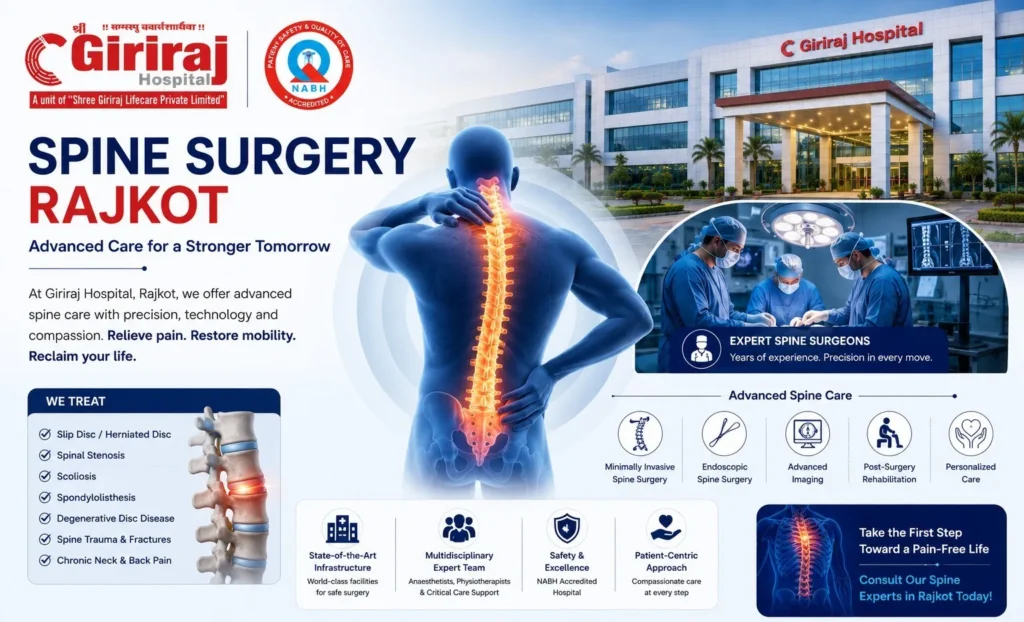
How Is a Spinal Condition Diagnosed?
An accurate diagnosis is the foundation of safe spine treatment. Doctors typically combine a physical examination with targeted tests rather than relying on a scan alone.
Blood Tests
- Complete Blood Count (CBC): checks for infection or anaemia that could be contributing to fatigue and pain.
- ESR and CRP: inflammation markers that help rule out an infective or inflammatory cause of back pain.
- Vitamin D and calcium levels: low levels can weaken bone and worsen spinal pain, especially in older adults.
Imaging Tests
- X-ray: a quick first-line scan to check for fractures, alignment issues, or bone spurs.
- MRI: the gold-standard scan for viewing discs, nerves, and soft tissue in detail without radiation.
- CT scan: provides a detailed 3D view of bone structure, often used when planning complex surgery.
Other Diagnostic Procedures
- Nerve conduction studies: measure how well electrical signals travel along a nerve to pinpoint compression.
- Bone density (DEXA) scan: checks for osteoporosis, which changes how a surgery is planned in older patients.
Many of these tests can be arranged as part of a broader health check-up plan at the hospital, so patients with vague symptoms are not sent from department to department. Once results are in, your consultant from Neurosurgery and Spine Surgery will explain what each finding means in plain language before recommending next steps.
Treatment Options for Spinal Conditions
Treatment always depends on the stage of the condition, the patient’s overall health, and how much the symptoms are affecting daily life. Most patients start with non-surgical care, and surgery is considered only when it does not bring lasting relief or when there is a risk of nerve damage.
Non-Surgical / Medical Management
The majority of spine patients improve with a structured non-surgical plan. This usually includes anti-inflammatory medication, activity modification, and a supervised programme through the Physiotherapy department, which focuses on strengthening the core muscles that support the spine. Pain-management injections may also be used for short-term relief while the underlying issue is treated.
Surgical / Procedural Treatment
When conservative treatment fails or nerve compression is significant, the Neurosurgery and Spine Surgery team may recommend a procedure such as microdiscectomy, laminectomy, or spinal fusion. For patients whose spinal issue overlaps with a joint or bone condition, the Ortho & Trauma department is consulted jointly to plan the most appropriate surgical approach.
Advanced or Emerging Treatments
Minimally invasive and endoscopic spine techniques use smaller incisions, specialised instruments, and image guidance to treat the same conditions as open surgery, typically with less blood loss and a shorter hospital stay. These approaches are especially suited to herniated discs and moderate spinal stenosis.
Shree Giriraj Hospital offers both conservative and surgical pathways under one roof, supported by Critical Care backup for complex cases. Where treatment is covered under government health insurance, our team helps patients understand the process – for eligibility and cashless-treatment queries, patients can reach our insurance desk through Contact Us before their first consultation.
Spine Surgery – Step by Step
Preparing for Spine Surgery
- Complete pre-operative blood tests, imaging, and a fitness assessment by the anaesthesia team
- Stop blood-thinning medication or supplements only as advised by your surgeon
- Fast for 6 to 8 hours before the procedure as instructed
- Arrange for a family member to be present on the day of surgery and during early recovery
Every patient is evaluated by the Anesthesiologist team beforehand to confirm the safest anaesthesia plan, especially for patients with diabetes, heart conditions, or advanced age.
The Procedure
- Anaesthesia: the anaesthesia team administers general anaesthesia and continuously monitors vital signs throughout.
- Positioning and access: the surgical team positions the patient carefully and makes a precise incision, sized according to whether an open or minimally invasive approach is used.
- Decompression or correction: the surgeon relieves pressure on the affected nerve or corrects the structural problem, such as removing herniated disc material or stabilising a slipped vertebra.
- Stabilisation (if required): for fusion procedures, screws, rods, or a cage may be placed to stabilise the spine while it heals.
- Closure: the incision is closed in layers and dressed; the entire procedure typically takes approximately 2 to 4 hours.
Immediately After – ICU and Recovery Ward
Most spine surgeries take approximately 2 to 4 hours, depending on complexity. Patients are monitored in a recovery area immediately afterward, and higher-risk cases may spend the first 24 hours in the ICCU for close observation before being shifted to the general ward. Within 24 hours, many patients are encouraged to sit up and take short, supported walks to reduce the risk of blood clots and stiffness.
If you experience a spine injury after an accident, the hospital’s Ambulance Service can transport you directly to the Operation Theatre complex for emergency stabilisation. Rest assured, the entire care team – from anaesthetist to nursing staff – works together at every step so you are never navigating surgery day alone.
Recovery and Life After Spine Treatment
Recovery from spine surgery is gradual, and following the right steps at each stage makes a real difference to the final outcome.
Week 1
- Do: take short, frequent walks as advised; keep the incision clean and dry
- Don’t: sit for long stretches, bend at the waist, or lift anything heavier than a light bag
Most patients are shifted from the ICCU to the General Ward within a day or two, where nursing staff monitor wound healing and pain control closely.
Weeks 2 to 4
- Gradually increase walking distance as tolerated
- Follow a protein-rich, high-fibre diet to support tissue healing and prevent constipation from pain medication
- Attend wound-check appointments as scheduled
Month 2 to 3
Most patients begin a structured, supervised programme with the Physiotherapy Services team to rebuild core strength safely. Light household activity and short commutes usually resume during this period, though driving and heavy lifting are typically restricted until the surgeon confirms it is safe.
Long-Term
Long-term success depends on maintaining a healthy body weight, practising correct lifting technique, and attending periodic follow-up visits. Patients who had spinal fusion may need imaging at set intervals to confirm the bones have healed properly.
| A Patient’s Story (Representative Example) A 52-year-old shop owner from Rajkot had struggled with leg pain for over a year before undergoing minimally invasive decompression surgery. Within six weeks of consistent physiotherapy, he was back to standing at his shop counter for full working days – a reminder that recovery is a process, not a single event. |
Patients recovering from any major surgery often ask what post-operative monitoring actually involves – our guide on what happens inside an ICU explains the process in detail and can help ease first-time surgery anxiety.
Cost and Insurance Coverage for Spine Surgery
Spine surgery costs in India vary widely depending on the type of procedure, whether it is minimally invasive or open, the implants used, the length of hospital stay, and any complications that arise. Rather than quoting a fixed price, most reputable hospitals provide a personalised estimate after your diagnosis is confirmed, since two patients with the same condition can need very different levels of surgical complexity.
Factors That Affect Total Cost
- Type of surgery (decompression versus fusion versus deformity correction)
- Whether implants or spinal instrumentation are required
- Length of hospital stay and any ICU care needed
- Pre-existing conditions that require additional monitoring
Many spine procedures are covered under government health insurance schemes, including PM-JAY (Ayushman Bharat), where the patient meets the eligibility criteria. Shree Giriraj Hospital’s insurance desk supports patients through the cashless-approval process, from document verification to claim coordination with the insurer or scheme administrator. To confirm your specific eligibility and begin the cashless process, patients are encouraged to speak with our team via Contact Us or while scheduling a visit through Book an Appointment.
Do’s and Don’ts for Spine Patients
| Do This | Don’t Do This |
|---|---|
| Sleep on a firm mattress with a pillow between your knees if you sleep on your side | Sleep on a soft, sagging mattress that lets your spine sag out of alignment |
| Sit with your back supported and feet flat on the floor while working | Sit cross-legged on the floor for long periods, common during long family gatherings |
| Bend your knees and keep the load close to your body when lifting anything, including water pots | Bend from the waist to lift heavy items such as LPG cylinders or grocery bags |
| Take short walking breaks every 30 to 40 minutes during desk work or long drives | Sit through hour-long two-wheeler or car commutes without a single break |
| Include calcium- and protein-rich foods such as milk, dal, and leafy vegetables in your diet | Skip meals or rely heavily on fried snacks, which contributes to excess weight on the spine |
| Do the stretching and strengthening exercises your physiotherapist recommends, consistently | Return to gym weightlifting or heavy exercise without your surgeon’s clearance |
| Wear supportive, flat footwear for daily activities | Wear high heels or completely flat, unsupportive footwear for long durations |
| Schedule a preventive check-up if back pain lasts more than two weeks | Ignore radiating leg pain or numbness, hoping it resolves on its own |
If you are unsure whether your current symptoms warrant a visit, a general health check-up can help identify early spine and joint issues before they progress.
Common Myths About Spine Surgery
| Myth | Fact |
|---|---|
| Spine surgery always leaves you paralysed or worse off | Serious complications are uncommon with modern techniques and an experienced surgical team; most patients report significant pain relief and improved mobility |
| Once you have back pain, surgery is inevitable | The majority of spine patients recover fully with physiotherapy, medication, and lifestyle changes alone; surgery is considered only when conservative care fails |
| Bed rest for weeks is the best cure for back pain | Prolonged bed rest actually weakens the muscles that support the spine; gentle, guided movement usually speeds up recovery |
| Younger people don’t need to worry about spine problems | Disc herniation and posture-related spine issues are increasingly common in people in their 20s and 30s due to desk jobs and screen time |
| MRI reports that mention a “bulge” or “degeneration” always mean you need surgery | Many such findings are incidental and asymptomatic; treatment decisions are based on symptoms, not scan wording alone |
| Minimally invasive surgery is less effective than open surgery | For appropriately selected cases, minimally invasive techniques achieve comparable results to open surgery with less tissue damage and a shorter recovery |
| For this treatment you need to travel to a big city | Shree Giriraj Hospital provides spine care to the same clinical standard as top hospitals in larger cities – right here in Rajkot |
Why Choose Shree Giriraj Hospital for Spine Surgery?
Choosing where to undergo spine treatment is a significant decision, and it is natural to want clear, specific reasons rather than general reassurance. Here is what sets Shree Giriraj Hospital apart for patients evaluating spine surgery in Rajkot.
A Dedicated Neurosurgery and Spine Surgery Department
The Neurosurgery and Spine Surgery department treats conditions across the full spectrum – from disc herniation and spinal stenosis to trauma and spinal cord injury – with specialists who coordinate directly with orthopaedics for joint-related overlap.
Integrated Orthopaedic and Joint Care
Spine problems often coexist with hip or knee issues, particularly in older patients. Close coordination with the Joint Replacement and Ortho & Trauma teams means mobility problems are assessed holistically, not in isolation.
Critical Care Backup for Complex Cases
Higher-risk or elderly patients are supported by a dedicated Critical Care unit, so post-operative monitoring is available around the clock when a case demands it.
Modern Infrastructure
From modular operation theatres to imaging and a purpose-built Hospital Infrastructure, patients are treated in a facility designed specifically for surgical safety and comfort.
Two Accessible Campuses
Shree Giriraj Hospital operates from Rajkot Main (27 Navjyot Park, 150 Ft Ring Road, Rajkot – 360005) and Kuvadva (Plot No. 28, 29, 30, Near Wankaner Chowkdi, Kuvadva, Rajkot – 360023), giving patients across the city and surrounding areas a nearer point of access to specialist spine care.
Insurance and PM-JAY Support
The hospital works with a wide network of insurers and TPAs, and supports eligible patients through the PM-JAY (Ayushman Bharat) cashless process. Reach the insurance desk through Contact Us for a coverage check before your visit.
In an emergency, the hospital’s Ambulance Service ensures patients reach specialist care without delay. To take the next step, meet our specialist team by consulting the Doctors page, and book a consultation with our Neurosurgery and Spine Surgery team today through Book an Appointment.
Frequently Asked Questions
Is spine surgery painful?
Modern spine surgery is performed under general anaesthesia, so patients feel no pain during the procedure. Post-operative discomfort is managed with medication and typically eases significantly within the first week.
How many days of rest are needed after spine surgery?
Most patients stay in hospital for a few days depending on the procedure, then continue recovery at home with restricted activity for 4 to 6 weeks before gradually resuming normal routines under medical guidance.
Is spine surgery covered under Ayushman Bharat (PM-JAY)?
Many spine procedures are covered under PM-JAY for eligible beneficiaries. Contact our insurance desk through Contact Us to confirm your eligibility and start the cashless approval process.
Can spine problems be treated without surgery?
Yes. The majority of spine conditions respond well to physiotherapy, medication, and lifestyle changes. Surgery is recommended only when conservative treatment fails or when there is a risk of nerve damage.
What is the success rate of spine surgery?
Outcomes depend on the specific condition and procedure, but most well-selected surgical cases report significant, lasting pain relief and improved mobility. Your surgeon can explain expected outcomes for your specific diagnosis during consultation.
How do I know if my back pain needs a doctor’s visit?
If pain lasts more than two to three weeks, radiates down a leg, or comes with numbness, weakness, or bladder changes, it’s time to consult a specialist rather than wait it out.
Does Shree Giriraj Hospital treat complex or revision spine cases?
Yes, the Neurosurgery and Spine Surgery department manages a full range of spinal conditions, supported by Critical Care and modern imaging for complex presentations.
How do I book a consultation for spine pain?
You can schedule a consultation directly through the Book an Appointment page, or call the hospital’s contact numbers listed on the Contact Us page.
Is minimally invasive spine surgery available in Rajkot?
Yes, minimally invasive and image-guided techniques are used where clinically appropriate to reduce blood loss, scarring, and recovery time compared with traditional open surgery.
What should I bring for my first spine consultation?
Bring any previous X-rays, MRI or CT scan reports, a list of current medications, and details of your symptoms and how long they’ve lasted, so your consultant can make the most informed assessment.
Conclusion
Back and neck pain that lingers is worth taking seriously, but it rarely means surgery is your only option – most patients recover with the right combination of diagnosis, conservative care, and, when truly needed, modern surgical treatment close to home.
If persistent pain, numbness, or weakness is affecting your daily life, don’t wait for it to worsen. Consult the Neurosurgery and Spine Surgery team at Shree Giriraj Hospital, Rajkot, and take the first step toward lasting relief. You can book an appointment directly online, or reach our team through the Contact Us page for any questions before your visit.
Read More: What Happens Inside an ICU – A Complete Guide | Stroke Symptoms Everyone Should Know | Knee Replacement Surgery – When Do You Actually Need It? – or explore more articles on our Blogs page.