





When a family member is rushed into intensive care, there’s rarely time for careful research – decisions happen in minutes, not days. This guide exists for two moments: the calmer one, when you’re researching in advance so you know where to turn if a crisis ever hits, and the urgent one, when you need to quickly understand what actually makes a genuinely strong critical care team. Either way, this is a guide to finding the best critical care doctor in Rajkot based on real, checkable criteria, not marketing claims.
We’re writing this because most search results for the best critical care doctor in Rajkot lead to thin directory listings with a name, a fee, and little else – nothing that actually explains what separates a strong ICU team from an average one. Critical care is genuinely different from most other medical decisions, since the stakes are immediate and the window for research is often measured in hours. This guide is built to give you the real substance behind that decision, whether you’re planning ahead or facing it right now.
Rajkot’s critical care infrastructure has expanded considerably over the past decade, with multiple hospitals now offering dedicated ICU capability and specifically-trained intensivists rather than relying on general physicians to cover intensive care as an additional responsibility. This is genuinely important progress for a region that once needed to refer the most critical cases to Ahmedabad, and it means finding the best critical care doctor in Rajkot today is a genuinely meaningful research question, not a compromise on quality.
What Does a Critical Care Doctor Actually Do?
A critical care doctor, formally called an intensivist, specialises in managing patients whose condition is severe enough to threaten life or major organ function. Unlike a general physician managing chronic, stable conditions, the best critical care doctor in Rajkot works specifically within the intensive care unit (ICU), coordinating moment-to-moment decisions for patients who are often unstable and require continuous monitoring and rapid intervention.
This role covers an enormous range of conditions, including:
- Severe Respiratory Failure – requiring ventilator support and advanced oxygen management
- Septic Shock and Severe Infections – where rapid, coordinated treatment directly affects survival
- Post-Major-Surgery Care – particularly following cardiac, neurological, or other high-risk operations
- Major Trauma – stabilising patients after serious accidents or injuries
- Stroke and Acute Neurological Emergencies – requiring rapid assessment and coordinated specialist care
- Multi-Organ Dysfunction – managing simultaneous failure of several organ systems
- Cardiac Arrest and Post-Resuscitation Care – stabilising patients after a cardiac event
Because critical illness rarely respects departmental boundaries, the best critical care doctor in Rajkot works as part of a genuinely coordinated team, rather than managing a patient in isolation from cardiology, neurology, or surgery.
Why This Decision Deserves Real Scrutiny
Critical care sits in a uniquely time-pressured part of medicine – decisions often need to happen within hours, sometimes minutes, and the difference between a well-coordinated ICU team and an average one can genuinely affect survival and long-term recovery. This is precisely why understanding what makes the best critical care doctor in Rajkot different from an adequate one matters more here than for almost any other medical decision covered in a typical “best doctor” search.
At the same time, this shouldn’t become a source of paralysing anxiety, particularly if you’re researching calmly in advance. The vast majority of critical care admissions in Rajkot are managed successfully by qualified, dedicated ICU teams. The goal of this guide is to help you recognise genuine quality markers quickly, whether you have days to research or only minutes.
Critical Care Doctor vs. Other Specialists: Avoiding Confusion
Patients and families are often unsure how a critical care doctor differs from other specialists they’ve encountered, so a bit of clarity helps here. An internal medicine specialist manages long-term, generally stable conditions like diabetes or hypertension in an outpatient setting. An emergency medicine doctor handles the immediate first response when a patient arrives at the hospital, stabilising them before determining next steps. A critical care doctor (intensivist), by contrast, takes over ongoing, minute-to-minute management once a patient is admitted to the ICU, coordinating their care for as long as that intensive level of support is needed.
Many of the best critical care doctor in Rajkot options are actually dual-trained – holding qualifications in both internal medicine and critical care specifically – which means they can move fluidly between managing a patient’s broader health picture and responding to the moment-to-moment demands of intensive care. Understanding this distinction helps you ask sharper, more specific questions when evaluating a hospital’s ICU team.
Preparing Before a Crisis: What Families Can Do in Advance
One of the most valuable things you can do is research the best critical care doctor in Rajkot and the hospitals available to you before an emergency ever happens, rather than trying to evaluate options while already in crisis. Knowing in advance which hospitals near you offer 24/7 dedicated critical care, having basic medical history for family members with chronic conditions readily accessible, and understanding your insurance coverage for emergency and ICU care can all save critical time when it matters most.
This kind of advance preparation costs nothing and is worth doing even if you never end up needing it. Simply knowing which hospital to head toward, and having a general sense of what questions to ask once there, removes one layer of decision-making from an already overwhelming situation, and means you’ve effectively already identified the best critical care doctor in Rajkot for your family before a crisis ever forces the question.
How Critical Care Decisions Get Made
Understanding the decision-making process behind critical care admission helps demystify what can otherwise feel like a sudden, frightening escalation. When a patient’s condition is assessed as requiring ICU-level care, the best critical care doctor in Rajkot available will typically evaluate vital signs, organ function, and the trajectory of the underlying illness to determine the appropriate level of intervention.
This isn’t a single, isolated decision – critical care is an ongoing, continuously reassessed process. The treating intensivist adjusts the treatment plan hour by hour based on how the patient responds, which is precisely why having a dedicated, experienced critical care specialist making these calls, rather than a rotating team without specific ICU training, genuinely matters for outcomes and is worth prioritising when identifying the best critical care doctor in Rajkot for an ongoing admission.
What Qualifications Should You Look For?
Not every doctor working in or around an ICU has the same depth of training, and understanding these distinctions is genuinely useful when evaluating the best critical care doctor in Rajkot for a specific situation.
IDCCM (Indian Diploma in Critical Care Medicine)
A dedicated, recognised qualification specifically focused on critical care medicine, representing genuine specialised training beyond a general MD or MBBS.
FCCS (Fundamental Critical Care Support) Certification
An internationally recognised certification specifically focused on the initial management of critically ill patients, often held alongside a base medical qualification.
MD (Internal Medicine) with Critical Care Focus
Many experienced critical care doctors hold a base MD in Internal Medicine with substantial additional experience and often further certification specifically in critical care, rather than a separate ICU-only degree.
General Physicians Without Specific Critical Care Training
A general physician can certainly provide competent care for many hospitalised patients, but genuinely critical, unstable cases benefit considerably from a doctor with dedicated critical care training and hands-on ICU experience specifically, which is exactly the distinction that separates a generalist from the best critical care doctor in Rajkot for a genuinely unstable patient.
When researching the best critical care doctor in Rajkot for a loved one, asking directly about their specific critical care qualification – IDCCM, FCCS, or equivalent – rather than assuming any hospital physician is equally equipped for intensive care, is one of the most useful questions you can ask.
Beyond Qualifications: What Else Matters in Critical Care
A strong qualification is the foundation, but several additional factors genuinely affect the quality of care delivered by the best critical care doctor in Rajkot and the team around them.
1. 24/7 Physical Presence, Not Just On-Call Availability
Genuinely strong ICUs have intensivists physically present or immediately available around the clock, rather than relying solely on an on-call system that could introduce delay during a rapidly evolving emergency.
2. Nurse-to-Patient Ratio
Critical care requires intensive, continuous monitoring. A lower nurse-to-patient ratio in the ICU generally allows for closer observation and faster response to subtle changes in a patient’s condition.
3. Multidisciplinary Coordination
The best critical care doctor in Rajkot works closely with cardiology, neurology, surgery, and other specialities as needed, rather than managing complex cases in isolation. This kind of coordination is one of the clearest, most checkable signs of a genuinely strong critical care programme, and it’s worth asking specifically how a hospital’s ICU team coordinates with other departments for complex, overlapping conditions.
4. Advanced Equipment and Monitoring Technology
Ventilators, continuous cardiac monitoring, dialysis capability for kidney support, and rapid diagnostic imaging all matter significantly for ICU outcomes, particularly for the most unstable patients, and are worth asking about directly when trying to identify the best critical care doctor in Rajkot and hospital combination for a specific medical situation.
5. Clear, Consistent Family Communication
Because ICU patients often can’t communicate for themselves, how clearly and consistently a critical care team updates family members is a genuine marker of a well-run department, not just a courtesy – and it’s a marker worth actively weighing when identifying the best critical care doctor in Rajkot for a loved one’s care.
6. Emergency and Trauma Integration
For critical illness arising from accidents or sudden medical emergencies, a hospital’s ICU capability is only as good as how quickly a patient can move from emergency admission into coordinated critical care.
Critical Care at Giriraj Hospital
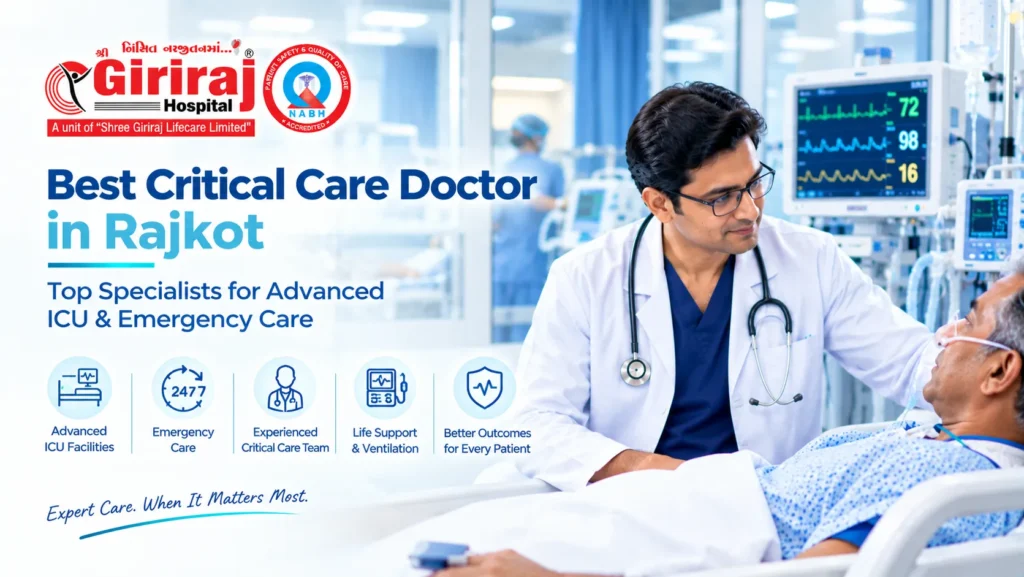
At Giriraj Hospital, our Critical Care department is led by an experienced, multi-doctor team providing round-the-clock intensive care for the most seriously ill patients. Dr. Mayank Thakker, our Medical Director, holds an MD in Internal Medicine and is a Critical Care Specialist with 22 years of experience, including clinical training at Nanavati Hospital and P.D. Hinduja National Hospital in Mumbai – two of India’s most respected tertiary care institutions. He’s supported by Dr. Vishal Sadatia (MD Medicine, IDCCM, Consultant Physician & Critical Care Specialist) and Dr. Devang Ambaliya (MBBS, DA, IDCCM, FCCS Critical Care Medicine), giving our ICU dedicated, specifically-qualified critical care coverage rather than relying on general physicians alone.
When families search for the best critical care doctor in Rajkot, here’s what our Critical Care team offers:
- Dedicated, IDCCM/FCCS-Qualified Intensivists – specifically trained critical care specialists, not general physicians covering the ICU as a secondary responsibility
- 24/7 Critical Care Coverage – round-the-clock monitoring and rapid response capability
- Continuous Heart Monitoring, Ventilator Support & Oxygen Therapy – comprehensive life-support infrastructure for the most seriously ill patients
- Multidisciplinary Coordination – close integration with our Cardiology, Neurology, Cardiothoracic & Vascular Surgery, and Nephrology departments for complex, overlapping cases
- Experienced Medical Leadership – Dr. Thakker’s 22 years of experience, including training at major Mumbai tertiary centres, anchors a genuinely experienced critical care team
- Cashless Insurance & Ayushman Bharat (PM-JAY) Support – assistance with documentation and pre-authorisation for eligible patients
If you’re researching the best critical care doctor in Rajkot, whether for advance planning or because a loved one needs care right now, our Critical Care team and emergency services are available around the clock. Contact us or visit our emergency services page for immediate support.
Emergency vs. Planned: Two Different Search Scenarios
It’s worth acknowledging directly that this guide serves two genuinely different readers. If you’re researching the best critical care doctor in Rajkot calmly, perhaps because a family member has a chronic condition that carries some risk of future hospitalisation, you have the luxury of time to research thoroughly, visit facilities, and ask detailed questions well in advance.
If you’re reading this in the middle of an actual emergency, the most useful thing this guide can offer is a fast, practical filter: get to the nearest hospital with 24/7 critical care and emergency capability immediately, and use the quality markers in this guide – qualifications, staffing, communication – to evaluate and advocate for care once your loved one is admitted, rather than spending precious time comparing multiple hospitals from scratch. Both approaches are legitimate, and this guide is structured to serve either one.
What Patients and Families Often Get Wrong When Searching Online
A quick search for the best critical care doctor in Rajkot often surfaces star ratings and review counts as the primary quality signal, but these numbers deserve particular scrutiny in a critical care context specifically. Reviews for ICU care are relatively rare compared to routine outpatient visits, often reflect the emotional aftermath of a genuinely traumatic family experience rather than an objective clinical assessment, and rarely capture the specific quality markers – staffing ratios, qualification levels, coordination with other specialities – that matter most.
A more reliable approach combines several signals discussed throughout this guide: verified critical care qualifications, 24/7 physical staffing, multidisciplinary coordination, and how clearly a team communicates, rather than relying on review counts alone when evaluating the best critical care doctor in Rajkot for your specific situation. Treat online reviews as one input among several, not the deciding factor for a decision this significant.
The Role of Technology in Modern Critical Care
Critical care medicine has advanced considerably over the past two decades, and understanding these changes helps set realistic expectations when evaluating the best critical care doctor in Rajkot and the infrastructure supporting them today. Modern ICU monitoring systems now track multiple vital parameters continuously and can alert staff to subtle deterioration far earlier than manual checks alone would catch.
Advances in ventilator technology, dialysis capability for acute kidney support, and rapid bedside diagnostic testing have all meaningfully improved outcomes for critically ill patients compared to a generation ago. This progress is worth keeping in mind if your mental picture of intensive care is shaped by an older family experience – today’s critical care, delivered by a well-equipped team, is considerably more advanced than it was even a decade ago.
Common Conditions Managed in Critical Care
To give a fuller picture of what the best critical care doctor in Rajkot actually manages, here’s a closer look at common ICU admissions:
Severe Sepsis and Septic Shock – a life-threatening response to infection requiring rapid antibiotic treatment, fluid management, and often circulatory support, where delays in treatment directly affect survival.
Acute Respiratory Distress Syndrome (ARDS) – severe lung inflammation requiring ventilator support, sometimes for extended periods, managed closely by the critical care team alongside pulmonology.
Post-Cardiac Surgery Recovery – patients recovering from major heart surgery require intensive monitoring for rhythm disturbances, bleeding, and circulatory stability during the critical early recovery period.
Major Trauma – accident victims often require simultaneous management of multiple injuries, close monitoring for internal bleeding or organ damage, and coordination with surgical teams.
Acute Stroke – time-critical management in the first hours after a stroke, often requiring close coordination between critical care and neurology to protect brain function.
Diabetic Emergencies – severe blood sugar imbalances requiring careful, continuous monitoring and correction, particularly in patients with additional complications.
When Does a Patient Need Critical Care?
Understanding when critical care becomes necessary helps families recognise the signs early rather than delaying. A patient generally requires ICU-level care and the best critical care doctor in Rajkot available when they show signs indicating a genuinely unstable, life-threatening condition rather than a routine hospital stay:
- Severe difficulty breathing or dangerously low oxygen levels
- Signs of shock – dangerously low blood pressure, rapid heart rate, confusion, or cold, clammy skin
- Loss of consciousness or a significant, sudden change in mental status
- Severe, uncontrolled bleeding
- Signs of a major stroke – facial drooping, slurred speech, or sudden weakness on one side
- Complications following major surgery, such as unstable vital signs or excessive bleeding
- Multi-organ involvement, such as combined kidney and respiratory distress
If you or someone near you shows these signs, seeking emergency care immediately is more urgent than researching a specific doctor – get to the nearest hospital with 24/7 emergency and critical care capability first, then apply the evaluation criteria in this guide once care has begun.
How Family Involvement Supports Better Outcomes
While the clinical decisions in critical care rest with the treating team, family involvement genuinely matters throughout an ICU admission. Providing accurate medical history, medication lists, and details about pre-existing conditions helps the best critical care doctor in Rajkot treating your family member make faster, more informed decisions, particularly if the patient themselves can’t communicate.
Beyond the practical information, being present and engaged – asking questions, requesting updates, and staying informed about the treatment plan – helps ensure nothing falls through the cracks during what’s often a complex, multi-day process involving several specialists. A good critical care team welcomes this involvement rather than viewing it as an interruption to their work.
Questions to Ask When Evaluating Critical Care
Whether you’re researching in advance or making a decision under pressure, these questions help you evaluate the best critical care doctor in Rajkot for your specific situation:
- Is a dedicated intensivist physically present in the ICU, or is coverage primarily on-call?
- What specific critical care qualifications does the treating doctor hold?
- What’s the nurse-to-patient ratio in the ICU?
- How does the critical care team coordinate with other specialists for complex cases?
- How and how often will our family receive updates on the patient’s condition?
- What equipment and monitoring capability does the ICU have for this specific condition?
- Is cashless insurance or Ayushman Bharat (PM-JAY) support available?
A confident, well-organised critical care team will answer these questions clearly and without hesitation, even amid the urgency of an actual admission, and their willingness to engage with these specific questions is itself a strong signal when you’re trying to identify the best critical care doctor in Rajkot for your family’s situation.
Red Flags Worth Watching For
Just as certain markers indicate genuine quality, certain patterns are worth taking seriously when evaluating critical care:
- Vague or evasive answers about staffing, qualifications, or equipment
- Inconsistent or infrequent communication with family members
- No clear answer about coordination with other specialities for complex cases
- Long delays between emergency admission and critical care evaluation
- Lack of clarity around cost estimates or what’s included in ICU charges
None of these signs alone is necessarily disqualifying, but together, they’re genuinely worth weighing, particularly if you have any flexibility in choosing where a loved one receives care.
Second Opinions in Critical Care: When and How
For patients who are critically ill but stable enough for transfer, or for families with genuine flexibility in an urgent but not immediately life-threatening situation, seeking a second opinion on treatment approach is entirely reasonable, and can be a genuine part of confirming you’ve found the best critical care doctor in Rajkot for a loved one’s specific condition. A second opinion can confirm the current treatment plan, or occasionally surface additional considerations worth discussing with the primary critical care team.
That said, critical care is different from most other medical decisions in one important way: in a genuine, rapidly evolving emergency, delaying necessary treatment to seek a second opinion can itself carry real risk. The best critical care doctor in Rajkot for your situation will help you understand honestly whether your specific circumstances allow time for this kind of additional consultation, or whether immediate treatment is the safer path forward, and being guided by that honest assessment matters more than insisting on a second opinion regardless of urgency.
The Emotional Side of Critical Care
Beyond the clinical details, it’s worth acknowledging that having a loved one in intensive care is genuinely one of the most stressful experiences a family can face. The best critical care doctor in Rajkot isn’t only defined by clinical skill – genuine communication, patience with anxious family members, and honest, compassionate updates matter just as much during this period, and this human dimension is exactly what separates a merely competent ICU team from the best critical care doctor in Rajkot a family could hope to find during a genuine crisis.
Most well-run ICUs have structured update times and, ideally, staff trained to support families through this process, not just the patient. Don’t hesitate to ask for clearer explanations or more frequent updates if you need them – a good critical care team understands that supporting the family is part of supporting the patient.
It’s also worth recognising that critical illness affects families over an extended, unpredictable timeline, not just the initial admission. Extended ICU stays can stretch on for days or weeks, and the emotional toll of that uncertainty compounds over time. Many hospitals with strong critical care programmes have social workers or counsellors available specifically to support families through this, and it’s genuinely worth asking about this kind of support if you’re navigating an extended ICU stay with a loved one.
Life After the ICU: What Recovery Looks Like
Leaving the ICU isn’t the end of the recovery journey for most critically ill patients – it’s typically the beginning of a longer path back to full health. Patients who’ve spent extended time in intensive care often face genuine physical and sometimes psychological recovery, well beyond the point of being medically stable enough to leave critical care.
The best critical care doctor in Rajkot and their team will typically coordinate this transition carefully, working with physiotherapy, and relevant specialists to support continued recovery after ICU discharge. Understanding that this transition period matters just as much as the acute crisis itself helps families set realistic expectations for the weeks and months following a serious critical care admission.
Insurance and Cost Considerations for Critical Care
ICU care is resource-intensive, and cost is a genuine concern for most families, particularly given how unpredictable the length of a critical care stay can be. Most private health insurance policies cover ICU care when medically necessary, and the Ayushman Bharat (PM-JAY) scheme can cover eligible patients at empanelled hospitals for a range of critical conditions.
Because the exact cost of critical care depends heavily on the underlying condition, length of stay, and specific interventions required, a direct conversation with the hospital’s billing and insurance team is the most reliable way to understand what to expect financially, ideally as early in the admission process as possible.
Common Terms Explained: A Quick Glossary
If some of the terminology in this guide feels unfamiliar, here’s a plain-language glossary to keep handy:
- Intensivist – a doctor specifically trained and qualified to manage critically ill patients in the ICU
- IDCCM – Indian Diploma in Critical Care Medicine, a dedicated critical care qualification
- FCCS – Fundamental Critical Care Support, an internationally recognised critical care certification
- Sepsis – a life-threatening response to infection requiring urgent treatment
- Ventilator – a machine that supports or takes over breathing for patients with respiratory failure
- ARDS – Acute Respiratory Distress Syndrome, severe lung inflammation often requiring ventilator support
- Multi-Organ Dysfunction – simultaneous impairment of several organ systems, a common feature of the most critical cases
Understanding this vocabulary makes conversations with a critical care team considerably easier during what’s often an overwhelming and time-pressured situation, whether you’re speaking with the best critical care doctor in Rajkot you found through advance research, or the on-duty team during an actual emergency admission.
Frequently Asked Questions About Critical Care in Rajkot
Who is the best critical care doctor in Rajkot?
Rather than a single definitive name, the best critical care doctor in Rajkot for your situation depends on their specific qualifications (ideally IDCCM, FCCS, or equivalent), the hospital’s 24/7 ICU coverage, and how well their team coordinates with other specialities for complex cases. At Giriraj Hospital, our Critical Care team is led by Dr. Mayank Thakker, with 22 years of experience including training at Nanavati Hospital and P.D. Hinduja National Hospital, Mumbai, supported by Dr. Vishal Sadatia and Dr. Devang Ambaliya.
What’s the difference between a critical care doctor and an emergency room doctor?
An emergency room doctor manages the immediate first response and stabilisation when a patient arrives at the hospital, while the best critical care doctor in Rajkot for an ongoing ICU admission takes over intensive, continuous management once a patient is admitted.
When does a patient need to be moved to the ICU?
Patients generally need care from the best critical care doctor in Rajkot available when they show signs of severe breathing difficulty, shock, loss of consciousness, uncontrolled bleeding, stroke symptoms, or complications following major surgery that require continuous, intensive monitoring.
What qualifications should a critical care doctor have?
Look for IDCCM (Indian Diploma in Critical Care Medicine), FCCS certification, or an MD in Internal Medicine with substantial dedicated critical care training and experience, rather than assuming any hospital physician is equally equipped for intensive care.
How much does ICU treatment cost in Rajkot?
Cost varies considerably based on the underlying condition, length of stay, and specific interventions required. Most private insurance and the Ayushman Bharat (PM-JAY) scheme cover ICU care when medically necessary; confirm specifics directly with the hospital’s insurance desk.
Can family members visit patients in the ICU?
Most ICUs regulate visiting hours to protect patient safety and support recovery, though policies vary by hospital. It’s worth asking directly about visiting policies and how the team keeps families updated between visits.
Is 24/7 critical care available in Rajkot?
Yes, several hospitals in Rajkot, including Giriraj Hospital, offer round-the-clock critical care and emergency capability, which is essential for time-sensitive conditions like severe trauma, stroke, or cardiac emergencies.
How is critical care different from a general hospital admission?
Critical care involves continuous, intensive monitoring and rapid intervention for patients whose condition is severe enough to threaten life or major organ function, delivered by specifically trained intensivists, unlike a standard hospital admission for a stable condition.
Can I choose which critical care doctor treats a family member in an emergency?
In a genuine emergency, treatment typically begins with whichever qualified intensivist is available and on duty, since time is critical. For non-emergency ICU admissions, or once a patient is stabilised, you generally have more flexibility to discuss the treating team and, if appropriate, seek input from a specific critical care doctor.
What should I do if I’m not satisfied with the communication from an ICU team?
Raise your concerns directly and specifically with the treating team or hospital administration. The best critical care doctor in Rajkot and their team should welcome this feedback and work to address it, since clear communication is a core part of quality critical care, not an optional extra.
How long do patients typically stay in the ICU?
Length of stay varies enormously depending on the underlying condition, ranging from a day or two for closer post-surgical monitoring to weeks for the most severe, complex cases. The treating critical care team will reassess readiness for transfer out of the ICU on an ongoing basis.
Final Thoughts
Finding the best critical care doctor in Rajkot isn’t about a single name or a star rating – it’s about understanding the qualifications, staffing, coordination, and communication that genuinely determine ICU quality, and knowing these criteria before you ever need them. Whether you’re planning ahead or facing an urgent situation right now, this understanding puts you in a considerably stronger position to advocate for the care a loved one needs.
If you or a family member needs critical care, the team at Giriraj Hospital, led by Dr. Mayank Thakker alongside Dr. Vishal Sadatia and Dr. Devang Ambaliya, is available around the clock. Contact us immediately for emergencies, or book a consultation to discuss ongoing care needs for yourself or a family member.
Whether you found this guide while calmly planning ahead, or while searching anxiously in the middle of an actual emergency, the same underlying truth applies: the best critical care doctor in Rajkot for your family isn’t defined by a single ranking or review score, but by verifiable qualifications, genuine coordination, and clear communication, all of which you’re now equipped to recognise and ask about directly.