


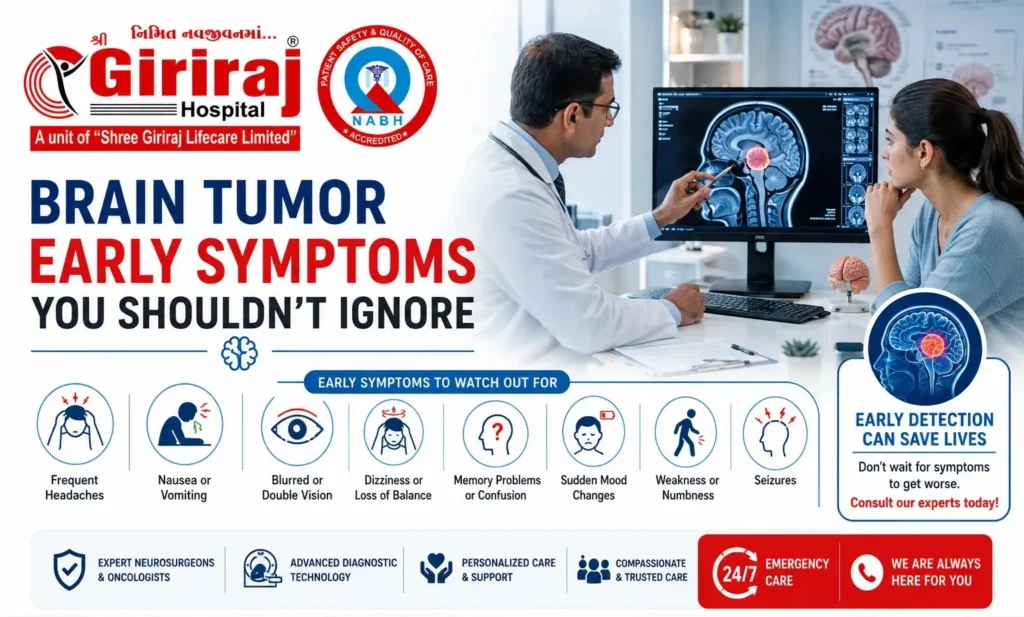
A headache that won’t quit. A seizure out of nowhere. A subtle personality shift the family notices before the person does. Recognising brain tumor early symptoms matters because these tumors are often found only once they’ve grown large enough to press on surrounding brain tissue. Central nervous system tumors account for roughly 2% of all cancers in India, with incidence rising as people age (Indian Council of Medical Research, 2024), and globally there were an estimated 321,000 new brain and CNS cancer cases in 2022 (GLOBOCAN, IARC, 2022).
At Shree Giriraj Hospital in Rajkot, our Neurosurgery & Spine Surgery department evaluates and treats brain tumors directly, without needing to refer patients out of the city for surgical care. This article explains what a brain tumor is, the early and advanced symptoms to watch for, common types, how diagnosis works, treatment options available locally, and what recovery and cost look like, including Ayushman Card coverage.
What Is a Brain Tumor?
A brain tumor is an abnormal growth of cells in or near the brain. Some tumors, called benign, grow slowly and don’t spread to other parts of the body. Others, called malignant, grow more aggressively and can invade nearby tissue. A tumor can also start elsewhere in the body and spread to the brain, which doctors call a secondary or metastatic brain tumor.
This distinction matters because it shapes both symptoms and treatment. A small tumor in an area of the brain that controls a lot of function can cause symptoms quickly, while a tumor in a quieter area can grow for a long time before anyone notices anything unusual.
| Think of It Like This Picture the brain as a busy office building where every floor has a specific job. A tumor is like construction work starting on one floor. If it’s on a floor handling something critical, like speech or movement, people notice disruption almost immediately. If it’s on a quieter, less-trafficked floor, the work can go on for a while before anyone outside really notices something has changed. |
Because headache is one of the most common early symptoms, and also one of the easiest to dismiss, our guide on migraine vs normal headache can help you understand when a headache pattern is worth a closer look. Ongoing evaluation of brain-related symptoms is handled by our Neurology & Interventional Neurology department here in Rajkot.
Warning Signs You Should Never Ignore
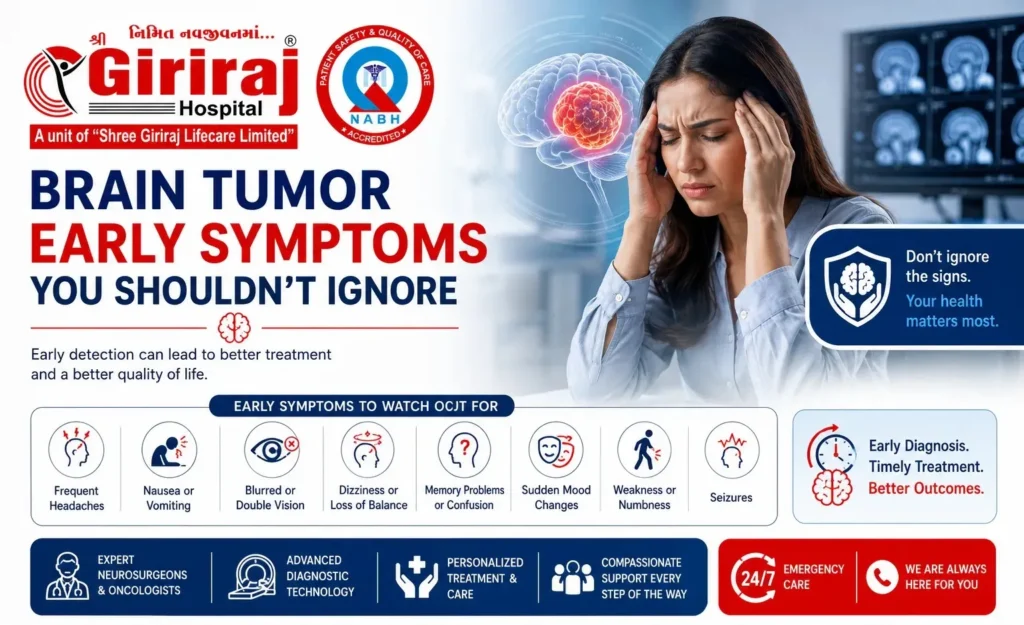
Early Warning Signs
- A headache pattern that’s new for you, often worse in the morning and easing through the day
- Headaches that don’t respond well to regular painkillers
- Nausea, especially right after waking, without an obvious cause
- Subtle memory slips, trouble concentrating, or losing a word mid-sentence
- Blurry or double vision that comes and goes
- Mild weakness, numbness, or coordination changes on one side of the body
- Noticeable mood or personality changes that family members pick up on first
- A first-time seizure in adulthood, even a brief one
Advanced or Serious Warning Signs
- Sudden, severe headache unlike anything felt before
- Sudden one-sided weakness or numbness
- Sudden vision loss or significant double vision
- Repeated vomiting alongside a worsening headache
- Confusion or difficulty staying alert
- Seizures that don’t stop or occur repeatedly
- Sudden difficulty speaking or understanding speech
| When to Seek Emergency Care Immediately A sudden, severe headache, sudden one-sided weakness, sudden vision loss, or a seizure that doesn’t stop are emergencies. Get to the nearest hospital’s emergency department right away rather than waiting for a scheduled appointment. |
Our Ambulance Services are equipped to respond quickly across Rajkot for exactly these situations, while our Neurosurgery & Spine Surgery team is on standby to assess urgent neurological symptoms the moment a patient arrives.
Causes and Risk Factors
Common Causes
Unclear Origin: Most brain tumors have no identifiable single cause. Cells in the brain undergo changes that lead to uncontrolled growth, but why this happens in any individual case is usually not fully understood.
Genetic Syndromes: Rare inherited conditions such as neurofibromatosis and Li-Fraumeni syndrome can raise the likelihood of developing certain brain tumors, though these account for only a small fraction of cases.
Prior Radiation Exposure: High-dose radiation to the head, including from previous cancer treatment, is a recognised risk factor for developing a brain tumor later in life.
Age: Brain tumors can occur at any age, but risk generally rises as people get older, alongside a smaller peak in childhood for certain tumor types.
Spread From Other Cancers: A history of cancer elsewhere in the body, particularly lung, breast, or skin cancer, raises the chance of a secondary brain tumor developing later.
Who Is at Risk
- People with a family history of brain tumors, though most cases are not hereditary
- Anyone with a known genetic syndrome linked to brain tumors
- People with a history of significant radiation exposure to the head
- Adults over 60, though brain tumors occur across all age groups
- People with a personal history of cancer elsewhere in the body
Having one or more of these risk factors doesn’t mean a brain tumor is inevitable, and many people diagnosed with one have no identifiable risk factor at all. For patients managing other chronic conditions, our Internal Medicine department can help coordinate overall care alongside a neurosurgical evaluation.
Types of Brain Tumors
Brain tumors are grouped by where they start and how they behave. Knowing the type helps guide what treatment looks like.
| Type | Where It Starts | General Behaviour |
|---|---|---|
| Glioma | Glial cells (supporting brain tissue) | Ranges from slow-growing to aggressive; glioblastoma is the most aggressive form |
| Meningioma | Meninges (membranes covering the brain) | Usually benign and slow-growing, though some are atypical |
| Pituitary Adenoma | Pituitary gland | Generally benign; can affect hormone levels |
| Schwannoma | Schwann cells insulating nerves | Typically benign; acoustic neuroma affects hearing and balance nerves |
| Metastatic (Secondary) | Spreads from cancer elsewhere in the body | Behaviour depends on the original cancer type |
Why the Type Matters
A benign meningioma may sometimes be safely monitored, while a fast-growing glioma usually needs prompt surgical evaluation. The tumor’s type, grade, and location together determine the urgency and shape of the treatment plan.
| Clinical Insight A tumor being “benign” doesn’t automatically mean it’s harmless. Even a slow-growing, non-cancerous tumor can cause serious problems if it presses on a critical area of the brain, which is why location matters as much as tumor type when planning treatment. |
Surgical evaluation and treatment planning for all these tumor types, including complex cranial surgery, is handled by our Neurosurgery & Spine Surgery department.
How Is a Brain Tumor Diagnosed?
Blood Tests
- Complete Blood Count (CBC): checks overall health before any procedure
- Hormone Panels: checked when a pituitary tumor is suspected, since these can affect hormone levels
- Tumor Marker Tests: used selectively, more often to help identify whether a tumor may have spread from elsewhere
Imaging Tests
- MRI Brain (with contrast): the primary imaging test, giving detailed images of brain tissue and any abnormal growth
- CT Scan: often used first in an emergency, or when MRI isn’t immediately available
- PET Scan: sometimes used to help distinguish active tumor tissue from surrounding healthy tissue
Other Diagnostic Procedures
- Neurological Examination: checks vision, hearing, balance, reflexes, and coordination to identify which brain areas may be affected
- Biopsy: a tissue sample taken to confirm the exact tumor type and grade, which shapes the treatment plan
- Lumbar Puncture: occasionally used to check spinal fluid, particularly if spread to the central nervous system is a concern
A scan alone rarely tells the whole story. Results are interpreted together with the neurological exam and, where needed, a biopsy, before any treatment decision is made. Our Health Check-up Plans, including the Non-Invasive Cardiology & Radiology Package, can help identify unrelated health issues that matter for overall treatment planning.
Our Oncology and Oncology Surgery department coordinates staging and treatment planning once a diagnosis is confirmed, working alongside neurosurgery from the outset.
Treatment Options for Brain Tumors
Treatment depends on the tumor’s type, grade, location, and the patient’s overall health. Many patients need a combination of approaches rather than just one.
Non-Surgical / Medical Management
For tumors that don’t need immediate surgery, or as part of a broader treatment plan, medication and close monitoring may be used. Chemotherapy and ongoing medical cancer management are provided through our Oncology and Oncology Surgery department.
Surgical / Procedural Treatment
For many brain tumors, surgical removal offers the best chance at controlling the disease. Dr. Sagar Ghodasara, our DNB-qualified neurosurgeon with endovascular training from Zydus Hospital, Ahmedabad, performs craniotomy for brain tumor resection, including glioma, meningioma, and pituitary tumor surgery, using an operative microscope for precision. Learn more on our Best Neurosurgeon in Rajkot page.
Advanced or Emerging Treatments
Post-operative care for brain tumor surgery takes place in our Neuro ICU, and for patients who need it, our multidisciplinary team coordinates with medical oncology for chemotherapy and, when radiation therapy is required, helps arrange that referral smoothly through our Second Opinion & Teleconsultation service, since radiation oncology is coordinated rather than delivered on-site.
Brain surgery is understandably a major financial concern for most families. Eligible neurosurgical procedures, including certain brain tumor surgeries, are covered under the Ayushman Bharat PM-JAY scheme; our detailed PM-JAY guide explains exactly how the cashless process works.
Brain Tumor Surgery – What to Expect, Step by Step
For patients whose treatment plan includes surgery, knowing the general sequence in advance can ease some of the uncertainty.
Preparing for Surgery
- Pre-operative imaging maps the tumor’s exact location and its proximity to critical brain structures
- Blood tests and a general health assessment confirm you’re fit for anaesthesia
- The surgical team explains the planned approach, expected duration, and possible risks in detail
During the Procedure
- You are given general anaesthesia, and the surgical team positions you precisely based on the tumor’s location.
- A craniotomy is performed, temporarily opening a section of the skull to access the tumor.
- Using an operative microscope for precision, the neurosurgeon removes as much of the tumor as safely possible, typically over several hours depending on complexity.
- The skull section is secured back in place, and the incision is closed carefully.
Immediately After – Neuro ICU
Patients are moved directly to our Neuro ICU for close monitoring, typically for the first 24 to 48 hours, before shifting to a general recovery ward as their condition stabilises.
Recovery timelines vary, but many patients are able to begin gentle mobilisation within a day or two under supervision, with our ICCU providing continuous monitoring for as long as needed. Please be reassured that the same surgical and nursing team follows your case from admission through discharge, not a rotating handoff between departments.
Recovery and Life After Brain Tumor Treatment
Week 1
Do follow all positioning and activity restrictions closely during this period, since the surgical site needs time to heal. Don’t skip prescribed anti-seizure or anti-inflammatory medication, even if you feel well.
Weeks 2 to 4
This period typically involves the first follow-up scans to check healing and confirm the extent of tumor removal, along with a gradual return to light daily activity as advised.
Month 2 to 3
Many patients begin physiotherapy or occupational therapy during this window if the tumor or surgery affected movement, speech, or coordination, with steady, individualised progress tracked at each follow-up.
Long-Term: Follow-Up and Monitoring
Long-term care includes regular follow-up scans to watch for any regrowth, ongoing management of any related symptoms, and ongoing coordination with oncology if further treatment is needed.
| A Patient’s Story One of our patients, a 47-year-old shopkeeper from Rajkot, had been dismissing months of morning headaches as stress until a first-time seizure brought him to our emergency department. An MRI confirmed a meningioma, and he underwent craniotomy with our neurosurgery team. Within three months of physiotherapy, he had returned to work full-time. Every case is different, but his experience shows why persistent, unusual headaches are worth a proper evaluation. |
Our Physiotherapy Services team designs a personalised rehabilitation plan for every patient as part of our broader patient care approach.
Our guide on cancer screening tests everyone should know is worth reading for broader context on preventive health after any cancer-related diagnosis.
Cost and Insurance / Ayushman Card Coverage
The cost of brain tumor treatment in India varies widely, from around Rs 1.5 lakh for more straightforward surgical procedures to Rs 5 lakh or more for complex cases, depending on tumor type, surgical complexity, and length of ICU stay (industry cost ranges, 2026). We do not publish fixed prices here, since every treatment plan is different; our billing desk can provide a written estimate once your specific case is assessed.
Factors that affect total cost include the complexity of the surgery, the length of Neuro ICU stay, whether additional chemotherapy is needed, and the number of follow-up scans required.
Is this treatment covered under PM-JAY? Yes, for eligible procedures. Eligible neurosurgical procedures, including certain brain tumor surgeries, are covered under the Ayushman Bharat PM-JAY scheme for eligible families. Once eligibility is confirmed through the Ayushman card, the hospital coordinates directly with the scheme so covered treatment proceeds on a cashless basis.
Our on-site Ayushman Mitra desk assists families with the entire verification and approval process, and our cashless health insurance facility covers 37+ insurance companies and TPAs for eligible neurosurgical care.
For a full walkthrough of eligibility and the cashless process, read our Ayushman Bharat Health Card / PM-JAY guide. If you would like to discuss your specific situation, speak to our team and we will guide you through the next steps.
Do’s and Don’ts If You Notice Symptoms
| Do This | Don’t Do This |
|---|---|
| Keep a simple diary noting when headaches occur and how long they last | Don’t dismiss a genuinely new or unusual headache pattern as “just stress” |
| See a doctor promptly after a first-time seizure, even a brief one | Don’t wait to see if a first seizure happens again before seeking care |
| Mention subtle memory or personality changes a family member has noticed | Don’t assume mood or memory changes are simply ageing or work stress |
| Get vision changes checked by an eye doctor or neurologist | Don’t ignore blurry or double vision that keeps recurring |
| Follow through on a recommended MRI if a doctor suggests one | Don’t delay imaging out of fear of what it might show |
| Ask your doctor to explain scan results in plain language | Don’t try to self-diagnose from online symptom searches alone |
| Bring a family member to appointments to help recall details | Don’t attend a first neurology consultation without notes on your symptoms |
| Ask about cost and PM-JAY coverage early in the process | Don’t delay care due to assumed cost without checking first |
Routine health check-ups won’t screen for brain tumors specifically, but they help rule out other causes of similar symptoms, like high blood pressure or metabolic issues, that are far more common than a tumor.
Common Myths About Brain Tumors
| Myth | Fact |
|---|---|
| Most headaches are a sign of a brain tumor | The overwhelming majority of headaches have far more common causes; brain tumor headaches are typically part of a broader, persistent pattern |
| A brain tumor is always fatal | Many brain tumors are benign, and even some malignant ones respond well to treatment, especially when caught early |
| Only older adults get brain tumors | Brain tumors occur across all age groups, including children and younger adults |
| Mobile phones cause brain tumors | Major health bodies, including WHO, have found no consistent evidence linking mobile phone use to brain tumor risk |
| If a scan is clear, ongoing symptoms can be ignored | Persistent symptoms sometimes warrant a repeat or more detailed scan, especially if they’re worsening |
| Brain surgery always causes permanent disability | Many patients recover well after brain tumor surgery, particularly with prompt treatment and structured rehabilitation |
| Personality changes are always psychological, not medical | Personality and mood changes can have a genuine neurological cause and deserve medical evaluation, not just psychological assessment |
| For proper brain tumor treatment you need to travel to a big city | Shree Giriraj Hospital provides this care to the same standard as top hospitals in larger cities, right here in Rajkot |
Why Choose Shree Giriraj Hospital for Brain Tumor Care?
Choosing where to get evaluated and treated for a possible brain tumor is one of the most consequential decisions a family can make. You can read more about our hospital here, but the points below focus on what matters most for brain tumor care specifically.
A Named, Verified Neurosurgeon With Endovascular Training
Dr. Sagar Ghodasara holds MS and DNB in Neurosurgery, with two years of exclusive endovascular neurosurgery training from Zydus Hospital, Ahmedabad. His surgical practice covers craniotomy for brain tumor resection, including glioma, meningioma, and pituitary tumors, through our Neurosurgery & Spine Surgery department.
Coordinated Oncology Support
Our Oncology and Oncology Surgery department coordinates diagnosis, staging, and chemotherapy alongside neurosurgery, so treatment planning happens as one connected process rather than separate referrals.
Neuro ICU and Critical Care Backup
Post-operative recovery is supported by our Critical Care team and ICCU, providing continuous monitoring for as long as each patient needs it after surgery.
Two Accessible Campus Locations
Our Rajkot Main and Kuvadava campuses both support neurosurgical follow-up, so patients across the city have genuinely convenient access to ongoing care rather than a single distant location.
Transparent, Cashless Ayushman Bharat / PM-JAY Coverage
Eligible neurosurgical procedures are covered under the PM-JAY scheme, and our Ayushman Mitra desk manages verification and cashless processing directly. Read more in our PM-JAY guide.
You do not have to face this alone. Our experienced doctors are ready to guide your family through diagnosis, treatment, and recovery. If you’d like a broader view of what to look for in a hospital, our guide on the best hospital in Rajkot covers the key factors worth considering.
Book a consultation with our neurosurgery team today to get a clear picture of your symptoms and next steps.
Frequently Asked Questions
What are the first signs of a brain tumor?
The first signs are often subtle: a new headache pattern, mild memory or concentration issues, or slight vision changes. These early symptoms are frequently mistaken for stress, ageing, or other everyday causes, which is why persistence and pattern matter more than any single symptom.
Can headaches be a sign of a brain tumor?
Yes, but most headaches are not caused by a brain tumor. Brain tumor headaches tend to be worse in the morning, may wake you from sleep, worsen with coughing or bending, and often don’t respond well to regular painkillers. Our guide on migraine vs headache differences can help you understand more common headache patterns.
Is brain tumor surgery available in Rajkot?
Yes. Our Neurosurgery & Spine Surgery department, led by Dr. Sagar Ghodasara, performs craniotomy for brain tumor resection directly in Rajkot, without requiring referral to another city for surgical care.
Is brain tumor treatment covered under Ayushman Bharat?
Eligible neurosurgical procedures, including certain brain tumor surgeries, are covered under the PM-JAY scheme for eligible families. See our full Ayushman Bharat / PM-JAY guide for the step-by-step process.
Does Shree Giriraj Hospital have the facilities to treat brain tumors?
Yes. Our hospital offers neurosurgical evaluation and surgery, a Neuro ICU for post-operative recovery, and coordinated Oncology support for chemotherapy and treatment planning.
How do I book an appointment for brain tumor-related symptoms?
You can book an appointment online for a neurosurgery consultation, or come directly to our emergency department if you’re experiencing sudden, severe symptoms right now.
Are all brain tumors cancerous?
No. Many brain tumors are benign, meaning they don’t spread to other parts of the body, though they can still cause problems by pressing on nearby brain tissue. Malignant tumors grow more aggressively and may spread.
How long does recovery take after brain tumor surgery?
Recovery varies significantly based on tumor size, location, and the extent of surgery. Many patients spend the first day or two in Neuro ICU, with gradual mobilisation over the following weeks and continued recovery over two to three months, depending on individual circumstances.
Can a brain tumor be found during a routine check-up?
Not typically through standard blood tests, but a thorough neurological exam during a check-up can sometimes catch subtle signs worth investigating further, especially if a patient mentions symptoms they might otherwise dismiss.
What is the difference between a benign and malignant brain tumor?
A benign tumor grows slowly and doesn’t spread to other body parts, though it can still cause symptoms by pressing on brain tissue. A malignant tumor grows more aggressively and may invade surrounding tissue, generally requiring a more urgent and comprehensive treatment approach.
Conclusion and Next Steps
Recognising brain tumor early symptoms and acting on a persistent, unusual pattern, rather than waiting it out, genuinely changes outcomes. Most symptoms won’t turn out to be a brain tumor, but the only way to know is a proper evaluation.
If you or a loved one has noticed any of these warning signs, don’t wait. Contact our Neurosurgery & Spine Surgery department in Rajkot for an evaluation, or book an appointment for a consultation.
Get in touch with our team with any questions about symptoms, cost, or PM-JAY coverage. Our staff are ready to support your family at every step of the journey.
Read More:
- Stroke Symptoms Everyone Should Know
- Migraine vs Normal Headache
- Cancer Screening Tests Everyone Should Know