




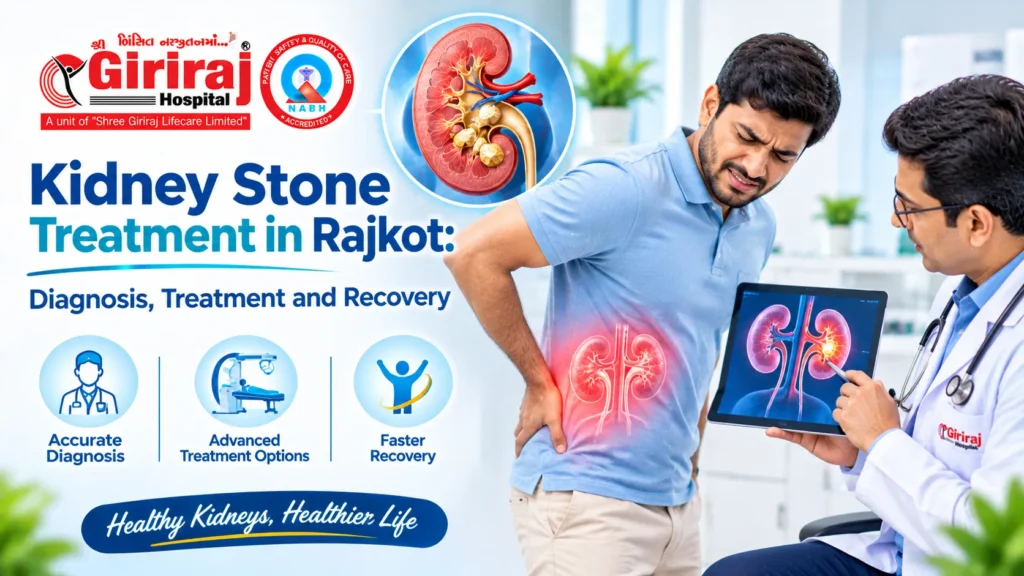
It usually begins at night. A dull ache in your back turns into a sharp, stabbing pain that comes in waves. You cannot sit, you cannot lie still, and you may start to vomit. Some people call it the worst pain they have ever felt.
If this sounds familiar, you may already be searching for kidney stone treatment in Rajkot. You want to know three things fast: is this really a stone, does it need an operation, and where can I get safe, honest care?
The good news is that kidney stones are very treatable. Many small stones pass by themselves. Larger ones can be removed through the natural urinary passage with no cut at all. The challenge is that the choices can feel confusing, with terms like ESWL, RIRS, PCNL and laser used by everyone.
This guide explains them in plain words. You will learn how stones are diagnosed, how doctors choose between treatments, what happens on the day, how recovery works and how to stop the next stone. You will also see how to choose kidney stone treatment in Rajkot with confidence, and what the Urology and Andrology department at Shree Giriraj Multispeciality Hospital offers.
This article follows widely accepted urology guidance and is reviewed by the hospital’s clinical team. It is for education only and does not replace an examination by a doctor.
Quick Takeaways Before You Read On
- Many stones smaller than about 5 mm pass on their own with water, pain relief and monitoring.
- Kidney stone treatment in Rajkot is usually done without a cut. ESWL and RIRS use no incision. PCNL uses a very small one for large stones.
- The right procedure depends on the stone’s size, position, hardness and your health. There is no single best option for everyone.
- Fever with stone pain is an emergency. An infected, blocked kidney needs urgent drainage.
- Stones come back in many people. Prevention, based on your stone type, is part of good kidney stone treatment in Rajkot.
- Always ask for a written estimate, and ask to have the stone analysed after it is removed.
What Is a Kidney Stone?
A kidney stone is a hard lump made of minerals and salts that crystallise out of urine. It can stay inside the kidney or travel down the thin tube called the ureter that carries urine to the bladder. Doctors call it nephrolithiasis or urolithiasis.
Stones can be as tiny as a grain of sand or as big as a golf ball. You can have one stone or many, in one kidney or both. A stone that causes no trouble may be found by chance on a scan done for another reason.
How Stones Form
Think of urine as a glass of water with sugar dissolved in it. If you add too much sugar, or let the water evaporate, crystals begin to form at the bottom. In the same way, when urine becomes too concentrated, minerals clump together and slowly grow into a stone.
Low water intake is the single biggest cause. Diet, family history, infections and certain medical conditions add to the risk. This is why prevention always starts with water.
Types of Kidney Stones
The type of stone affects both treatment and prevention.
| Stone type | How it forms | Prevention focus |
|---|---|---|
| Calcium oxalate | The most common type. Linked to low fluid intake and diet. | Water, moderate salt, careful oxalate intake |
| Calcium phosphate | Often linked to alkaline urine or metabolic causes | Water, medical review |
| Uric acid | Forms in very acidic urine. Linked to high animal protein, gout and diabetes | Water, less animal protein, medicines that alkalinise urine |
| Struvite (infection stone) | Linked to repeated urinary infections. Can grow large quickly. | Treat infection, complete stone removal |
| Cystine | Rare. An inherited condition. | Specialist long-term care |
Why Stone Size and Position Matter
Stones are measured in millimetres. Size and position decide whether a stone is likely to pass, and which treatment fits.
- Stones below about 5 mm often pass on their own, usually within a few weeks.
- Stones between 5 and 10 mm may pass, but are less likely to, and often need help.
- Stones above 10 mm rarely pass and usually need treatment.
- A stone stuck in the ureter can block urine and swell the kidney. A stone sitting quietly in the kidney may cause no symptoms.
Your urologist will use the scan to judge both size and position before recommending kidney stone treatment in Rajkot or anywhere else.
Kidney Stone Symptoms: What Does It Feel Like?
Many kidney stones cause no symptoms until they move. When they do, the pain has a classic pattern. Our broader guide on kidney stone symptoms and treatment covers symptoms in detail, and the key points are below.
Renal Colic (the Classic Stone Pain)
Renal colic is the sharp pain caused by a stone blocking the flow of urine. It usually starts suddenly in the side or back, just below the ribs. It comes in waves, builds up and eases, and then returns.
The pain may travel toward the lower abdomen, groin or inner thigh as the stone moves down. People often feel restless and cannot find a comfortable position, unlike those with other abdominal problems who prefer to lie still.
Other Symptoms
- Blood in the urine, which may look pink, red or brown
- Burning or pain while passing urine
- A frequent urge to pass urine, often only small amounts
- Nausea and vomiting
- Cloudy or foul-smelling urine
- Pain in the lower abdomen or at the tip of the penis or the vulva as a stone nears the bladder
- Fever and chills, if there is also an infection
Emergency Warning Signs
Go to an emergency department without delay if you have any of these:
- Fever or shivering with stone pain
- Severe pain that does not settle with medicine
- Repeated vomiting so that you cannot keep fluids down
- Passing very little or no urine
- Stone pain if you have a single kidney, kidney disease or are pregnant
- Confusion, a very fast heartbeat or feeling faint
A stone that blocks urine and an infection together is dangerous and can spread to the blood. This needs urgent drainage first. Do not wait at home. Call an ambulance. Shree Giriraj runs 24×7 emergency services in Rajkot and ambulance services. Our emergency hospital guide explains the first minutes. Emergency kidney stone treatment in Rajkot should never wait for an appointment.
Causes and Risk Factors
Stones form when urine contains too much of certain minerals and too little water to keep them dissolved. Several factors work together.
- Low fluid intake. The most common cause worldwide.
- Diet. Too much salt, animal protein or oxalate-rich foods in people who are prone to stones.
- Family history. Stones tend to run in families.
- Obesity, diabetes and metabolic syndrome. These raise the risk of uric acid and calcium stones.
- Repeated urinary infections. These can form infection stones.
- Medical conditions. Gout, overactive parathyroid glands and some bowel diseases.
- Some medicines and supplements. For example, excess vitamin C or calcium supplements in certain people.
Why Kidney Stones Are Common in Rajkot
Gujarat’s hot climate pushes up sweating and fluid loss, and many people drink too little during long working hours. Drivers, factory and workshop workers, shopkeepers, farm workers and office staff in air-conditioned rooms who forget to drink water are all at risk.
If you work long shifts or outdoors, tell your doctor. It affects both your risk and your prevention plan. This local picture is a reason why prevention advice is as important as kidney stone treatment in Rajkot itself.
Who Is at Higher Risk
- Adults aged 20 to 60, and men slightly more than women
- People who have had a stone before, or who have a family history
- People who drink less than about two litres of fluid a day
- People with diabetes, obesity or gout. See our guide on diabetes complications and treatment
- People with fatty liver disease or metabolic syndrome
- People who lose weight very fast, including after bariatric surgery
When to See a Doctor for Kidney Stone Treatment in Rajkot
Do not wait for the pain to become unbearable. See a doctor the same day if you have back or side pain with blood in the urine, burning urine or nausea. See a doctor at once if there is fever.
Book a visit within a few days if you have any of these:
- Recurring pain in the side or back, even if it goes away
- Blood in the urine, even once
- A stone found by chance on a scan or ultrasound
- A history of stones, even if you feel well now
- Repeated urinary infections
A stone found by chance should not be ignored. A silent stone can move later, cause a sudden blockage or slowly harm the kidney. Early advice on kidney stone treatment in Rajkot can help you plan calmly, instead of facing an emergency.
You can start with a urologist, who treats stones, or a nephrologist, who looks at the kidney’s function and the causes of stone formation. Our guides to the best urologist in Rajkot for kidney problems and the best nephrologist in Rajkot explain the difference.
Not all abdominal pain is a stone. Gallstones can also cause right-sided pain. Our guide on gallbladder stone surgery in Rajkot explains how to tell them apart.
How Kidney Stones Are Diagnosed
Good treatment starts with the right diagnosis. Doctors confirm the stone, measure it, check that the kidney is safe and look for infection. This step is the foundation of safe kidney stone treatment in Rajkot.
History and Examination
Your doctor will ask about the pain, its pattern, any fever, urine changes, earlier stones, family history, diet, water intake and medicines. They will examine your abdomen and back and check your pulse and blood pressure.
Ultrasound and X-Ray
An ultrasound of the kidneys, ureters and bladder is a quick, radiation-free first test. It shows stones in the kidney and any swelling of the kidney caused by a blockage. It is also the preferred test in pregnancy and for children.
A plain X-ray of the abdomen (KUB) shows many, but not all, stones. Together, ultrasound and X-ray help track a stone over time.
CT KUB Scan
A low-dose non-contrast CT scan of the kidneys, ureters and bladder is the most accurate test for stones. It shows the exact size, number, position and even the likely hardness of a stone. That information helps the urologist choose between ESWL, RIRS and PCNL.
If you are in severe pain, a CT scan is often the fastest way to a clear answer. It is a routine step before kidney stone treatment in Rajkot hospitals plan a procedure.
Urine and Blood Tests
- Urine routine and culture. Looks for blood, crystals and infection. Infection must be treated before most procedures.
- Blood tests. Creatinine and urea show kidney function. A blood count and markers of infection are also checked.
- Calcium and uric acid. Checked if stones are repeated.
Many of these tests can be arranged through the hospital’s collection of laboratory samples service or as part of a health check-up plan.
Stone Analysis and Metabolic Tests
Once a stone is passed or removed, ask for it to be analysed. Knowing whether it is calcium oxalate, uric acid or another type changes the prevention advice.
For people who form stones again and again, a 24-hour urine test and blood tests for calcium, uric acid and parathyroid hormone can find hidden causes. A good plan for kidney stone treatment in Rajkot includes this step for repeat stone formers.
Kidney Stone Treatment in Rajkot: Options Explained
There is no single treatment for every stone. The best choice depends on the stone’s size, position and hardness, whether there is infection or a blockage, and your overall health. Here is how kidney stone treatment in Rajkot usually works, from the simplest option to the most advanced.
The urology team at Shree Giriraj Hospital offers watchful waiting, ESWL, ureteroscopy, RIRS and PCNL, so the treatment can be matched to the stone and not limited by what is available.
How Doctors Choose the Treatment
The table below gives a simplified picture. Your urologist will decide after seeing your scan, so please treat it as a guide and not as advice for your own case.
| Situation | Usual approach |
|---|---|
| Stone under about 5 mm, mild pain, no infection | Water, pain relief, close follow-up. Many pass on their own. |
| Ureteric stone of 5 to 10 mm that is not passing | A short trial of passage, then ureteroscopy (URS) or ESWL |
| Kidney stone up to about 2 cm | ESWL or RIRS, depending on hardness, position and body build |
| Lower-pole kidney stone above about 1 cm | RIRS is often preferred. ESWL is less effective here. |
| Stone above about 2 cm, very hard or branched (staghorn) | PCNL, sometimes combined with other methods |
| Stone and infection with a blocked kidney | Urgent drainage first (stent or nephrostomy tube). Stone treatment follows once infection is controlled. |
| Stone in a single kidney, or with falling kidney function | Urgent specialist care |
This careful matching is what separates good kidney stone treatment in Rajkot from a one-size-fits-all approach.
Pain Relief and Watchful Waiting
If the stone is small and you are otherwise well, your doctor may suggest letting it pass. This is called watchful waiting or conservative treatment. You are given pain relief, advice to drink plenty of water and regular scans to check progress.
Some doctors also prescribe a tablet that relaxes the ureter, called an alpha blocker, to help a lower ureteric stone pass. The benefit is modest and not for everyone, so it is your urologist’s call. Do not take painkillers or other tablets on your own, especially if you have kidney disease or ulcers.
Watchful waiting works only if there is no fever, no blockage that threatens the kidney and pain is controlled. If the stone does not move in a few weeks, or symptoms worsen, a procedure is the next step. This is a normal part of kidney stone treatment in Rajkot, and it is not a failure.
ESWL (Shock Wave Lithotripsy)
ESWL uses focused shock waves from a machine outside the body to break the stone into small pieces. These pieces then pass out in the urine over days to weeks. There is no cut and no scope. It is usually done as a day-care procedure and takes about 45 to 60 minutes.
ESWL works best for small to moderate stones, up to about 2 cm, in a good position and not too hard. Some people need more than one session. It is less effective for very hard stones, some lower-pole stones, and in people with a larger body build.
Possible effects include flank discomfort, blood in the urine for a day or two, bruising and pain as fragments pass. ESWL is not suitable in pregnancy, with uncontrolled infection or with untreated bleeding problems. Ask your urologist whether ESWL suits your stone before you choose it as your kidney stone treatment in Rajkot.
Ureteroscopy (URS) and Laser Lithotripsy
In ureteroscopy, the surgeon passes a thin telescope through the urethra and bladder into the ureter. There is no skin cut. When the stone is seen, a laser fibre is used to break it into tiny fragments, which are then removed or flushed out.
URS is the standard treatment for many ureteric stones, especially in the middle and lower ureter. It is done under spinal or general anaesthesia and usually takes 30 to 90 minutes. A small plastic tube called a DJ stent is often left in the ureter for a short time. Many patients go home the same day or after one night.
It is a reliable choice when a stone has been stuck for weeks or when ESWL is not suitable. For patients comparing kidney stone treatment in Rajkot, URS is among the most commonly performed procedures.
RIRS (Retrograde Intrarenal Surgery)
RIRS is like URS, but it uses a very thin, flexible scope that can bend and reach inside the kidney itself. The surgeon locates the stone, breaks it with a laser and removes the fragments. There is no cut on the body.
RIRS is excellent for kidney stones up to about 2 cm, including hard stones and stones in awkward positions such as the lower pole. It is often chosen when ESWL has failed or is unlikely to work, and it can be a good option for people with a higher body weight. A larger stone may need two stages.
Sterling Hospitals and other centres promote RIRS heavily, and for good reason, because it is a leading minimally invasive method. If you are searching for RIRS surgery in Rajkot, ask the surgeon about the scope and laser used, whether a stent is needed and the plan if the first stage is not enough.
PCNL (Percutaneous Nephrolithotomy)
PCNL is used for large or complex stones, typically above 2 cm, and for staghorn stones that fill the kidney. The surgeon makes a very small cut, about the size of a keyhole, in the back and creates a narrow channel straight into the kidney. A scope and laser or other energy then break and remove the stone.
This is a more involved operation under general anaesthesia. It usually needs a hospital stay of one to three days. A small drainage tube may be left in the kidney for a day or two. Bleeding is the main risk, and infection, injury to nearby organs and, rarely, the need for a blood transfusion are also possible.
PCNL offers a high chance of clearing big stones in one go. Smaller versions, often called mini-PCNL, can reduce bleeding in suitable cases. If you have a large stone, PCNL is the dependable form of kidney stone treatment in Rajkot, and our ICCU and critical care teams are available as backup if monitoring is needed.
DJ Stent and Emergency Drainage
A DJ stent is a soft, thin tube placed inside the ureter. It keeps the passage open so urine can drain from the kidney to the bladder. It is used after URS and RIRS, and in emergencies when a stone blocks the kidney.
When a stone blocks urine and there is fever or infection, the first step is to drain the kidney, either with a stent placed through the bladder or a nephrostomy tube placed through the back. The stone itself is treated later, once the infection is under control.
A stent can cause burning on passing urine, frequent urgency, flank discomfort and blood-tinged urine. These are common and settle once it is removed. Never forget a stent. A stent left for many months can become coated with crystals and cause infection or blockage. Note the date and the planned removal date, and keep that appointment.
Quick Tip
Ask for a card or written note stating the date your stent was placed and when it must be removed. Photograph it and set a phone reminder.
Laser Kidney Stone Surgery: What Is True and What Is Marketing?
Many advertisements promise “laser operation” or “no-cut laser surgery” for kidney stones. Here is what that really means, in plain words.
- What is true. The laser, usually a holmium laser, is a tool used inside the body during URS, RIRS and PCNL. It breaks the stone into small fragments or fine dust. These procedures can be done without any skin cut when the scope goes up the natural urinary passage.
- What is not true. The laser does not shine through the skin and dissolve stones from outside. A stone cannot be removed by laser without a scope reaching it.
- What ESWL is. ESWL uses shock waves, not a laser.
- What to ask. Which procedure will you actually do: URS, RIRS or PCNL? Which laser? Will I need a stent? How many stages?
No clinic can promise a stone-free result, no stent, no pain and no repeat procedure for every patient. Honest kidney stone treatment in Rajkot explains the procedure, the benefits and the limits before you agree.
ESWL vs RIRS vs PCNL at a Glance
| Point | ESWL | RIRS | PCNL |
|---|---|---|---|
| Cut on the skin | None | None (goes through the natural passage) | Small keyhole cut in the back |
| Anaesthesia | Sedation or pain relief | General or spinal | General |
| Best for | Small to moderate, softer stones in good positions | Kidney stones up to about 2 cm, including hard or lower-pole stones | Large, complex or staghorn stones above about 2 cm |
| Typical stay | Day-care | Day-care to one night | About 1 to 3 days |
| Stent or tube | Usually no stent | Usually a stent for a short time | A drainage tube for a day or two in many cases |
| Repeat sessions | Sometimes needed | Occasionally staged | Usually one, sometimes a second look |
| Usual return to routine | A few days | A few days to one week | About one to two weeks |
These are typical figures and not promises. Your surgeon will confirm what applies to you. A good centre for kidney stone treatment in Rajkot will explain why one option suits your stone better than the others.
Preparing for Kidney Stone Surgery
Good preparation makes the procedure safer and recovery smoother. Your team will give exact instructions, but most patients are told the following.
- Complete the tests. CT scan, urine culture, blood tests for kidney function and a blood count. An ECG or chest X-ray may be needed for older adults.
- Treat infection first. A urine infection must be treated before most stone surgeries, because operating on infected urine can cause serious illness.
- Review your medicines. Tell the team about blood thinners, aspirin, diabetes medicines and herbal products. Do not stop any medicine on your own.
- Control your sugar and blood pressure. This lowers risk.
- Fast as instructed. Usually six to eight hours without food if you will have anaesthesia.
- Arrange company. Ask a family member to stay with you and drive you home.
- Understand the stent. Ask whether you will have one, for how long and what symptoms are normal.
If you are a woman of child-bearing age, tell the team if you could be pregnant. Ask every question that worries you. Being prepared makes your kidney stone treatment in Rajkot calmer and safer.
On the Day: Procedure and Hospital Stay
Knowing what to expect lowers fear. Here is a simple walk-through.
- Admission and check. Your identity, consent and fasting are checked. A drip may be started.
- Anaesthesia. The anaesthesiology team gives spinal or general anaesthesia, or sedation for ESWL.
- The procedure. ESWL usually takes about 45 to 60 minutes. URS, RIRS and PCNL generally take one to two hours, depending on the stone.
- Recovery room. You are watched as the anaesthesia wears off, then shifted to your room or discharged, depending on the procedure.
- Hospital stay. ESWL and many URS or RIRS cases are day procedures or need a very short stay. PCNL typically needs one to three days in the general ward.
- Discharge. You leave with a medicine list, a stent note if you have one, diet and water advice and a follow-up date.
Procedures are done in the hospital’s operation theatre, within its wider hospital infrastructure. That is the usual course of kidney stone treatment in Rajkot for an uncomplicated case.
Recovery After Kidney Stone Treatment
Most people recover quickly, and many are back to routine within days. The pattern differs by procedure. Everyone heals at their own pace, so follow your surgeon’s advice.
After ESWL
- Mild flank discomfort and some blood in the urine for a day or two are common.
- You may pass small fragments, like sand, over days to weeks. Strain your urine and keep any pieces for analysis.
- Drink plenty of water and take the prescribed pain relief.
- Most people return to normal activity in one to three days.
- A follow-up scan or X-ray in a few weeks checks that the stone is gone.
After URS or RIRS (With a Stent)
- Burning, urgency and blood-tinged urine are common while the stent is in.
- You may feel flank discomfort when passing urine. This is normal and does not mean something went wrong.
- Many people return to desk work in a few days. Avoid heavy lifting and strenuous exercise until advised.
- The stent is usually removed within a week or two, though timing varies. Keep the appointment.
- Do not drive for 24 hours after anaesthesia.
After PCNL
- Expect back soreness near the small cut and some blood in the urine for a few days.
- Hospital stay is usually one to three days.
- Avoid heavy lifting and hard exercise for about two to four weeks, or as your surgeon says.
- Most people return to light work in one to two weeks.
- A follow-up scan confirms that the stone has been fully cleared.
For all procedures, drink plenty of water, walk daily and attend every review. Complete clearance matters, because leftover fragments can grow back into new stones. A follow-up is a key part of kidney stone treatment in Rajkot, not an optional extra.
Call Your Doctor If
- Fever above 38 degrees Celsius (100.4 Fahrenheit) or chills
- Severe pain that medicine does not control
- You cannot pass urine
- Heavy bleeding or large clots in the urine
- Repeated vomiting
- Redness, swelling or leaking from the wound after PCNL
- Your stent removal date has passed
These are uncommon, but acting early is important. Keep your surgical team’s number handy after kidney stone treatment in Rajkot, or anywhere else.
How to Stop Kidney Stones from Coming Back
Stones are likely to return. Roughly half of people who have one stone may form another within about ten years. The good news is that simple habits cut that risk a great deal. Prevention is as important as the procedure itself.
Water and Urine Volume
The single most powerful step is to drink enough water to pass at least about two to two-and-a-half litres of urine a day. In Rajkot’s heat, that often means drinking around three litres or more of fluid, and more if you sweat a lot. If you have heart or kidney failure, ask your doctor first about a safe amount.
A simple test: your urine should be pale yellow through the day. Dark yellow means you need more water. Drink steadily through the day and a glass before bed. Plain water is best. Fresh lemon water may help a little, but sugary soft drinks and colas are best limited.
Diet Changes That Work
- Do not cut calcium. Eat normal amounts of calcium-rich foods, such as milk, curd and paneer. Cutting calcium can actually raise stone risk.
- Cut down on salt. Less salt means less calcium in the urine.
- Moderate animal protein. Limit red meat, organ meat and excess eggs, especially for uric acid stones.
- Watch oxalate if you form calcium oxalate stones. Limit very large amounts of spinach, beetroot, almonds, chocolate and excess tea, and eat calcium foods with those meals.
- Avoid high-dose vitamin C supplements unless your doctor advises them.
- Keep a healthy weight and limit alcohol.
Your stone type decides which of these matter most. That is why stone analysis is so valuable. Do not follow a generic diet list from the internet.
Medicines and Follow-Up
For people who form stones again and again, doctors may prescribe medicines based on blood and urine tests and the stone type. Examples include medicines that raise urine citrate, lower urine calcium or lower uric acid. These are chosen by your doctor, never by guesswork.
Nephrology can help with recurrent stones and kidney function. See our Nephrology department and our guide to the best nephrologist in Rajkot. Many people also benefit from internal medicine review for diabetes, gout or weight.
Have a follow-up ultrasound or scan as advised, often once or twice a year for repeat stone formers. A good long-term plan is a core part of kidney stone treatment in Rajkot.
Kidney Stones in Special Groups
Some people need extra care because a stone can behave differently or the usual treatments are not suitable. Always follow your own doctor’s advice.
Pregnancy
Stones can occur in pregnancy, and the pain can be confused with other problems. An ultrasound is the first test, and CT is avoided unless essential. Many cases settle with fluids and pain relief that are safe in pregnancy. If there is infection or blockage, a stent or a nephrostomy tube can protect the kidney until after delivery.
ESWL is not used in pregnancy. Kidney stone treatment in Rajkot during pregnancy needs a team approach, with the urologist, the obstetrician and the anaesthetist working together.
Children
Kidney stones are less common in children, but they do occur, especially with a family history, repeated urinary infections or certain metabolic conditions. Children need a doctor experienced in paediatric stone disease, and a search for the underlying cause. Please confirm with the hospital desk whether paediatric urology is available at your chosen centre. [Confirm and edit for Giriraj.]
Diabetes, Kidney Disease and a Single Kidney
People with diabetes, existing kidney disease or only one working kidney face higher risks from infection and blockage. Even a small stone should be taken seriously, and these patients should not delay care when they have fever or reduced urine.
Painkillers such as anti-inflammatory tablets can harm weak kidneys, so use them only as advised. Good control of sugar also lowers infection risk. Our guide on diabetes complications and treatment explains why. For these patients, kidney stone treatment in Rajkot works best when the urologist, nephrologist and physician share the plan.
Home Remedies and Common Myths
Many families try home or herbal remedies before, or alongside, kidney stone treatment in Rajkot. That is understandable, but it needs care, because a blocked kidney can be harmed while you wait.
Drinking more water is the one “home remedy” with real evidence. Beyond that, there is no good proof that kulthi dal water, pathar chatt, banana stem juice, herbal powders or lemon and olive oil “flushes” dissolve most stones. Some uric acid stones can be dissolved with medicines under medical supervision, but that is a doctor’s decision, not a kitchen remedy.
Myths and Facts
- “Tomato seeds or spinach cause stones.” Tomato seeds do not cause stones. Some foods are rich in oxalate, but your doctor should tell you what matters for your stone type.
- “Avoid all calcium.” No. Normal dietary calcium actually helps protect you.
- “Beer helps flush stones.” No. Alcohol can dehydrate you and is not a treatment.
- “A stone means the kidney will be removed.” Almost never. Most stones are treated without removing the kidney.
- “Laser surgery means no pain and no stent.” Not always. Laser is a tool, and many patients still have a stent for a while.
- “If the pain has gone, the stone has gone.” Not necessarily. A stone can sit silently in the kidney. Always confirm with a scan.
- “Only men get stones.” Men are affected slightly more, but women get stones too.
- “Once I have had a stone, I will always get more.” Not always. Good habits cut the risk sharply.
Clearing these myths early makes kidney stone treatment in Rajkot safer and quicker for your whole family.
How to Choose Kidney Stone Treatment in Rajkot
Not every hospital offers the same range of care. Whether you pick a clinic or a hospital department, use the checklist below to judge the quality of kidney stone treatment in Rajkot before you commit.
Your 8-Point Checklist
- The right specialist. An MS or MCh in Urology, with regular experience in stone surgery.
- A full range of options. ESWL, URS, RIRS and PCNL. A centre with only one option may be tempted to fit every stone to it.
- Scan-based planning. A CT scan or equivalent before the procedure is chosen.
- Infection control. Urine tested and treated before surgery, and a clean operation theatre.
- Safe anaesthesia and backup. An anaesthesiology team, ICU access and 24×7 emergency care.
- Stone analysis and prevention plan. You leave with advice for your stone type, not only a procedure.
- Clear explanation. The urologist explains the options, success chance, risks and the role of a stent.
- Transparent cost and insurance help. A written estimate and support with cashless or PM-JAY.
A centre that meets these points gives dependable kidney stone treatment in Rajkot. You can also use our best hospital in Rajkot checklist for a broader comparison.
Questions to Ask Your Urologist
- What is the size and position of my stone, and does it need treatment now?
- Which procedure do you recommend, and why that one over the others?
- What is the chance the stone is cleared in one go, and could I need a second stage?
- Will I need a stent, and for how long?
- How long will I stay in hospital, and when can I return to work?
- What are the main risks in my case?
- What is the total estimated cost, and what is not included?
- How will we stop stones from coming back?
A doctor who answers these clearly is a good sign for your kidney stone treatment in Rajkot decision. If you want a second view, our second opinion and teleconsultation service can review your scan and reports.
Cost, Insurance and PM-JAY for Kidney Stone Treatment
Cost is a natural worry, and it is better to talk about it early. The cost of kidney stone treatment in Rajkot depends on the type of procedure, the size and position of the stone, the hospital and room category, the length of stay and any complications. Online cost pages often show very wide or blank ranges, so ask the hospital itself.
What Affects the Cost
- ESWL, URS, RIRS or PCNL, because each uses different equipment and time
- Stone size, hardness and position, and whether a second stage is needed
- Anaesthesia, operation theatre and surgeon charges
- Stent placement and removal
- Tests such as CT scan, urine culture and blood tests
- Room category and length of stay
- Treatment of infection or emergency drainage, if needed
When comparing kidney stone treatment in Rajkot, compare the full package and not only the headline number. Ask what is included, whether stent removal is included and what a second stage would cost.
Health Insurance and Waiting Periods
Most health policies cover stone treatment that is medically necessary. Many list urinary stones among conditions with a waiting period, often around two years, so check your policy. Also check room-rent limits, co-payment and whether day-care procedures are covered. If you already have stone pain, do not delay care because of paperwork, as the insurance desk can help later.
If your insurer works with the hospital, the approved amount can be settled directly, so you do not pay it yourself. Our cashless insurance page lists the insurers and TPAs the hospital works with. Confirm your own cover with the desk before you rely on it for kidney stone treatment in Rajkot.
PM-JAY (Ayushman Bharat)
Eligible families may be able to use PM-JAY for many stone procedures, subject to scheme rules and the package list. Our Ayushman Bharat PM-JAY guide explains who qualifies. Ask the hospital desk to confirm your eligibility and the package before admission.
Kidney Stone Care at Shree Giriraj Multispeciality Hospital
Shree Giriraj Multispeciality Hospital has been serving Rajkot since 2008. Its Urology and Andrology department treats kidney stones with watchful waiting, ESWL, ureteroscopy, RIRS and PCNL, matched to the stone and the patient.
Our aim is simple. If you need kidney stone treatment in Rajkot, you should get a clear diagnosis, an honest plan and a team that explains every step, including when you do not need a procedure at all. You can read more about the hospital in our guide on about Giriraj Hospital.
Our Urology Team
[Urologist name, qualification (MS General Surgery, MCh Urology), years of experience and number of stone procedures performed. Please complete from the doctor profile before publishing.] You can also browse the hospital’s doctors page.
What Patients Can Expect
Here is what patients seeking kidney stone treatment in Rajkot at Giriraj can expect.
- A careful history, examination, ultrasound and, when needed, CT scan
- Urine and blood tests through the hospital’s laboratory sample collection service
- [Confirm and edit: laser type, flexible ureteroscope, mini-PCNL, ESWL machine, stone analysis]
- Support from the Nephrology team for repeat stones and kidney function
- 24×7 emergency access and ambulance services for stone with fever or blockage
- ICCU and critical care support if needed. See what happens inside an ICU
- Insurance desk support for cashless and PM-JAY patients
- A stone analysis request and a prevention plan after treatment
If you are comparing kidney stone treatment in Rajkot, we invite you to judge Giriraj by the 8-point checklist above. Meet the team, ask about the procedures and the plan, and compare us with any other centre. You can also read our guides to kidney stone symptoms and treatment and the best urologist in Rajkot for kidney problems, or add a health check-up plan. To compare packages, see master health checkup vs full body checkup.
Locations and Contact
- Rajkot Main Campus: 27 Navjyot Park, 150 Ft Ring Road, Rajkot 360005. OPD: 0281-7151200 / 7151201 / 7151202. Emergency: +91 99099 71130.
- Kuvadva Campus: Plot No. 28, 29, 30, Near Wankaner Chowkdi, Kuvadva, Rajkot 360023. OPD: +91 95371 07107. Emergency: +91 97108 36108.
To talk to the team, book an appointment or contact us.
Frequently Asked Questions About Kidney Stone Treatment in Rajkot
What is the best treatment for kidney stones?
The best treatment depends on the stone’s size, position and hardness, and on your health. Small stones may pass with water and pain relief. Others need ESWL, ureteroscopy, RIRS or PCNL. A urologist chooses after a scan.
Where can I get kidney stone treatment in Rajkot?
Kidney stone treatment in Rajkot is available at hospitals with a urology department. Choose a centre that offers CT-based planning, a full range of options such as ESWL, RIRS and PCNL, emergency care and ICU backup. Shree Giriraj Multispeciality Hospital offers watchful waiting, ESWL, URS, RIRS and PCNL with 24×7 emergency and ICCU support.
Can kidney stones pass without surgery?
Yes. Many stones smaller than about 5 mm pass on their own within a few weeks with plenty of water, pain relief and monitoring. Stones larger than about 10 mm rarely pass and usually need treatment.
How long does kidney stone treatment take?
ESWL usually takes about 45 to 60 minutes. Ureteroscopy, RIRS and PCNL generally take one to two hours. Most patients go home the same day or within one to three days.
What is the difference between ESWL, RIRS and PCNL?
ESWL breaks the stone from outside using shock waves. RIRS uses a thin flexible scope and a laser through the natural urinary passage with no cut. PCNL uses a small cut in the back and is for large or complex stones.
Is laser surgery for kidney stones painless?
Laser breaks stones during ureteroscopy, RIRS or PCNL under anaesthesia, so you feel nothing during the procedure. Some discomfort, burning urine and blood in the urine can occur afterwards, especially if a stent is placed.
What is a DJ stent and do I need one?
A DJ stent is a thin tube placed in the ureter to keep urine draining. It is often placed after ureteroscopy or RIRS, or in emergencies. It must be removed or changed on time, usually within weeks.
How long is recovery after kidney stone surgery?
After ESWL most people return to routine in one to three days. After ureteroscopy or RIRS it is often a few days to one week. After PCNL it is usually one to two weeks. Your surgeon will advise you.
What happens if a kidney stone is left untreated?
A stone that blocks urine can cause severe pain, repeated infection and damage to the kidney over time. A stone with fever is an emergency. Even a silent stone needs a plan and follow-up.
How much does kidney stone treatment in Rajkot cost?
The cost depends on the procedure, the stone, the hospital, the room, the length of stay and whether a stent is needed. Online cost pages often show wide or blank ranges. For kidney stone treatment in Rajkot, ask for a written estimate that lists what is included.
Is kidney stone treatment covered by insurance or PM-JAY?
Usually yes when medically necessary, after any waiting period under your policy. Many policies list urinary stones with a waiting period. Eligible patients may be able to use PM-JAY for covered procedures. Confirm cashless approval and eligibility with the hospital desk before admission.
How can I prevent kidney stones from coming back?
Drink enough water to pass at least two to two-and-a-half litres of urine daily, cut down on salt, moderate animal protein and keep normal calcium in your diet. Get the stone analysed, and follow your doctor’s advice on medicines and follow-up scans.
Does drinking water or lemon water dissolve kidney stones?
Water helps small stones pass and prevents new ones, but it does not dissolve most existing stones. Lemon water may help a little with prevention. Neither replaces proper treatment for a large or painful stone.
Which doctor treats kidney stones?
A urologist treats kidney stones, including by ESWL, RIRS and PCNL. A nephrologist helps find causes and protects kidney function in repeat stone formers. Choose a kidney stone doctor in Rajkot who plans with a CT scan and explains every option.
Conclusion: Treat the Stone, Then Stop the Next One
Kidney stones can be intensely painful, but they are very treatable. With the right scan, the right procedure and simple prevention, most people recover quickly and return to normal life.
The key steps are clear. Get a scan, ask about the full range of options, never ignore fever with stone pain and expect a prevention plan with any good kidney stone treatment in Rajkot.
Shree Giriraj Multispeciality Hospital is ready to guide you through every stage. Our team will explain the diagnosis, the options and the cost in plain words, so kidney stone treatment in Rajkot feels clear and manageable for your family.
To plan your care, contact our team today. Choosing the right kidney stone treatment in Rajkot protects your kidneys and your comfort, and it deserves a calm, well-informed decision.
Disclaimer: This article is for general education and does not replace medical advice, diagnosis or treatment. If you have stone pain with fever, repeated vomiting, very little urine, or you are pregnant or have a single kidney, seek emergency care immediately.