


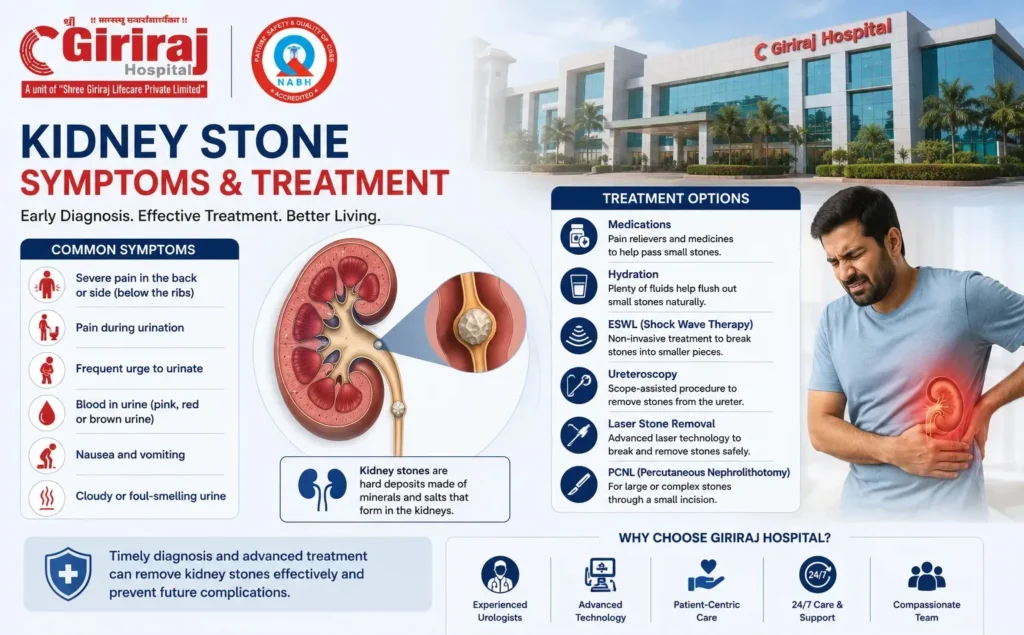
Sudden, severe pain that comes in waves and won’t let you sit still is often the first sign of a kidney stone – and understanding kidney stone symptoms and treatment can help you know exactly what to expect next. Kidney stones affect an estimated 1 in 11 people at some point in their lives, and rates have been rising steadily over recent decades (National Kidney Foundation, 2023).
Gujarat’s hot climate and typically low fluid intake during long working hours make dehydration-related kidney stones especially common across Rajkot and the wider region. At Shree Giriraj Hospital, the Urology and Andrology department manages the full range of kidney stone treatment, from watchful waiting for small stones to advanced procedures for larger ones. For a broader look at kidney and nephrology care generally, our companion article on finding a kidney specialist in Rajkot covers the full spectrum of kidney conditions – this guide focuses specifically on stones.
This guide explains what kidney stone pain actually feels like, the different types of stones and why that matters, how stones are diagnosed, the full range of treatment options, what recovery looks like, and how to reduce your risk of getting another one.
What Is a Kidney Stone?
A kidney stone is a hard, solid mass formed from crystals that separate out of urine when it becomes too concentrated with certain minerals and salts. Small stones often pass unnoticed, while larger ones can cause severe pain as they move through the urinary tract.
| Think of it this way Think of your urine like a saturated sugar solution – dissolve too much sugar in too little water, and crystals start to form at the bottom of the glass. Kidney stones form the same way, when urine becomes too concentrated with crystal-forming substances relative to the fluid available to keep them dissolved. |
What Does Kidney Stone Pain Actually Feel Like?
Kidney stone pain, medically called renal colic, has a distinctive pattern that sets it apart from most other types of abdominal pain.
Typical Pain Pattern
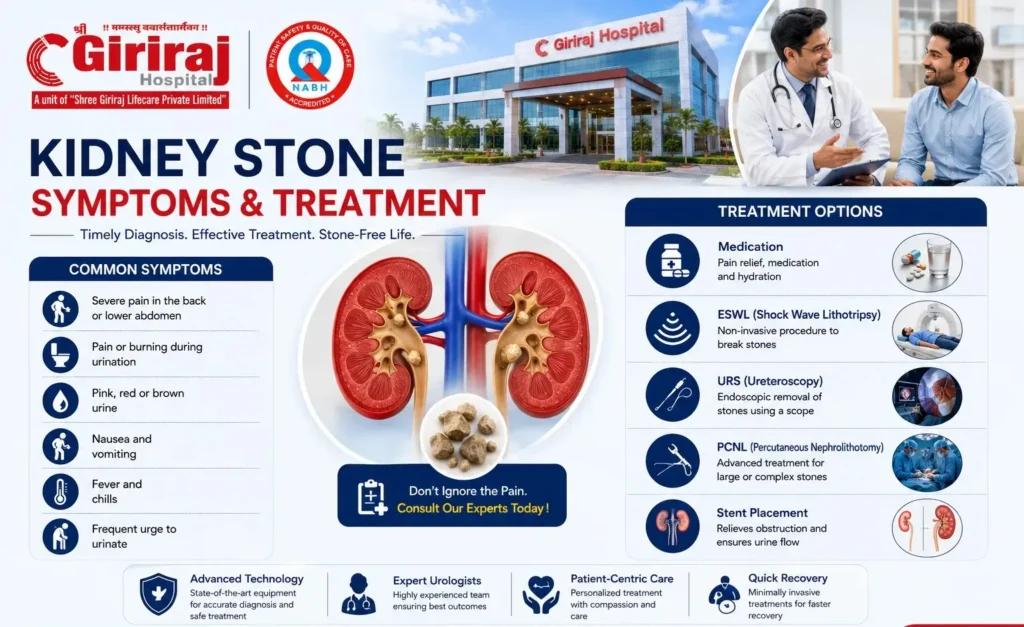
- Sudden, severe pain in the side or back, below the ribs
- Pain that comes in waves, intensifying and easing rather than staying constant
- Pain that radiates toward the lower abdomen and groin as the stone moves
- Pain that changes location as the stone travels through the urinary tract
- Restlessness – unlike many types of abdominal pain, people with kidney stones often can’t find a comfortable position
Other Common Symptoms
- Pain or burning during urination
- Pink, red, or brown-tinged urine
- Cloudy or foul-smelling urine
- Frequent urge to urinate, sometimes only passing small amounts
- Nausea and vomiting
- Fever and chills, particularly if an infection is also present
| When to Seek Emergency Care Immediately Fever and chills alongside kidney stone pain can indicate a serious infection, and severe pain that isn’t controlled by usual measures needs prompt evaluation. Call the hospital’s Ambulance Service or reach the nearest emergency department without delay – don’t wait it out at home. |
Types of Kidney Stones
Not all kidney stones are the same, and knowing the type matters for both treatment and prevention. The Urology and Andrology team typically analyses a passed or removed stone to determine its exact composition.
| Stone Type | How It Forms | Prevention Focus |
|---|---|---|
| Calcium oxalate | The most common type, often linked to low fluid intake and diet | Hydration, moderating oxalate-rich foods |
| Uric acid | Forms when urine is too acidic, often linked to high-protein diets or gout | Reducing animal protein, alkalising urine if advised |
| Struvite | Often linked to urinary tract infections | Treating underlying infections promptly |
| Cystine | A rarer type linked to a genetic condition affecting amino acid processing | Specialised long-term management |
| Clinical Insight Stone composition genuinely changes the prevention conversation. Advice that helps prevent calcium oxalate stones isn’t automatically right for uric acid stones – this is exactly why stone analysis matters, not just treatment of the current episode. |
Causes and Risk Factors
Kidney stones develop from a combination of fluid intake, diet, and sometimes underlying metabolic or genetic factors. It’s not a reflection of anything done “wrong” – many people with excellent health habits still develop stones.
Common Contributing Factors
- Low fluid intake: insufficient water, especially in hot climates or physically demanding jobs, concentrates urine and encourages crystal formation.
- Diet: diets high in animal protein, salt, or oxalate-rich foods can increase stone risk for susceptible individuals.
- Family history: a family history of kidney stones meaningfully raises individual risk.
- Obesity and metabolic conditions: excess body weight and conditions like diabetes are linked to higher stone risk.
Who Is at Higher Risk
- People with physically demanding or outdoor jobs involving heavy sweating
- Individuals with a personal or family history of kidney stones
- People with a diet high in salt, animal protein, or oxalate-rich foods
- Individuals with obesity or metabolic syndrome
- People with recurrent urinary tract infections
Because metabolic conditions like diabetes influence stone risk, doctors sometimes coordinate care with Internal Medicine and Nephrology for patients with recurrent stones or related health conditions.
How Are Kidney Stones Diagnosed?
Diagnosis combines imaging, urine testing, and sometimes blood work to confirm a stone and understand what’s causing it.
- CT scan: the most reliable way to detect a stone’s size, location, and number, especially useful in acute pain episodes.
- Ultrasound: a radiation-free option often used for initial evaluation or during pregnancy.
- Urine test: checks for blood, infection, and crystal-forming substances.
- Blood test: assesses kidney function and levels of calcium, uric acid, and other relevant markers.
Many of these tests can be arranged through Collection of Laboratory Samples for convenience, or as part of a broader Health Check-Up Plan for patients wanting a general risk assessment.
Treatment Options for Kidney Stones
Treatment depends heavily on stone size, location, and type – not every stone needs a procedure.
Watchful Waiting and Medical Management
Stones smaller than about 5mm often pass on their own with increased fluid intake and pain management, monitored by the Urology and Andrology team. Medication to relax the ureter can sometimes help ease stone passage.
Extracorporeal Shock Wave Lithotripsy (ESWL)
ESWL uses focused sound waves from outside the body to break a stone into smaller fragments that can then pass naturally. It’s non-invasive and typically used for moderate-sized stones in accessible locations.
Ureteroscopy (URS) and RIRS
URS and Retrograde Intrarenal Surgery (RIRS) involve passing a thin scope through the urinary tract to directly locate and remove or fragment a stone, often using a laser. These are performed under Anesthesiologist support and don’t require any external incision.
Percutaneous Nephrolithotomy (PCNL)
For larger or more complex stones, PCNL involves a small incision in the back to access the kidney directly and remove the stone. This is a more involved procedure, typically requiring a short hospital stay with ICCU monitoring available if needed.
Many kidney stone treatments are covered under PM-JAY (Ayushman Bharat) for eligible beneficiaries. Our Ayushman Bharat (PM-JAY) guide explains eligibility, and our team can confirm your specific coverage when you schedule a visit through Book an Appointment.
The Treatment Process – What to Expect
Preparing for a Procedure
- Complete pre-procedure blood and urine tests as advised
- Inform your doctor of all current medications, especially blood thinners
- Fast as instructed if the procedure requires anaesthesia
- Arrange for someone to accompany you, especially for procedures requiring sedation
On the Day
- Anaesthesia: depending on the procedure, local, spinal, or general anaesthesia is used, managed by the anaesthesia team.
- The procedure: ESWL sessions typically take 45 to 60 minutes; URS/RIRS and PCNL procedures generally take 1 to 2 hours depending on complexity.
- Recovery room: patients are monitored as anaesthesia wears off before being moved to a hospital room or discharged, depending on the procedure.
Hospital Stay
ESWL and URS/RIRS are often done as day procedures or with a very short stay, while PCNL typically requires 1 to 3 days in the General Ward. Rest assured, the surgical and nursing team monitors recovery closely at every stage, particularly for pain control and confirming the stone has been adequately treated.
Recovery After Kidney Stone Treatment
First Few Days
- Do: drink plenty of water to help flush any remaining fragments
- Don’t: ignore fever, worsening pain, or inability to urinate – these need prompt attention
First Two Weeks
- Follow any activity restrictions from your urologist, particularly after PCNL
- Attend follow-up imaging to confirm the stone has fully cleared
- Report any blood in urine that doesn’t improve as expected
Long-Term Follow-Up
Since kidney stones frequently recur, long-term prevention matters as much as initial treatment. Depending on stone composition, your doctor may recommend dietary changes, medication, or periodic monitoring through Nephrology.
| A Patient’s Story (Representative Example) A 39-year-old delivery driver from Rajkot experienced sudden, severe flank pain that sent him to the emergency department. A CT scan revealed an 8mm stone, treated successfully with URS. Follow-up testing identified it as a uric acid stone, and dietary changes over the following months meant no recurrence – a reminder that identifying the stone type genuinely changes long-term outcomes. |
Cost and Insurance Coverage
Kidney stone treatment cost varies significantly depending on the procedure needed – watchful waiting costs little beyond consultation, while PCNL for a complex stone costs considerably more than ESWL for a straightforward one. Rather than a single figure, most hospitals provide a personalised estimate once stone size, location, and type are confirmed.
Factors That Affect Cost
- Type of treatment – medical management, ESWL, URS/RIRS, or PCNL
- Number and size of stones requiring treatment
- Length of hospital stay needed
- Any additional imaging or repeat procedures required
Many kidney stone procedures are covered under PM-JAY for eligible beneficiaries, and some private insurance policies cover treatment as well. Shree Giriraj Hospital’s insurance desk can help verify your specific coverage – reach our team through Contact Us for a personalised estimate.
Do’s and Don’ts for Kidney Stone Patients
| Do This | Don’t Do This |
|---|---|
| Drink enough water to keep urine pale yellow throughout the day | Rely on tea, coffee, or sugary drinks as your main fluid intake |
| Increase water intake further during Rajkot’s hot summer months | Reduce fluid intake even when sweating heavily during outdoor work |
| Moderate salt and animal protein intake if advised | Continue a very high-salt or high-protein diet after a stone diagnosis |
| Get your stone analysed if one is passed or removed | Assume all kidney stones are the same or need the same prevention approach |
| Attend follow-up imaging to confirm complete stone clearance | Assume pain relief means the stone is fully gone |
| Seek prompt care for fever alongside stone symptoms | Wait out fever and pain together at home, which can signal infection |
Common Myths About Kidney Stones
| Myth | Fact |
|---|---|
| All kidney stones need surgery | Many small stones pass naturally with increased fluid intake and pain management, without any procedure |
| Drinking milk causes kidney stones because of the calcium | Dietary calcium from food sources like milk generally doesn’t increase stone risk; it’s excess oxalate and low fluid intake that matter more |
| Once you’ve had a kidney stone, you’ll definitely get another | Recurrence is common but not certain – proper prevention based on stone type meaningfully reduces the risk |
| Kidney stone pain always stays in the same place | Pain often changes location as the stone moves through the urinary tract, which is actually a distinctive feature of stone pain |
| ESWL and PCNL are interchangeable options for any stone | The right procedure depends on stone size, location, and composition – not every treatment suits every stone |
| For advanced kidney stone treatment, you need to travel to a big city | Shree Giriraj Hospital provides the full range of stone treatment, including ESWL, URS, RIRS, and PCNL, right here in Rajkot |
Why Choose Shree Giriraj Hospital for Kidney Stone Treatment?
Choosing where to treat a kidney stone matters, especially since the right procedure depends on accurate diagnosis, not guesswork. Here is what sets Shree Giriraj Hospital apart for patients in Rajkot.
The Full Range of Treatment Options
The Urology and Andrology department offers the complete spectrum of stone treatment, from watchful waiting through ESWL, URS/RIRS, and PCNL, so treatment is matched to the stone, not limited by what’s available.
Coordinated Nephrology Support
For patients with recurrent stones or underlying kidney function concerns, Nephrology works alongside urology to address root causes, not just the current episode.
Round-the-Clock Emergency Readiness
Kidney stone pain often strikes without warning. Our Ambulance Service and Critical Care support ensure patients reach treatment quickly when pain becomes severe.
Modern Surgical Infrastructure
Procedures are performed within a purpose-built Hospital Infrastructure designed for both precision and patient comfort.
To take the next step, meet our specialist team by consulting the Doctors page, and book a consultation with our Urology team today through Book an Appointment.
Frequently Asked Questions
What does kidney stone pain feel like?
Kidney stone pain typically starts suddenly in the side or back below the ribs, comes in waves rather than staying constant, and often radiates toward the lower abdomen and groin as the stone moves.
What is the difference between ESWL and PCNL?
ESWL uses external sound waves to break up a stone without any incision, suited to moderate-sized stones, while PCNL involves a small incision to directly access and remove larger or more complex stones.
Can kidney stones be treated without surgery?
Yes, stones smaller than about 5mm often pass naturally with increased fluid intake and pain management, without any procedure being needed.
How can I prevent kidney stones from coming back?
Prevention depends on stone type – generally, adequate hydration, moderating salt and animal protein, and following any specific dietary guidance based on your stone’s composition all help reduce recurrence.
Is kidney stone treatment covered under Ayushman Bharat (PM-JAY)?
Many kidney stone procedures are covered under PM-JAY for eligible beneficiaries. Our Ayushman Bharat / PM-JAY guide explains eligibility and the cashless process in detail.
How long does it take to recover from kidney stone surgery?
Recovery varies by procedure – ESWL and URS/RIRS patients often resume normal activity within a few days, while PCNL recovery may take one to two weeks depending on individual factors.
What foods should I avoid with kidney stones?
This depends on your stone type – calcium oxalate stones generally benefit from moderating oxalate-rich foods, while uric acid stones benefit from reduced animal protein. A proper stone analysis guides specific dietary advice.
Does Shree Giriraj Hospital perform PCNL and other advanced stone procedures?
Yes, the Urology and Andrology department offers the full range of stone treatment, supported by Anesthesiologist and Critical Care teams.
How do I book a consultation for kidney stone symptoms?
You can schedule a consultation directly through the Book an Appointment page, or call the hospital’s contact numbers listed on the Contact Us page.
Should I see a urologist or nephrologist for a kidney stone?
A urologist typically manages stone removal procedures, while a nephrologist focuses on underlying kidney function and metabolic causes. Our team can help direct you to the right specialist based on your situation.
Conclusion
Kidney stone pain can be sudden and severe, but understanding your symptoms, stone type, and treatment options helps you move from confusion to a clear plan quickly.
If you’re experiencing symptoms of a kidney stone, don’t wait for the pain to become unbearable. Consult the Urology and Andrology team at Shree Giriraj Hospital, Rajkot, for prompt diagnosis and the right treatment for your specific stone. You can book an appointment directly online, or reach our team through the Contact Us page for any questions before your visit.
Read More: Kidney Specialist Rajkot | Ayushman Bharat / PM-JAY Guide | Best Hospital in Rajkot – or explore more articles on our Blogs page.