Most people have never heard the term “aortic aneurysm” until a routine scan turns one up, or worse, until a family emergency forces the issue. It’s one of those conditions that can sit quietly for years without a single symptom, then suddenly become life-threatening within hours. This guide walks through everything you need to know about an Aortic Aneurysm – what it actually is, how doctors in Rajkot diagnose it, which symptoms should never be ignored, and what surgical treatment looks like today.
We wrote this because so much of what’s available online about an aneurysm is either overly clinical or too generic to be genuinely useful to someone trying to understand their own diagnosis or a loved one’s. Whether you’ve just been told you have an Aortic Aneurysm, or you’re trying to understand a parent’s diagnosis, this guide is meant to be read start to finish, or navigated section by section using the headings below.
Vascular disease affecting the aorta is more common than most people realise, and awareness has genuinely improved outcomes over the past decade. Cardiac and vascular surgery in Rajkot has advanced considerably, meaning patients no longer need to travel to Ahmedabad or Mumbai for expert diagnosis and treatment of an aneurysm – local specialists now offer the same imaging technology, surgical techniques, and post-operative care you’d expect from any major metro hospital, closer to home during what is often an anxious and uncertain time.
What Is an Aortic Aneurysm?
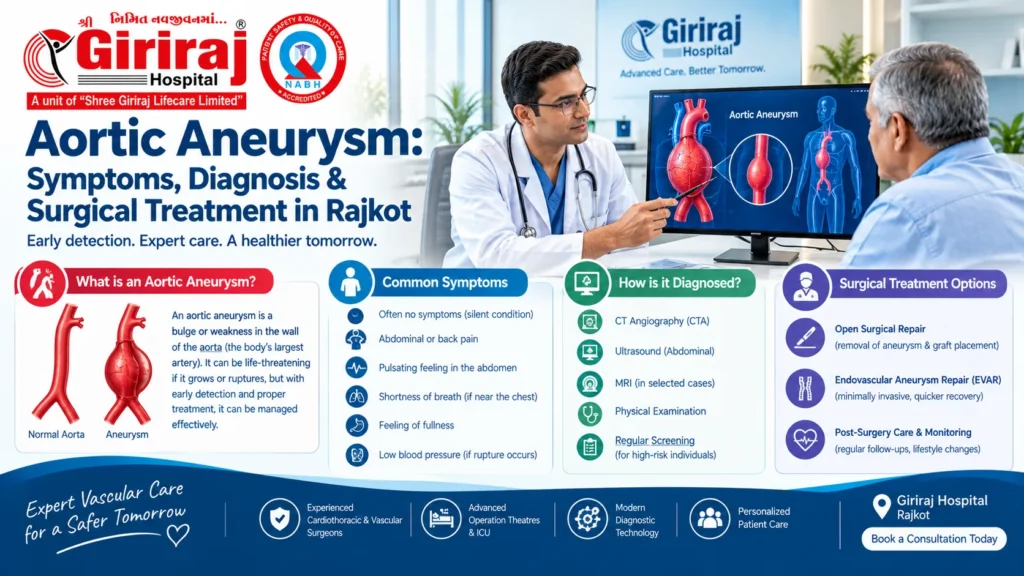
The aorta is the largest blood vessel in the human body – a thick, muscular tube that carries oxygen-rich blood from the heart to every organ and limb. An aneurysm develops when a section of this vessel wall weakens and balloons outward, much like a worn patch on a garden hose that bulges under pressure. Over time, this bulge can continue to enlarge, and if it grows too large, the wall may tear (dissection) or burst (rupture), causing sudden, massive internal bleeding.
An Aortic Aneurysm can form anywhere along the aorta, but it’s typically classified based on location:
- Abdominal aneurysm (AAA) – occurs in the section of the aorta that runs through the abdomen; this is the most common type
- Thoracic aneurysm (TAA) – occurs in the section of the aorta that passes through the chest
- Thoracoabdominal Aneurysm – spans both the chest and abdominal sections of the aorta, and is generally the most complex to treat surgically
What makes an aneurysm particularly dangerous is that it usually causes no symptoms at all while it’s growing slowly. Many people only discover they have one during an unrelated scan – an ultrasound, CT, or MRI ordered for a completely different reason.
What Causes an Aortic Aneurysm?
Understanding why an Aortic Aneurysm develops helps explain who’s most at risk and why regular screening matters for certain people. The most common contributing factors include:
- Atherosclerosis – plaque buildup in the artery walls, which weakens their structural integrity over time
- High blood pressure (hypertension) – sustained pressure against the aortic wall accelerates weakening
- Smoking – one of the strongest modifiable risk factors linked to aneurysm formation and growth
- Genetic and connective tissue conditions – disorders like Marfan syndrome or Ehlers-Danlos syndrome make the aortic wall inherently weaker
- Family history – having a close relative with an Aortic Aneurysm increases personal risk significantly
- Age and gender – risk rises after age 65, and men are diagnosed more frequently than women
- Trauma or infection – rare, but injury or certain infections can occasionally trigger aneurysm formation
Most cases of aneurysm result from a combination of these factors building up gradually over years, rather than any single cause.
Symptoms of an Aortic Aneurysm You Shouldn’t Ignore
This is the section that matters most, because an Aortic Aneurysm behaves very differently depending on whether it’s stable, growing, or in the process of rupturing.
Symptoms of a Stable, Slow-Growing Aortic Aneurysm:
In most cases, there are simply no symptoms at all. When symptoms do appear, they tend to be vague and easy to dismiss:
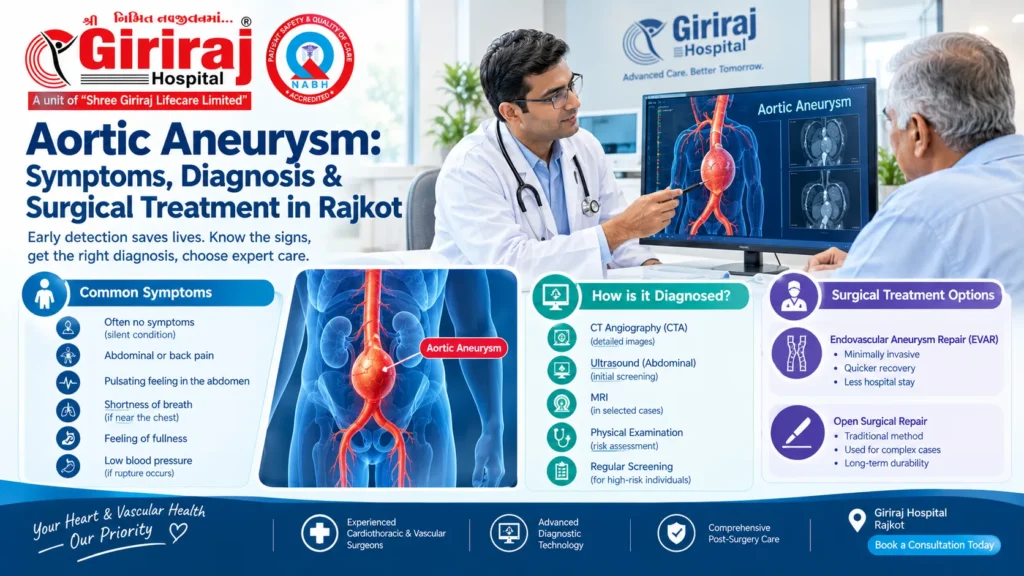
- A pulsing sensation near the navel (more noticeable with abdominal aneurysms)
- Persistent, dull pain in the abdomen, back, or chest
- A feeling of fullness after eating only a small amount
- Unexplained fatigue
Warning Signs of a Growing or Leaking Aortic Aneurysm:
- Sudden, severe pain in the chest, abdomen, or back that doesn’t ease with rest
- Pain that radiates toward the lower back, groin, or legs
- Clammy skin, sweating, or a rapid heartbeat
- Dizziness, fainting, or loss of consciousness
Emergency Symptoms of a Ruptured Aortic Aneurysm:
A ruptured aneurysm is a medical emergency requiring immediate hospitalisation. Symptoms include sudden, tearing pain described as one of the worst pains a person has ever felt, along with a rapid drop in blood pressure, extreme weakness, and loss of consciousness. If you or someone near you experiences this combination of symptoms, call for emergency medical help immediately rather than waiting to see if it improves.
How Is an Aortic Aneurysm Diagnosed?
Because an aneurysm rarely causes symptoms in its early stages, diagnosis often happens either incidentally during an unrelated scan, or deliberately through screening in high-risk individuals. Once a suspected aneurysm is identified, doctors use a combination of imaging tests to confirm the diagnosis and plan treatment.
Ultrasound
Usually the first test used, particularly for suspected abdominal aortic aneurysms. It’s painless, quick, and doesn’t involve radiation, making it ideal for both initial diagnosis and ongoing monitoring of a small, stable Aortic Aneurysm.
CT Angiography (CTA)
A CT scan combined with contrast dye provides highly detailed, three-dimensional images of the aorta, allowing doctors to precisely measure the size, shape, and exact location of an aneurysm. This is typically the gold-standard test used before planning any surgical treatment.
MRI / MR Angiography
An alternative to CT angiography, particularly useful for patients who need to avoid radiation exposure or iodine-based contrast dye, offering detailed imaging of the aortic wall and surrounding structures.
Echocardiography
Especially useful for aneurysms near the heart, an echocardiogram (transthoracic or transesophageal) can assess the aortic root and ascending aorta, and is often used alongside CT or MRI for a complete picture.
Once an Aortic Aneurysm is confirmed, your doctor will track its size over time using regular follow-up imaging, since the size and growth rate of an aneurysm are the two biggest factors determining whether surgery is needed and when.
When Does an Aortic Aneurysm Need Surgery?
Not every aneurysm requires immediate surgery. Small, stable aneurysms are often simply monitored through regular imaging and managed with blood pressure control and lifestyle changes. Surgery generally becomes necessary when:
- The aneurysm reaches a critical size – typically around 5.5 cm for abdominal aortic aneurysms and slightly larger thresholds for thoracic aneurysms, though your surgeon will use your specific case to decide
- The aneurysm is growing rapidly, even if it hasn’t yet reached the standard size threshold
- The patient develops symptoms suggestive of an expanding or leaking aneurysm
- There is evidence of dissection (tearing) within the aortic wall
- The aneurysm has already ruptured, which requires emergency surgery
This size-based approach exists because the risk of rupture rises sharply once an Aortic Aneurysm crosses certain size thresholds, while the risks of surgery itself remain relatively constant – so surgeons weigh the risk of waiting against the risk of operating for each individual patient.
Surgical Treatment for Aortic Aneurysm in Rajkot
When surgery becomes necessary, there are two main surgical approaches used to treat an aneurysm today, and your surgical team will recommend one based on the aneurysm’s location, size, shape, and your overall health.
1. Open Surgical Repair
This is the traditional, time-tested approach to treating an aneurysm. The surgeon makes an incision in the abdomen or chest to directly access the weakened section of the aorta, removes or bypasses the diseased segment, and sews in a synthetic graft to replace it. Open repair remains the gold standard for complex aneurysms, particularly those involving major branch arteries or an unfavourable shape for endovascular treatment.
2. Endovascular Aneurysm Repair (EVAR / TEVAR)
A minimally invasive alternative, endovascular repair treats an aneurysm from inside the blood vessel rather than through a large incision. A compressed stent-graft is threaded through a small incision in the groin using catheters and guided into position using live imaging, where it expands to reinforce the weakened section of the aorta from within.
- EVAR (Endovascular Aneurysm Repair) – used for abdominal aortic aneurysms
- TEVAR (Thoracic Endovascular Aortic Repair) – used for thoracic aortic aneurysms
- FEVAR (Fenestrated EVAR) – a specialised technique for complex aneurysms located near branch arteries supplying the kidneys and other organs
Endovascular repair generally offers a shorter hospital stay, faster recovery, and less post-operative pain compared to open surgery, but it isn’t suitable for every Aortic Aneurysm – the shape, location, and condition of surrounding blood vessels all determine candidacy. Patients treated with EVAR or TEVAR also require lifelong follow-up imaging to ensure the stent-graft remains properly positioned and functioning.
Aortic Aneurysm Surgery: The Step-by-Step Procedure
Understanding what actually happens during treatment can meaningfully ease the anxiety of an upcoming aneurysm surgery. Here’s how each approach typically unfolds.
Open Repair, Step by Step
- Pre-Operative Evaluation – comprehensive imaging (CT angiography), blood tests, cardiac fitness assessment, and anaesthesia clearance
- Anaesthesia and Access – general anaesthesia is administered, and the surgeon makes an incision in the abdomen or chest depending on the aneurysm’s location
- Clamping and Repair – blood flow is temporarily controlled above and below the aneurysm, the weakened section is opened, and a synthetic graft is sewn into place to replace the diseased segment
- Closing Up – once the graft is confirmed secure and blood flow is restored, the incision is closed and the patient is moved to intensive care for close monitoring
EVAR/TEVAR, Step by Step
- Pre-Operative Planning – detailed CT angiography to map the aneurysm and select a correctly sized stent-graft
- Anaesthesia – often performed under general or regional anaesthesia, sometimes with sedation alone in select cases
- Catheter Access – small incisions are made in the groin to access the femoral arteries
- Stent-Graft Deployment – the compressed stent-graft is guided into position using live X-ray imaging and expanded to seal off the aneurysm from within
- Confirmation and Closure – imaging confirms correct placement with no leaks around the graft, the small incisions are closed, and the patient typically recovers in a shorter hospital stay than open surgery
Whether open or endovascular, treating an Aortic Aneurysm requires a highly experienced surgical team, precise pre-operative imaging, and a well-equipped operating theatre – all of which factor heavily into choosing the right hospital.
Aortic Aneurysm Treatment Cost in Rajkot
Cost is naturally one of the first questions families ask once an aneurysm diagnosis is confirmed. Treatment cost varies considerably depending on the surgical approach, size and location of the aneurysm, and whether the case is planned or an emergency.
What Affects the Cost of Aortic Aneurysm Treatment:
| Factor | How It Affects Cost |
| Surgical approach | Open repair vs. EVAR/TEVAR carry different costs due to graft materials and technique |
| Aneurysm location | Abdominal, thoracic, or thoracoabdominal cases vary in surgical complexity |
| Stent-graft type | Standard vs. fenestrated (FEVAR) grafts differ significantly in cost |
| Planned vs. emergency surgery | Emergency repair of a ruptured Aortic Aneurysm typically costs more due to ICU intensity and complications |
| Length of ICU/hospital stay | Extended monitoring due to complications adds to the overall bill |
| Pre-surgery diagnostics | CT angiography, MRI, and blood work costs |
| Insurance and government schemes | Cashless insurance or Ayushman Bharat (PM-JAY) can substantially reduce out-of-pocket cost |
As a general guide, endovascular treatment (EVAR/TEVAR) tends to involve higher device costs but shorter hospital stays, while open surgical repair typically involves lower device costs but a longer hospital and ICU stay. Rajkot offers considerably more accessible pricing for aneurysm treatment than metro cities like Mumbai or Delhi, without compromising on surgical standards, which is why patients across Saurashtra increasingly choose to be treated locally.
Ways to Reduce Out-of-Pocket Expense:
- Confirm whether your health insurance offers cashless treatment at your chosen hospital
- Check your eligibility for the Ayushman Bharat (PM-JAY) scheme, which can cover vascular surgery for eligible families
- Request a detailed, itemised cost estimate before admission, particularly for planned (non-emergency) cases
- Ask the hospital’s insurance desk to assist with pre-authorisation ahead of a scheduled surgery date
Because aneurysm treatment costs depend heavily on the exact surgical approach and any complications involved, an in-person consultation and imaging review remain the only reliable way to get an accurate estimate.
Why Choose Giriraj Hospital for Aortic Aneurysm Treatment in Rajkot
At Giriraj Hospital, aneurysm cases are managed by a dedicated Cardiothoracic and Vascular Surgery team, supported by advanced imaging, a modern cardiac ICU, and 24/7 emergency readiness for ruptured or urgent cases. Families choosing Giriraj Hospital for Aortic Aneurysm treatment can expect:
- Experienced Cardiothoracic and Vascular Surgeons – trained in both open surgical repair and endovascular (EVAR/TEVAR) techniques for aneurysm
- Advanced Diagnostic Imaging – CT angiography and echocardiography available for precise pre-operative planning
- 24/7 Emergency Care – critical for ruptured or rapidly expanding Aortic Aneurysm cases requiring immediate intervention
- Dedicated Cardiac ICU – specialised post-operative monitoring from a critical care team trained in vascular recovery
- Transparent Cost Estimates – a clear cost breakdown provided before scheduled aneurysm surgery, avoiding surprises at discharge
- Cashless Insurance & Ayushman Bharat (PM-JAY) Support – assistance with documentation and pre-authorisation for eligible patients
- Complete Continuum of Care – from diagnosis through surgery, ICU recovery, and long-term follow-up imaging
If you or a family member has been diagnosed with an Aortic Aneurysm, the cardiac and vascular surgery team at Giriraj Hospital is available for a detailed consultation to review your imaging and explain your treatment options clearly.
Recovery After Aortic Aneurysm Surgery
Recovery timelines differ meaningfully between open repair and endovascular treatment, so it helps to understand what to expect from each.
Recovery After Open Surgical Repair
Patients typically spend one to three days in the ICU, followed by another five to seven days in a step-down ward. Full recovery at home generally takes six to eight weeks, with restrictions on heavy lifting and strenuous activity during this period while the incision and abdominal or chest muscles heal.
Recovery After EVAR/TEVAR
Recovery is typically much faster. Many patients spend just one to three days in the hospital and can resume light activities within one to two weeks. However, unlike open repair, EVAR/TEVAR patients require lifelong periodic imaging to make sure the stent-graft remains correctly positioned and free of leaks.
General Recovery Tips After Aortic Aneurysm Surgery:
- Attend every scheduled follow-up imaging appointment, even if you feel completely well
- Keep blood pressure well controlled through medication and lifestyle changes
- Quit smoking completely, since continued smoking increases the risk of further aneurysm formation elsewhere in the aorta
- Follow a heart-healthy, low-sodium diet to support blood pressure management
- Report any new chest, back, or abdominal pain to your surgical team immediately
Life After an Aortic Aneurysm Diagnosis: Long-Term Outlook
A successfully treated aneurysm generally allows patients to return to a normal, active life. That said, having had one aneurysm – treated or not – does mean an increased likelihood of developing another aneurysm elsewhere in the aorta over time, which is why lifelong monitoring remains important even after successful surgery.
Managing blood pressure, avoiding tobacco completely, maintaining a healthy weight, and attending every scheduled follow-up scan are the most effective ways to protect long-term aortic health after an aneurysm diagnosis. Family members of someone diagnosed with an aneurysm, particularly first-degree relatives, are often advised to get screened themselves, given the genetic and familial component seen in many cases.
Aortic Aneurysm vs. Other Aortic Conditions: Avoiding Confusion
Patients often mix up an aneurysm with other aortic conditions they’ve read about, so it’s worth briefly clarifying the difference. An aortic dissection is a tear within the layers of the aortic wall that can occur with or without an underlying aneurysm, and it tends to present with sudden, tearing pain requiring emergency care. Atherosclerosis, by contrast, is the gradual narrowing of arteries from plaque buildup – a risk factor for aneurysm formation, but a distinct condition in itself. Understanding these distinctions helps patients ask sharper, more specific questions during their consultation, rather than assuming every aortic finding on a scan means the same thing.
It’s also worth noting that an aneurysm and an aortic aneurysm found incidentally on an unrelated scan aren’t automatically cause for panic. Many small, stable aneurysms are monitored safely for years without ever requiring surgery, and your vascular team will explain exactly where your specific case falls on that spectrum.
Living With a Monitored, Unruptured Aneurysm
Not every aneurysm diagnosis leads straight to the operating table, and understanding what “watchful waiting” actually looks like can ease a lot of unnecessary worry. If your doctor recommends monitoring rather than immediate surgery, you’ll typically follow a structured imaging schedule – often every six to twelve months depending on the aneurysm’s size and growth rate – alongside strict blood pressure control and lifestyle adjustments.
During this monitoring period, most patients continue living entirely normal lives, with a few sensible precautions: avoiding heavy lifting or straining activities that spike blood pressure suddenly, staying consistent with prescribed medications, and reporting any new or worsening symptoms promptly rather than waiting for the next scheduled scan. This structured approach allows your surgical team to time an intervention precisely when the benefits of surgery clearly outweigh the risks of continued monitoring – not before, and not after.
Risks and Possible Complications
As with any major vascular procedure, treating an Aortic Aneurysm carries some risk, though outcomes at experienced centres are generally strong, particularly for planned (non-emergency) surgery. Possible complications include bleeding, infection, blood clots, kidney complications related to contrast dye or reduced blood flow during surgery, and – specific to EVAR/TEVAR – a stent-graft leak known as an endoleak, which requires ongoing monitoring and sometimes a repeat procedure. Emergency surgery for a ruptured aneurysm carries meaningfully higher risk than planned surgery, which is precisely why early detection and timely treatment of a stable, unruptured aneurysm matters so much.
Open Repair vs. EVAR/TEVAR: What’s the Difference?
Patients are often unsure which surgical approach applies to their specific Aortic Aneurysm, so it helps to see the two side by side:
| Aspect | Open Surgical Repair | EVAR / TEVAR (Endovascular) |
| Invasiveness | Major abdominal or chest incision | Small groin incisions, catheter-based |
| Best suited for | Complex anatomy, aneurysms near branch arteries | Suitable aortic anatomy in candidates for stent-graft placement |
| Hospital stay | Typically 7-10 days | Typically 1-3 days |
| Recovery time | 6-8 weeks | 1-2 weeks for light activity |
| Long-term monitoring | Standard follow-up | Lifelong periodic imaging required to check the stent-graft |
Your surgeon will determine which option is appropriate for your aneurysm based on detailed CT angiography, your overall health, and the specific shape and location of the aneurysm.
Aortic Aneurysm Screening: Who Should Get Checked?
Because an Aortic Aneurysm so often develops silently, screening plays a major role in catching it before it becomes an emergency. You may be a candidate for proactive screening if you:
- Are over the age of 65, particularly men with a history of smoking
- Have a first-degree relative (parent or sibling) diagnosed with an aneurysm
- Have a personal history of high blood pressure, high cholesterol, or atherosclerosis
- Have a diagnosed connective tissue disorder such as Marfan syndrome
- Have previously been treated for an aneurysm elsewhere in the aorta
Screening for an aneurysm is typically done through a simple, painless abdominal ultrasound, and catching a small, stable aneurysm early gives doctors the opportunity to monitor it safely rather than face an emergency down the line.
Insurance, PM-JAY & Cashless Options for Aortic Aneurysm Treatment
aneurysm surgery, particularly emergency repair, can represent a significant and sudden financial burden, which makes understanding your coverage options genuinely important. Most private health insurance policies cover both open and endovascular aneurysm repair, provided pre-authorisation is completed correctly for planned cases, and many hospitals – including Giriraj Hospital – maintain cashless treatment tie-ups with major insurers.
Patients from economically weaker sections may also be eligible under the Ayushman Bharat (PM-JAY) scheme, which covers a range of vascular and cardiac procedures, including Aortic Aneurysm repair, at empanelled hospitals. If you’re unsure about eligibility, the hospital’s insurance help desk can guide you through documentation, ideally well before a scheduled surgery date, or as quickly as possible in an emergency situation.
How to Choose the Right Hospital for Aortic Aneurysm Treatment in Rajkot
Given how much urgency and precision an aneurysm diagnosis can demand, choosing the right hospital matters enormously. When evaluating where to seek treatment, consider:
- 24/7 emergency readiness – a ruptured Aortic Aneurysm can’t wait, so round-the-clock vascular surgical capability is essential
- Availability of both surgical approaches – a hospital equipped for both open repair and EVAR/TEVAR gives you more personalised, appropriate treatment options
- Advanced imaging capability – CT angiography availability directly affects how quickly and accurately an aneurysm can be diagnosed and planned for
- Dedicated ICU infrastructure – critical for safe recovery, particularly after open surgical repair or emergency cases
- Transparency on cost – a detailed estimate before scheduled surgery, not a surprise bill at discharge
- Insurance and scheme support – cashless tie-ups and Ayushman Bharat (PM-JAY) empanelment ease financial pressure during an already stressful situation
Asking about these factors during your first consultation tells you a great deal about how prepared a hospital is to manage an Aortic Aneurysm, both in routine and emergency circumstances.
Common Terms Explained: A Quick Glossary
If some of the terminology around an aneurysm feels overwhelming, here’s a plain-language glossary to keep handy:
- Aneurysm – an abnormal bulge or widening in a blood vessel wall
- Dissection – a tear within the layers of the aortic wall
- Rupture – a complete burst of the aortic wall, causing severe internal bleeding
- AAA – Abdominal aneurysm, the most common location
- TAA – Thoracic aneurysm, occurring in the chest portion of the aorta
- EVAR – Endovascular Aneurysm Repair, a minimally invasive stent-graft procedure for abdominal aneurysms
- TEVAR – Thoracic Endovascular Aortic Repair, the equivalent minimally invasive procedure for thoracic aneurysms
- Endoleak – a leak of blood around a stent-graft after EVAR/TEVAR, requiring monitoring or repeat treatment
- CT Angiography (CTA) – a contrast-enhanced CT scan used to precisely visualise the aorta
Understanding this vocabulary makes conversations with your surgical team far easier when navigating an Aortic Aneurysm diagnosis for yourself or a loved one.
Questions to Ask Your Vascular Surgeon
Walking into your consultation prepared helps you make a confident, informed decision about your aneurysm treatment. Before confirming your surgery date, consider asking:
- What is the current size and growth rate of my Aortic Aneurysm?
- Am I a candidate for endovascular repair (EVAR/TEVAR), or does my case require open surgery?
- What is your team’s experience treating aneurysms similar to mine?
- What are the specific risks in my case, given my age and other health conditions?
- How long will I need to stay in the ICU and general ward?
- What does long-term follow-up look like after my chosen treatment?
- What is the total estimated cost, and is cashless insurance or Ayushman Bharat (PM-JAY) available?
A confident surgical team will welcome these questions and answer them clearly, without rushing you toward a decision.
Frequently Asked Questions About Aortic Aneurysm
What is an aneurysm?
An Aortic Aneurysm is an abnormal bulge or ballooning in the wall of the aorta, the body’s largest artery. It can occur in the chest (thoracic) or abdomen (abdominal), and if left untreated and allowed to grow too large, it can tear or rupture, causing life-threatening internal bleeding.
What are the early warning signs of an aneurysm?
Most small aneurysms cause no symptoms at all. When symptoms do occur, they can include a pulsing sensation near the navel, persistent dull pain in the abdomen, back, or chest, and unexplained fatigue. Sudden, severe, tearing pain is a medical emergency and requires immediate attention.
How is an aneurysm diagnosed?
An aneurysm is typically diagnosed through imaging, most commonly ultrasound for abdominal aneurysms and CT angiography for detailed measurement and surgical planning. MRI and echocardiography are also used in specific situations.
At what size does an Aortic Aneurysm need surgery?
Surgery is generally considered once an abdominal aortic aneurysm reaches around 5.5 cm, though thoracic aneurysms and individual patient factors can shift this threshold. Rapid growth or the onset of symptoms can prompt earlier surgical treatment regardless of exact size.
What is the difference between open surgery and EVAR for an aneurysm?
Open surgery involves a large abdominal or chest incision to directly replace the diseased section of the aorta with a graft, while EVAR (or TEVAR for the chest) is a minimally invasive, catheter-based procedure that places a stent-graft inside the aorta through small groin incisions, generally offering a faster recovery.
Is Aortic Aneurysm surgery safe?
Yes, particularly when performed as planned, non-emergency surgery by an experienced vascular surgical team with proper pre-operative imaging and ICU support. Emergency surgery for a ruptured aneurysm carries higher risk, which is why early detection through screening and prompt treatment of a stable aneurysm matters so much.
Can an Aortic Aneurysm be treated without surgery?
Small, stable aneurysms are often simply monitored with regular imaging, blood pressure control, and lifestyle changes such as quitting smoking. Surgery becomes necessary once the aneurysm reaches a critical size, grows rapidly, or causes symptoms.
Which hospital is best for aneurysm treatment in Rajkot?
Look for a hospital with 24/7 emergency vascular surgical capability, advanced CT angiography imaging, both open and endovascular (EVAR/TEVAR) treatment options, a dedicated ICU, and cashless insurance or Ayushman Bharat support. Giriraj Hospital offers all of these under one roof through its Cardiothoracic and Vascular Surgery team.
Can Ayushman Bharat (PM-JAY) cover aneurysm treatment?
Yes, eligible patients under the Ayushman Bharat scheme can have a significant portion of their aneurysm treatment costs covered at empanelled hospitals. Check with the hospital’s insurance desk to confirm eligibility and documentation requirements.
Final Thoughts
An Aortic Aneurysm diagnosis is genuinely frightening, largely because it so often arrives without warning. But modern imaging, both open and minimally invasive surgical techniques, and dedicated vascular ICU care mean that today’s outcomes are far better than they were even a decade ago – and Rajkot’s cardiac and vascular teams now offer this level of care close to home. The single most important step is getting a clear, honest evaluation from a surgical team you trust, backed by proper imaging.
If you or someone in your family has been diagnosed with an aneurysm, the cardiothoracic and vascular surgery team at Giriraj Hospital is here to answer your questions, review your imaging, and walk you through exactly what treatment would look like for your specific case. Book a consultation or contact us today – and if you’re experiencing sudden, severe chest, back, or abdominal pain, seek emergency care immediately rather than waiting for an appointment.