





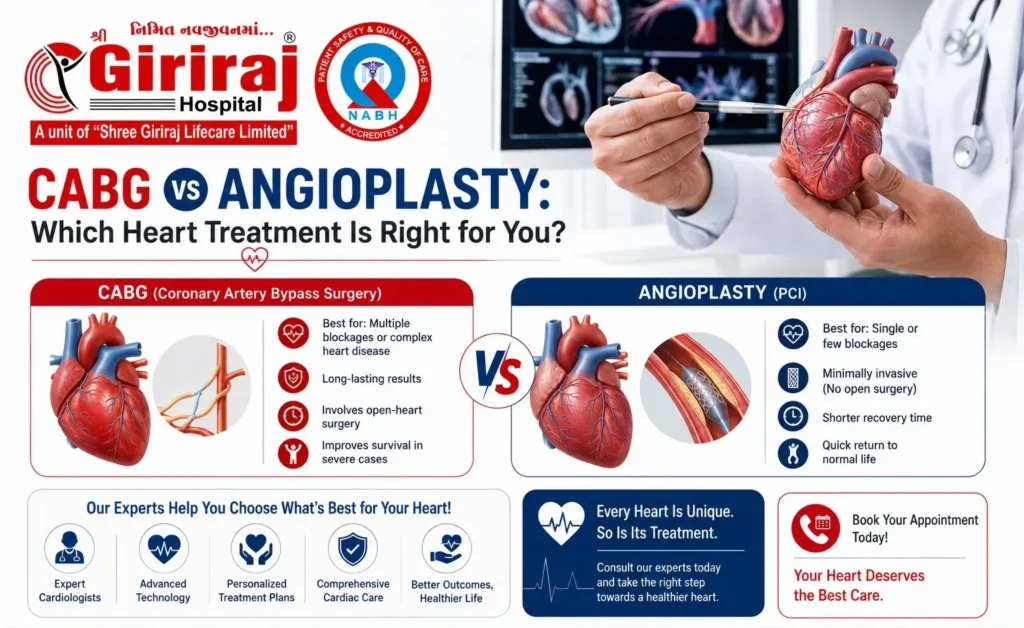
After an angiogram confirms blocked coronary arteries, the next question is rarely simple: CABG vs angioplasty – bypass surgery or a stent – and which one actually fits your specific situation. Both are highly effective, well-established treatments for coronary artery disease, but they aren’t interchangeable, and the right choice depends on real clinical factors, not personal preference alone.
At Shree Giriraj Hospital, the Cardiology and Cardiothoracic and Vascular Surgery departments work together on exactly this decision, so patients get a coordinated recommendation rather than two separate opinions. If your situation points toward bypass surgery specifically, our detailed guide on finding the best bypass surgeon in Rajkot covers that procedure in depth.
This guide walks through what each treatment actually involves, the specific clinical factors that genuinely influence the decision, what the evidence says about outcomes, recovery differences, and how cost and insurance coverage work for each.
What Each Treatment Actually Involves
Angioplasty (PCI)
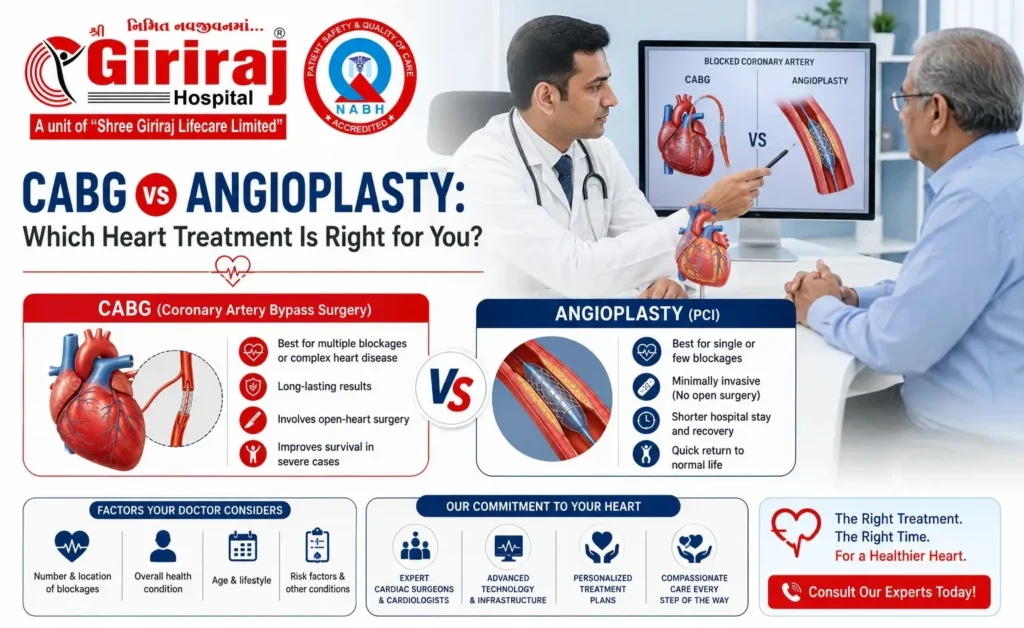
Angioplasty, formally called percutaneous coronary intervention (PCI), is a catheter-based procedure. A thin tube is guided through a blood vessel, usually from the wrist or groin, to the blocked coronary artery. A small balloon widens the narrowed section, and a stent – a small mesh tube – is typically placed to keep the artery open. It doesn’t require open surgery.
CABG (Bypass Surgery)
Coronary artery bypass grafting is open-heart surgery that creates an entirely new route for blood to flow around a blockage, using a healthy blood vessel taken from elsewhere in the body. Rather than opening the existing blockage, it reroutes blood flow around it entirely.
| Think of it this way Angioplasty is like clearing a specific blocked pipe from the inside, while CABG is like building a new pipe around the blockage entirely. Both solve the same underlying problem – restricted blood flow – but through fundamentally different approaches, which is exactly why the right choice depends on the specifics of the blockage. |
The Symptoms and Diagnosis That Lead to This Decision
This decision typically arises after symptoms prompt a cardiac workup, not before.
- Chest pain or pressure, especially during activity
- Breathlessness that’s new or worsening
- A heart attack, requiring urgent evaluation
- Abnormal findings on a routine cardiac stress test or ECG
Once symptoms prompt evaluation, coronary angiography is the definitive test that shows exactly how many arteries are affected, how severe the blockages are, and their precise location – the information that actually drives the CABG-versus-angioplasty decision. Many of the preliminary tests are available through the Non-Invasive Cardiology & Radiology Package.
The Factors That Actually Drive This Decision
This isn’t a preference-based choice – specific, measurable clinical factors determine which treatment is genuinely appropriate.
| Factor | Favours Angioplasty | Favours CABG |
|---|---|---|
| Number of blocked arteries | Single or two vessels, straightforward blockages | Multiple vessels (triple-vessel disease) |
| Left main artery involvement | Generally avoided unless anatomy is favourable | Often preferred for significant left main disease |
| Diabetes | Less durable long-term in diabetic patients | Better long-term outcomes per major trials (see below) |
| Blockage complexity | Simple, accessible blockages | Complex, heavily calcified, or diffuse blockages |
| Urgency | Preferred in acute heart attack for speed | Rarely emergency, except with complications |
| Overall surgical risk | Preferred for higher-risk or older patients | Preferred when a more durable, one-time solution is the priority |
| Clinical Insight Cardiologists often use a complexity scoring system, commonly known as the SYNTAX score, to formally assess how complicated a set of blockages is. In plain terms: higher complexity generally shifts the recommendation toward CABG, while simpler, more localised blockages often favour angioplasty. Ask your cardiologist directly where your case falls, rather than assuming based on general symptoms alone. |
What the Evidence Actually Shows
This isn’t a matter of opinion – several major clinical trials have directly compared outcomes between the two approaches.
Multivessel Disease
The BEST trial, presented at the American College of Cardiology’s Annual Scientific Session, found that patients with multiple narrowed arteries who received CABG had significantly better outcomes than those treated with modern drug-eluting stents – with angioplasty patients showing a 47% higher risk of death, heart attack, or a repeat procedure (American College of Cardiology, 2015).
A separate long-term outcomes study using New York’s cardiac registries found CABG provided a survival advantage of 2.3% at five years and 3.4% at eight years for patients with multivessel disease (New England Journal of Medicine).
Diabetic Patients
The landmark FREEDOM trial, published in the New England Journal of Medicine, found CABG produced significantly better 5- and 10-year outcomes than stenting in diabetic patients with multivessel coronary artery disease.
Repeat Procedures
A systematic review and meta-analysis of randomised trials found repeat revascularisation occurred in 19% of angioplasty patients compared to 4.7% of CABG patients over an average follow-up of about 16 months, though overall survival between the two approaches was similar in this analysis.
Angioplasty success rates in India are generally cited between 90 and 95%, with modern drug-eluting stents having meaningfully reduced restenosis risk compared to earlier stent generations, even though it hasn’t been eliminated entirely.
Recovery: A Real Comparison
| Angioplasty | CABG | |
|---|---|---|
| Procedure length | Roughly 30 minutes to under 2 hours | Typically 3 to 6 hours |
| Hospital stay | Often 1 to 2 days | Several days, with ICU monitoring initially |
| Return to light activity | Days | Several weeks |
| Full recovery | 1 to 2 weeks typically | Approximately 6 to 12 weeks |
Higher-complexity CABG cases are supported by Critical Care and ICCU monitoring during the initial recovery period, with Anesthesiologist support throughout the procedure itself.
Can You Have Both Over Time?
These treatments aren’t always a permanent either-or choice. Angioplasty can sometimes be used as a follow-up procedure after CABG – for example, if a graft narrows over time or a new blockage develops in a native artery not originally addressed. Your surgical history and anatomy play a significant role in determining what’s possible later, which is another reason accurate diagnosis and planning matter from the start.
Cost and Insurance Considerations
Cost differs meaningfully between the two approaches, generally reflecting the difference in complexity – angioplasty is typically less expensive than CABG per procedure, though a patient needing repeat angioplasty procedures over time may see costs add up differently than a single CABG.
Factors That Affect Cost
- Type of treatment and number of vessels involved
- Stent type for angioplasty, or graft approach for CABG
- Length of hospital stay
- Any additional complexity specific to your case
Both angioplasty and CABG may be covered under PM-JAY (Ayushman Bharat) for eligible beneficiaries. Our Ayushman Bharat (PM-JAY) guide explains eligibility, and our team can confirm your specific coverage through Book an Appointment.
Do’s and Don’ts When Weighing This Decision
| Do This | Don’t Do This |
|---|---|
| Ask your cardiologist specifically where your case falls on complexity | Assume the less invasive option is automatically the better choice |
| Mention if you have diabetes, since it genuinely affects the recommendation | Withhold relevant health information that could change the decision |
| Get a second opinion for a major decision if you’re unsure | Choose a treatment based on recovery time alone, ignoring long-term outcomes |
| Ask about PM-JAY and insurance coverage for either option | Assume cost alone should drive a major medical decision |
| Understand that both are highly effective, established treatments | View either option as inherently “better” without considering your specific case |
| Follow your care team’s recommendation while asking clarifying questions | Research generic online comparisons as a substitute for your own angiogram results |
Common Myths About CABG and Angioplasty
| Myth | Fact |
|---|---|
| Angioplasty is always the safer choice because it’s less invasive | For multivessel or complex disease, several major trials show CABG produces better long-term outcomes despite being more invasive |
| CABG is only for emergencies | CABG is rarely an emergency procedure – it’s typically planned once angiography confirms the extent of blockages |
| Once you have a stent, you’ll never need bypass surgery | Angioplasty and CABG aren’t mutually exclusive; some patients need one after the other over time depending on how their disease progresses |
| Diabetic patients do equally well with either treatment | Major trials, including the FREEDOM trial, show CABG produces better long-term outcomes specifically for diabetic patients with multivessel disease |
| The choice between CABG and angioplasty is mostly personal preference | The decision is driven by specific clinical factors – number of vessels, complexity, diabetes status – not preference alone |
| For advanced cardiac treatment decisions, you need a hospital in a bigger city | Shree Giriraj Hospital’s coordinated Cardiology and CTVS teams provide the same evidence-based decision-making right here in Rajkot |
Getting a Coordinated Recommendation at Shree Giriraj Hospital
Because this decision depends on genuinely coordinated input, Cardiology and Cardiothoracic and Vascular Surgery – led by Dr. Bhahul Vekariya, M.Ch. CTVS – work together on complex cases rather than operating as separate, disconnected opinions.
To take the next step, meet our specialist team by consulting the Doctors page, or if you’d like to discuss a prior angiogram remotely first, Second Opinion & Teleconsultation is available. When you’re ready, Book an Appointment for a coordinated evaluation.
Frequently Asked Questions
Is CABG better than angioplasty?
Neither is universally “better” – CABG shows better outcomes for multivessel disease, left main disease, and diabetic patients per major clinical trials, while angioplasty is often preferred for simpler, single or double-vessel blockages and urgent situations.
When is bypass surgery necessary instead of stenting?
Bypass surgery is generally recommended for multiple significant blockages, left main coronary artery disease, complex or heavily calcified blockages, or in diabetic patients with multivessel disease.
Does CABG last longer than a stent?
Generally yes – CABG grafts, particularly arterial grafts, tend to remain open longer than stents, which can be subject to restenosis over time, though modern drug-eluting stents have improved this significantly.
Is CABG better for diabetics?
Major trials, including the FREEDOM trial published in the New England Journal of Medicine, show CABG produces significantly better 5- and 10-year outcomes than stenting in diabetic patients with multivessel disease.
Can angioplasty be done after CABG?
Yes, angioplasty can sometimes be used to treat a narrowed graft or a new blockage in a native artery after CABG, depending on individual anatomy and surgical history.
Is CABG covered under Ayushman Bharat (PM-JAY)?
Both CABG and angioplasty may be covered under PM-JAY for eligible beneficiaries. Our Ayushman Bharat / PM-JAY guide explains eligibility in detail.
How long is recovery for each procedure?
Angioplasty recovery typically takes 1 to 2 weeks, while CABG recovery generally takes 6 to 12 weeks, depending on individual health and procedure complexity.
What is the SYNTAX score?
The SYNTAX score is a complexity assessment tool cardiologists use to evaluate how complicated a set of coronary blockages is, which helps guide the choice between angioplasty and CABG.
Does Shree Giriraj Hospital offer both treatments?
Yes, both are available – angioplasty through Cardiology and CABG through Cardiothoracic and Vascular Surgery, with both teams coordinating on complex cases.
How do I book a consultation to discuss my treatment options?
You can schedule a consultation directly through the Book an Appointment page, or call the hospital’s contact numbers listed on the Contact Us page.
Conclusion
Choosing between CABG and angioplasty isn’t about which sounds less intimidating – it’s a decision genuinely grounded in your specific angiogram findings, overall health, and the clinical evidence for your situation.
If you’ve received a recommendation for either treatment and want a coordinated second opinion, the Cardiology and Cardiothoracic and Vascular Surgery teams at Shree Giriraj Hospital, Rajkot, are available to help. You can book an appointment directly online, or reach our team through the Contact Us page for any questions before your visit.
Read More: Best Bypass Surgeon in Rajkot | All About CTVS | Ayushman Bharat / PM-JAY Guide – or explore more articles on our Blogs page.