

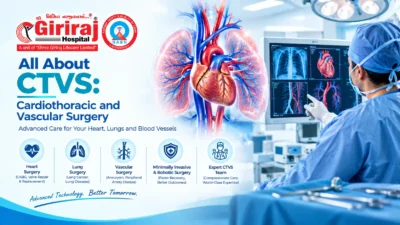


When a cardiologist recommends surgery, or a leg wound will not heal, the next question is often where to go for cardiothoracic and vascular surgery (CTVS) care. This guide explains what CTVS covers, what to look at when choosing a hospital and surgeon, how to plan for follow-up, and how cost and insurance work.
It also describes the Cardiothoracic and Vascular Surgery department at Shree Giriraj Hospital, Rajkot. The guide is general information and applies to any hospital you consider. For a detailed explanation of the conditions, tests, procedures and recovery in this specialty, see our companion article, All About CTVS.
What CTVS Covers
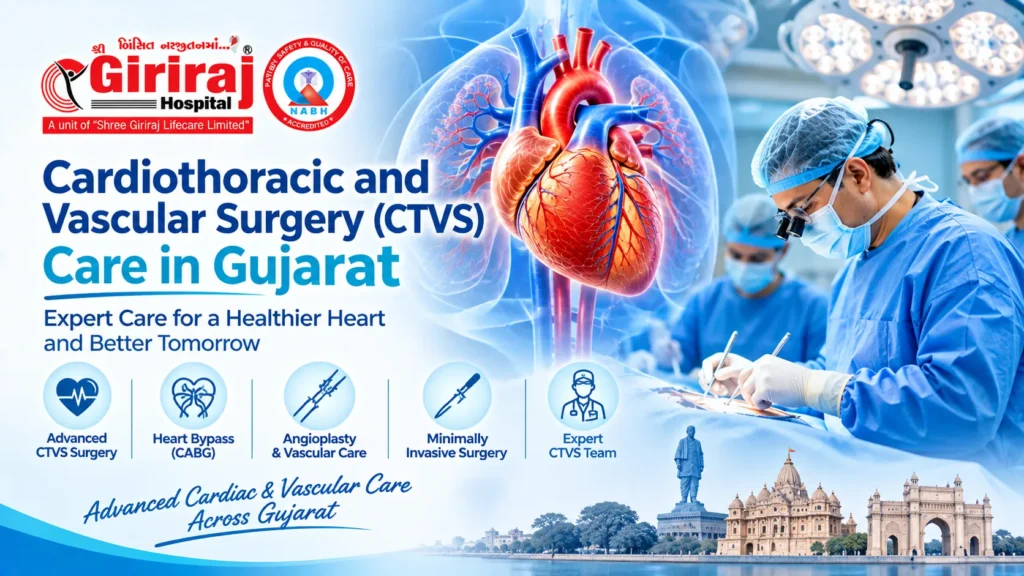
Cardiothoracic and vascular surgery is the surgical specialty for conditions of the heart, lungs, chest and blood vessels. In general it includes:
- Cardiac surgery: for example, coronary artery bypass grafting (CABG) and heart valve repair or replacement
- Thoracic surgery: conditions of the lungs, the chest wall and the lining around the lungs
- Vascular surgery: conditions of the arteries and veins outside the heart, such as peripheral artery disease, varicose veins and aneurysms
Which procedures a particular hospital performs differs. Procedures performed at Shree Giriraj Hospital.
| Clinical note Symptoms such as leg pain, swelling or a wound that does not heal can have vascular causes, and chest or breathing symptoms can have heart, lung or vessel causes. This is why a proper evaluation, and not self-diagnosis, matters. |
When to Seek Care
A doctor may advise a CTVS consultation when tests show a condition that may need surgery, or when symptoms point to a heart, lung or vascular problem. Examples include:
- Heart disease with blockages or valve problems identified on tests
- Chest pain or breathlessness that is persistent or getting worse
- Leg pain on walking, cold or discoloured feet, or wounds that do not heal
- Swollen, painful or visibly enlarged veins
- A lung or chest condition found on imaging
| When to seek emergency care immediately Severe chest pain, breathlessness at rest, sudden severe chest or back pain, or a limb that suddenly becomes painful, pale, cold or numb are medical emergencies. Call for an ambulance or go to the nearest emergency department without delay. The hospital’s emergency line is +91 99099 71130 . See the Ambulance Services page. Emergency cardiac and vascular care |
What to Look at When Choosing CTVS Care
A long list of names in a directory does not tell you what to look for. These points are useful for any hospital and surgeon.
| What to look at | Why it matters |
|---|---|
| The surgeon’s qualification and registration number | CTVS is a super-speciality. Ask for the registered qualification, such as an M.Ch. in Cardiothoracic and Vascular Surgery, and the registration number, and check it with the medical council. |
| Coordination with cardiology, anaesthesia and critical care | Complex cases often involve several specialities working together. |
| Intensive care and post-operative monitoring | Close monitoring after major surgery is an important part of care. |
| Range of conditions handled | Cardiac, thoracic and vascular conditions can overlap, so ask which are treated at the hospital. |
| Cost and insurance guidance | A clear estimate and information on coverage help you plan before a major procedure. |
| Follow-up arrangements | Recovery involves several follow-up visits, so ask how follow-up will work, including if you live some distance away. |
The Doctors page lists the hospital’s consultants with their qualifications.
When Referral to Another Centre May Be Considered
Not every condition is treated at every hospital. Some conditions, such as certain complex congenital heart conditions, heart or lung transplantation, or cases that need a very specific sub-specialist, may need a centre with particular services. Your doctors will tell you if referral is advisable for your case, and a second opinion is always an option.
If you want to discuss a diagnosis or recommendation before deciding, the Second Opinion & Teleconsultation page explains how to speak with a specialist remotely..
Questions to Ask a Cardiac or Vascular Surgeon
- What is your qualification and registration number?
- Why is surgery recommended in my case, and what are the alternatives?
- What are the risks, given my age and general health?
- How many procedures like mine are performed at this hospital, and what happens if complications occur?
- How will anaesthesia and intensive care be handled?
- What does recovery involve, and how will follow-up work?
- What will it cost, and what does the estimate include?
- Is my insurance or PM-JAY accepted for this procedure?
Diagnosis and Planning
Surgical planning depends on tests such as an ECG, echocardiogram, angiography, imaging of the chest or blood vessels, and blood tests. Some non-invasive cardiac and imaging tests are included in the Non-Invasive Cardiology & Radiology Package, and the Health Check-Up Plan page lists other packages.
Cost Considerations
The cost of CTVS surgery depends on the procedure, its complexity, whether minimally invasive techniques are used, and the length of hospital and ICU stay. A personalised estimate is usually more useful than a general comparison, because each case differs.
- Type of procedure: cardiac, thoracic or vascular
- Complexity of the condition and the technique used
- Length of hospital and ICU stay
- Any additional procedures needed
Coverage under PM-JAY depends on the scheme’s package list, the patient’s eligibility and whether the hospital is empanelled for the procedure. Private insurance coverage depends on the policy terms. Our Ayushman Bharat (PM-JAY) guide explains eligibility and the cashless process. The hospital’s insurance desk helps with document verification and claim coordination . For an estimate, use the Contact Us page.
Do’s and Don’ts When Choosing CTVS Care
| Do | Do not |
|---|---|
| Ask about the surgeon’s registered qualification and registration number | Assume every “heart surgeon” title means the same training |
| Plan for follow-up visits, not just the initial surgery | Overlook the logistics of several follow-up appointments after major surgery |
| Ask which cardiac, thoracic and vascular conditions the hospital treats | Assume you need a different provider for each type of concern without asking |
| Get a cost estimate and information on coverage before the procedure | Wait until after surgery to understand your coverage |
| Consider a second opinion for major surgery | Decide on a major procedure from general online information alone |
| Think about family support during recovery as part of your planning | Underestimate the support you will need after surgery |
Common Myths About CTVS Care
| Myth | Fact |
|---|---|
| A cardiologist’s finding of a blockage always means surgery | Treatment options include medicines, angioplasty and surgery. The choice depends on the pattern of disease and the patient’s health. |
| More surgeons listed in a directory means better care | A directory list does not show how a hospital coordinates care. Qualifications, facilities and a clear explanation from your doctor are more informative. |
| PM-JAY coverage depends on the size of the city | PM-JAY eligibility depends on the beneficiary’s status, the hospital’s empanelment and the scheme’s package list. |
| Leg pain is never connected to a vascular problem | Leg pain, swelling or slow-healing wounds can have vascular causes and should be evaluated. |
| Cardiac and vascular conditions always need separate specialists | CTVS is often grouped as one specialty. Which doctor treats which condition depends on training and the case, and your doctor will advise. |
CTVS Services at Shree Giriraj Hospital
The points below describe services at the hospital. Please confirm current availability by calling the hospital or visiting the Contact Us page.
- Cardiothoracic and Vascular Surgery department: evaluation and surgical care for cardiac, thoracic and vascular conditions. See the Cardiothoracic and Vascular Surgery page.
- Related departments: Cardiology, Anesthesiology and Critical Care work with the surgical team.
- Post-operative care: patients needing monitoring may be looked after in the ICCU.
- Facilities: see the Hospital Infrastructure page. Department location: [Rajkot Main / Kuvadva.
- Doctors: the Doctors page lists consultants with qualifications, registration numbers and OPD timings
- Appointments: use the Book an Appointment page, or call the numbers on the Contact Us page.
Frequently Asked Questions
What does a CTVS surgeon treat?
A CTVS surgeon treats surgical conditions of the heart, lungs, chest and blood vessels, such as coronary artery disease, valve disease, lung and chest conditions, and arterial and venous disease outside the heart.
How do I choose a CTVS surgeon?
Check the registered qualification and registration number, ask about experience with your procedure, find out how the surgeon works with cardiology, anaesthesia and critical care, and ask about ICU support, costs and follow-up.
Do I have to travel to another city for heart surgery?
It depends on the condition and on which procedures a hospital performs. Ask the hospital what it offers for your condition. Your doctors will advise if your case needs a centre with particular services.
What questions should I ask a cardiac surgeon?
Ask about the qualification, the reason surgery is advised, the alternatives, the risks, the experience with your procedure, how anaesthesia and intensive care are handled, recovery and follow-up, and the estimated cost.
Is vascular surgery covered under Ayushman Bharat (PM-JAY)?
Coverage depends on the scheme’s package list, the patient’s eligibility and the hospital’s empanelment. Our Ayushman Bharat (PM-JAY) guide explains eligibility and the cashless process.
Does distance from the hospital matter for recovery?
Recovery involves several follow-up visits, so it helps to plan how you will attend them and who will support you at home. Ask the hospital how follow-up is arranged.
Which departments work with the CTVS team?
Cardiology, Anesthesiology and Critical Care work with the surgical team .
Where can I read more about what CTVS treats?
Our detailed guide, All About CTVS, explains the conditions, tests, procedures and recovery in this specialty.
Can I get a second opinion?
Yes. See Second Opinion & Teleconsultation.
How do I book a consultation?
Use the Book an Appointment page, or call the numbers listed on the Contact Us page.
Conclusion
Choosing where to have cardiothoracic or vascular surgery is a personal decision. Checking the surgeon’s registered qualification, understanding how the team works together, planning for follow-up and getting a clear cost estimate will help you take part in the decision.
Information on the Cardiothoracic and Vascular Surgery department at Shree Giriraj Hospital, Rajkot is on its department page. For appointments, see Book an Appointment, or use Contact Us for questions before your visit.
Related reading: All About CTVS | Ayushman Bharat (PM-JAY) guide | bypass surgery (CABG) patient guide| All articles
| Disclaimer This article is for patient information only. It is not a substitute for consultation with a registered medical practitioner and does not constitute diagnosis or treatment advice. In an emergency, seek care immediately. Shree Giriraj Lifecare Private Limited, Rajkot |