





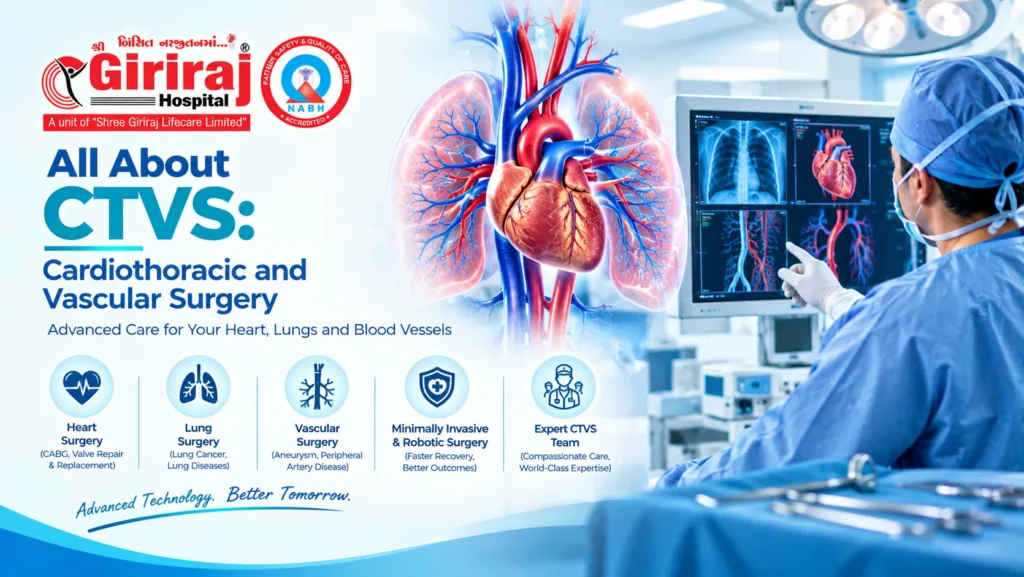
CTVS – Cardiothoracic and Vascular Surgery – is a term many patients first encounter on a referral slip or hospital signboard, without a clear sense of what it actually covers. It’s a broader specialty than most people expect, spanning the heart, lungs and chest, and the blood vessels throughout the body.
At Shree Giriraj Hospital, the Cardiothoracic and Vascular Surgery department is led by Dr. Bhahul Vekariya, M.Ch. (Cardiothoracic & Vascular Surgery), providing advanced surgical care for diseases affecting the heart, lungs, chest, and blood vessels using modern surgical techniques and evidence-based protocols. For readers researching a specific cardiac procedure, our companion articles on finding the best cardiologist in Rajkot and bypass surgery specifically cover that ground in depth – this guide takes the broader view across everything CTVS actually covers.
This guide explains what CTVS means, the symptoms across each of its three areas, how conditions are diagnosed, the full range of treatments available, what recovery looks like, and how cost and insurance coverage work.
What Does CTVS Actually Cover?
CTVS is often assumed to mean just “heart surgery,” but it genuinely spans three distinct categories of care, all handled by the same surgical team.
Cardiac (Heart) Surgery
This includes coronary artery bypass grafting (CABG), valve repair and replacement, congenital heart defect correction, and aortic surgery – the procedures most people associate with the term.
Thoracic (Chest) Surgery
This covers lung surgery, mediastinal tumour surgery, and treatment for pleural disease – conditions affecting the chest cavity beyond the heart itself.
Vascular Surgery
This addresses peripheral artery bypass surgery, varicose vein surgery, aneurysm repair, carotid artery surgery, and endovascular procedures – treating blood vessels throughout the body, not just those directly supplying the heart.
| Think of it this way If cardiology is like diagnosing and managing the heart’s “engine” with medication and minimally invasive procedures, CTVS is the surgical team that steps in when the engine, the surrounding chest structures, or the body’s “piping” – its blood vessels – need direct surgical repair. |
Symptoms Across the Three Areas of CTVS
Because CTVS spans three distinct areas, the symptoms that might lead to a consultation vary accordingly.
Cardiac Symptoms
- Persistent chest pain or pressure
- Shortness of breath
- Fatigue during minimal activity
- Irregular heartbeat
- Dizziness or fainting
Vascular Symptoms
- Pain in the legs while walking, a sign of peripheral artery disease
- Non-healing wounds on the feet due to poor circulation
| When to Seek Emergency Care Immediately Severe chest pain, breathlessness at rest, or sudden leg pain with colour changes are emergencies. Call the hospital’s ambulance service immediately or reach the nearest emergency department without delay – do not attempt to drive yourself. |
Symptoms suggesting broader cardiac risk are also worth understanding in more depth – our guide on early signs of heart disease you should never ignore covers this in detail.
Conditions Treated, by Category
Understanding which category a condition falls into helps set expectations for treatment through the Cardiothoracic and Vascular Surgery department.
| Category | Conditions Treated | Example Procedures |
|---|---|---|
| Cardiac | Coronary artery disease, valve disease, congenital heart defects, aortic disease | CABG, valve repair/replacement, aortic surgery |
| Thoracic | Lung tumours, mediastinal tumours, pleural disease | Lung surgery, mediastinal tumour surgery |
| Vascular | Peripheral artery disease, varicose veins, aneurysms, carotid artery disease | Peripheral bypass, varicose vein surgery, aneurysm repair |
| Clinical Insight Vascular symptoms like leg pain while walking are often mistaken for simple ageing or fatigue rather than recognised as peripheral artery disease – a condition treated by the same CTVS team as heart surgery. If leg pain consistently appears with walking and eases with rest, it’s worth raising specifically during a consultation. |
How CTVS Conditions Are Diagnosed
Diagnosis depends on which of the three areas is involved, combining imaging, functional testing, and specialist evaluation.
- Coronary angiography: shows blockages in the heart’s blood vessels for cardiac cases.
- Echocardiogram: assesses heart valve function and overall pumping ability.
- CT or MRI imaging: used for thoracic conditions like lung or mediastinal tumours, and for vascular conditions like aneurysms.
- Doppler ultrasound: assesses blood flow for suspected peripheral artery disease or varicose veins.
Many cardiac-specific tests are available through the Non-Invasive Cardiology & Radiology Package, giving patients a structured starting point before a CTVS consultation.
Treatment Options
The Cardiothoracic and Vascular Surgery department offers comprehensive surgical solutions across all three categories, working in close coordination with Cardiology, anaesthesiology, and critical care specialists.
Cardiac Procedures
- Coronary Artery Bypass Grafting (CABG)
- Valve repair and valve replacement surgery
- Congenital heart defect correction
- Aortic surgery
- Minimally invasive cardiac surgery
Thoracic Procedures
- Lung surgery
- Mediastinal tumour surgery
- Pleural disease treatment
Vascular Procedures
- Peripheral artery bypass surgery
- Varicose vein surgery
- Aneurysm repair
- Carotid artery surgery
- Endovascular procedures
Where CTVS treatment is covered under government health insurance, our team helps patients navigate the process. Our Ayushman Bharat (PM-JAY) guide explains eligibility, and our team can confirm your specific coverage through Book an Appointment.
The Procedure and Hospital Stay – What to Expect
Preparing for Surgery
- Complete all pre-operative tests and cardiac or vascular clearance as advised
- Inform your surgical team of all current medications, especially blood thinners
- Follow fasting instructions exactly as provided
- Arrange for family support during hospital stay and early recovery
On the Day
- Anaesthesia: general anaesthesia is administered, managed by the Anesthesiologist team throughout.
- The procedure: duration varies significantly by procedure type – cardiac surgery often takes several hours, while some vascular procedures are shorter.
- Advanced facilities: procedures are supported by modular operation theatres, a cardiopulmonary bypass (heart-lung) machine for applicable cardiac cases, and advanced intraoperative monitoring.
Hospital Stay
Higher-complexity procedures are supported by Critical Care and advanced post-operative cardiac monitoring, ensuring close observation during the most critical recovery period.
Recovery After CTVS Surgery
Recovery timelines vary meaningfully depending on which type of procedure is performed, though the department’s own guidance generally places recovery at approximately 4 to 8 weeks depending on the specific surgery.
Early Recovery
- Do: follow activity restrictions and wound care instructions exactly
- Don’t: lift heavy objects or drive during the initial recovery period
Ongoing Recovery
Many patients benefit from structured rehabilitation through Physiotherapy Services to rebuild strength and stamina, particularly after cardiac or major thoracic surgery.
| A Patient’s Story (Representative Example) A 58-year-old shopkeeper from Rajkot had lived with leg pain while walking for over a year, assuming it was simply ageing. A vascular evaluation identified significant peripheral artery disease, treated with bypass surgery. Within two months, he was walking without pain – a reminder that vascular symptoms deserve the same attention as cardiac ones, since they’re treated by the same specialist team. |
Cost and Insurance Coverage
CTVS surgery cost varies considerably depending on which of the three categories the procedure falls into, its complexity, and length of hospital stay. Rather than a single figure, the department provides a personalised estimate once diagnostic evaluation is complete.
Factors That Affect Cost
- Category and specific type of procedure – cardiac, thoracic, or vascular
- Whether minimally invasive or open techniques are used
- Length of hospital and critical care stay required
- Any additional complexity specific to the individual case
Many CTVS procedures may be covered under PM-JAY for eligible beneficiaries. Shree Giriraj Hospital’s insurance desk can help verify your specific coverage – reach our team through Contact Us for a personalised estimate.
Do’s and Don’ts for CTVS Patients
| Do This | Don’t Do This |
|---|---|
| Mention leg pain while walking to your doctor, even if mild | Dismiss leg pain as normal ageing without evaluation |
| Ask specifically which category – cardiac, thoracic, or vascular – your condition falls into | Assume all CTVS surgery is the same type of procedure |
| Disclose your complete medical history, including all medications | Withhold information about supplements or existing conditions |
| Ask about PM-JAY and insurance coverage before your procedure date | Wait until after surgery to understand your coverage |
| Follow post-operative activity restrictions exactly as advised | Rush back to normal activity before your surgical team confirms it’s safe |
| Get a second opinion for major surgical decisions if you’re unsure | Rush into major surgery without feeling fully informed |
Common Myths About CTVS
| Myth | Fact |
|---|---|
| CTVS only means heart surgery | CTVS genuinely covers three areas – cardiac, thoracic (chest and lungs), and vascular (blood vessels throughout the body) |
| Leg pain while walking is just a normal part of ageing | Persistent leg pain with walking can be a sign of peripheral artery disease, a treatable vascular condition |
| Vascular surgery and cardiac surgery are handled by completely different teams | At many hospitals, including this one, the same CTVS-trained surgeon manages both cardiac and vascular procedures |
| All CTVS surgery requires the heart-lung machine | Many procedures, including several vascular and some cardiac cases, use minimally invasive techniques that don’t require cardiopulmonary bypass |
| Recovery from any CTVS procedure takes the same amount of time | Recovery varies by procedure type and complexity, generally ranging from about 4 to 8 weeks depending on the surgery |
| For advanced CTVS care, you need to travel to a big city | Shree Giriraj Hospital’s CTVS department, led by a qualified M.Ch. surgeon, provides comprehensive cardiac, thoracic, and vascular surgical care right here in Rajkot |
CTVS Care at Shree Giriraj Hospital
The Cardiothoracic and Vascular Surgery department at Shree Giriraj Hospital is led by Dr. Bhahul Vekariya, M.B.B.S., M.S. (General Surgery), M.Ch. (Cardiothoracic & Vascular Surgery), providing high-risk cardiac procedures, emergency heart surgery management, and advanced minimally invasive techniques, working closely with Cardiology, anaesthesiology, and Critical Care for comprehensive, coordinated care.
The department is supported by advanced modular operation theatres, a cardiopulmonary bypass (heart-lung) machine, intraoperative monitoring systems, vascular imaging systems, endovascular surgical instruments, and advanced ICU and post-operative cardiac monitoring.
To take the next step, meet our specialist team by consulting Dr. Bhahul Vekariya’s profile or the wider Doctors page, or if you’d like to discuss a diagnosis remotely first, Second Opinion & Teleconsultation is available. When you’re ready, Book an Appointment with our Cardiothoracic and Vascular Surgery team.
Frequently Asked Questions
What does CTVS stand for?
CTVS stands for Cardiothoracic and Vascular Surgery, covering surgical care for the heart, lungs and chest, and blood vessels throughout the body.
What is the difference between cardiology and CTVS?
Cardiology focuses on diagnosing and medically managing heart conditions, including non-surgical procedures like stenting, while CTVS is the surgical specialty that performs open and minimally invasive heart, chest, and vascular surgery.
What is peripheral artery disease?
Peripheral artery disease occurs when blood vessels supplying the limbs become narrowed or blocked, commonly causing leg pain while walking and, in more advanced cases, non-healing wounds on the feet.
Is vascular surgery covered under Ayushman Bharat (PM-JAY)?
Many CTVS procedures, including certain vascular surgeries, may be covered under PM-JAY for eligible beneficiaries. Our Ayushman Bharat / PM-JAY guide explains eligibility in detail.
How long does recovery take after heart surgery?
Recovery generally takes approximately 4 to 8 weeks depending on the specific procedure, though this varies by individual health and surgery complexity.
What is an aortic aneurysm?
An aortic aneurysm is a bulge or weakened section of the aorta, the body’s main artery, which can require surgical repair to prevent rupture.
Are minimally invasive options available for CTVS procedures?
Yes, many CTVS procedures are performed using advanced minimally invasive techniques where clinically appropriate.
When is bypass surgery required?
Bypass surgery is generally required when coronary arteries are severely blocked and cannot be adequately managed with medication or stenting alone.
Who leads the CTVS department at Shree Giriraj Hospital?
The department is led by Dr. Bhahul Vekariya, M.Ch. (Cardiothoracic & Vascular Surgery).
How do I book a consultation for a CTVS evaluation?
You can schedule a consultation directly through the Book an Appointment page, or call the hospital’s contact numbers listed on the Contact Us page.
Conclusion
CTVS is broader than most patients expect – covering the heart, chest and lungs, and blood vessels throughout the body – and understanding which category applies to your situation helps replace uncertainty with a clearer next step.
Whether your concern is cardiac, thoracic, or vascular, the Cardiothoracic and Vascular Surgery team at Shree Giriraj Hospital, Rajkot, led by Dr. Bhahul Vekariya, is available to help. You can book an appointment directly online, or reach our team through the Contact Us page for any questions before your visit.
Read More: Best Cardiologist in Rajkot | Best Bypass Surgeon in Rajkot | Ayushman Bharat / PM-JAY Guide – or explore more articles on our Blogs page.