




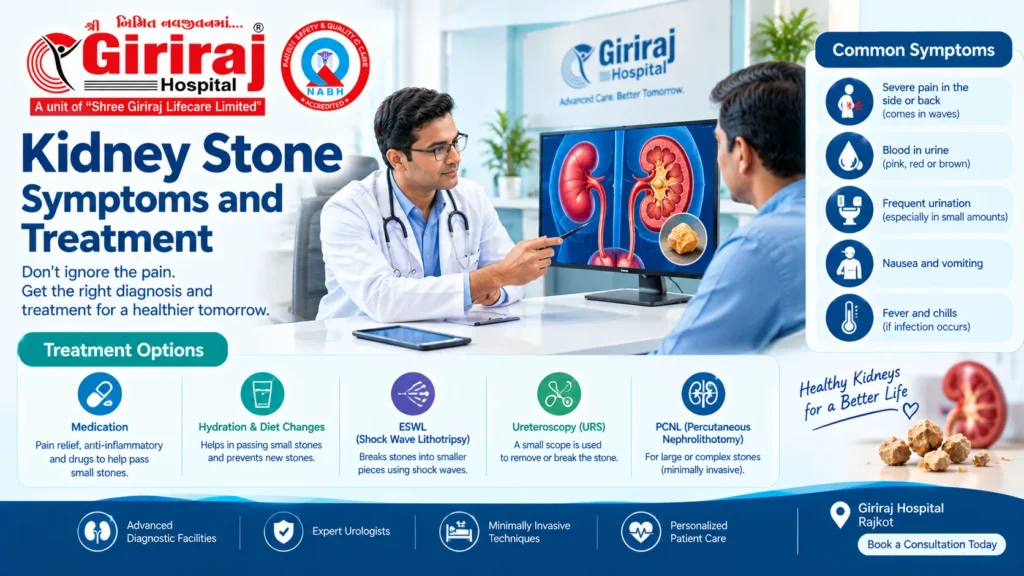
Kidney stone symptoms and treatment are especially relevant across Gujarat, where hot summers, high dietary salt intake, and low fluid consumption combine to make kidney stones one of the most common reasons patients visit a urologist. That sudden, severe pain many describe as one of the worst they’ve ever experienced often catches patients completely off guard, with no prior warning.
Gujarat consistently reports among the highest rates of kidney stones in India, largely linked to its hot, dry climate and regional dietary patterns (Source: Indian Journal of Urology, 2023).At Shree Giriraj Hospital’s Urology department in Rajkot, Dr. Naresh Sapariya and our expert urology team evaluate and treat kidney stones daily-from small stones managed with targeted medication to complex cases requiring advanced minimally invasive surgery.
What Is a Kidney Stone?
A kidney stone is a hard deposit made of minerals and salts that forms inside the kidney when urine becomes concentrated, allowing crystals to stick together and grow. Stones can range from as small as a grain of sand to as large as a golf ball, and their size largely determines whether they pass on their own or need medical treatment.
Think of kidney stones like sugar crystals forming at the bottom of a glass of overly concentrated syrup. When there isn’t enough liquid to keep everything dissolved, particles start clumping together. In the kidney, insufficient fluid intake creates a similar concentrated environment, allowing minerals like calcium and oxalate to crystallise into a stone over time.
This matters to nearly every adult in Gujarat because the region’s hot climate and common dietary patterns create exactly the conditions kidney stones need to form. Understanding the early signs and appropriate treatment can prevent a routine issue from becoming a recurring, painful problem.
Warning Signs of Kidney Stones You Should Never Ignore
Recognising the symptoms early helps patients get treatment before a stone causes a more serious blockage or infection.
Signs to watch for:
- Sudden, severe pain in the back or side, below the ribs
- Pain that radiates to the lower abdomen and groin
- Pain that comes in waves, fluctuating in intensity
- Pink, red, or brown-tinged urine
- Cloudy or foul-smelling urine
- Frequent urge to urinate, or pain during urination
- Nausea and vomiting alongside the pain
Early Signs
Mild, intermittent back or side discomfort, sometimes barely noticeable, can be an early sign of a small stone beginning to move within the kidney.
Advanced or Serious Signs
Severe pain accompanied by fever and chills suggests a possible infection alongside the stone, which needs urgent medical attention rather than home management.
When to see a doctor immediately: Severe pain combined with fever, chills, or inability to urinate needs emergency evaluation, as this may indicate an infected or completely blocked kidney. Visit the nearest emergency department without delay.
A commonly missed sign is blood in the urine that is only visible under laboratory testing, not to the naked eye – this is why a urine test is often part of the diagnostic process even when urine looks normal.
Common Causes and Risk Factors for Kidney Stones
Understanding why kidney stones form helps patients take practical steps to reduce their risk of developing new stones.
Common Causes
- Insufficient fluid intake, leading to concentrated urine
- Diets high in salt and animal protein
- Excess oxalate-rich foods, such as certain leafy greens and nuts, in susceptible individuals
- Underlying metabolic conditions affecting mineral levels in urine
- Reduced urine output due to hot climates and heavy sweating
Risk Factors
- Living in a hot, dry climate like Gujarat, which increases fluid loss through sweat
- Family history of kidney stones
- Obesity and sedentary lifestyle
- Diabetes and high blood pressure
- Previous history of kidney stones, which increases risk of recurrence
Gujarat’s climate is a particularly significant risk factor – outdoor workers and anyone with high daily fluid loss through sweat are especially prone to concentrated urine, the key condition that allows stones to form.
Types of Kidney Stones
Understanding the different types of kidney stones helps explain why treatment and prevention strategies can vary between patients.
| Type of Stone | What Causes It | What It Means for You |
|---|---|---|
| Calcium Oxalate Stones | The most common type, linked to diet and low fluid intake | Often preventable with dietary and hydration changes |
| Uric Acid Stones | Linked to high-protein diets and conditions like gout | May respond to specific dietary and medical management |
| Struvite Stones | Often associated with urinary tract infections | Require infection treatment alongside stone management |
| Cystine Stones | Caused by a rare inherited condition | Require specialised, ongoing management |
Calcium oxalate stones account for the large majority of cases seen in Gujarat, largely influenced by regional diet and hydration patterns. Your doctor may recommend a stone analysis after treatment to confirm the exact type and guide future prevention.
How Are Kidney Stones Diagnosed?
A urologist or nephrologist uses a combination of imaging and tests to confirm a kidney stone and determine the best treatment approach.
Imaging Tests
A CT scan or ultrasound of the abdomen is used to detect the stone’s size, location, and number, guiding the treatment decision.
Blood and Urine Tests
Blood tests check kidney function and mineral levels, while a urine test can identify infection or blood not visible to the naked eye.
What the Results Mean
A small stone, typically under 5mm, often has a good chance of passing naturally, while larger stones usually require active treatment to remove or break them down.
Diagnosis is usually quick, often completed within a single emergency or outpatient visit, and directly guides whether the stone can be managed with medication or needs a procedure.
Treatment Options for Kidney Stones
Led by Dr. Naresh Sapariya, our urology team evaluates each patient individually to recommend the least invasive, most effective approach-whether that is laser lithotripsy, ureteroscopy, or PCNL
Treatment depends on the size, location, and type of stone, along with whether it is causing a blockage or infection. Your doctor will recommend the best option based on your individual case.
Non-Surgical / Medical Management
For smaller stones likely to pass naturally, treatment often involves pain management, increased fluid intake, and medication to help relax the urinary tract and ease stone passage.
Procedural / Surgical Treatment
For larger stones or those not passing on their own, procedures such as shockwave lithotripsy (breaking the stone with sound waves), ureteroscopy, or PCNL (percutaneous nephrolithotomy, for larger stones) may be recommended.
When Each Option Is Chosen
Your doctor will recommend the best option based on your individual case, weighing stone size, location, and whether there are signs of infection or blockage requiring more urgent intervention.
Shree Giriraj Hospital’s Urology and Nephrology teams work together to determine the most appropriate, least invasive effective treatment for each patient’s specific stone.
Kidney Stone Procedure – Step by Step
For patients who need a procedure to remove or break down a stone, understanding what happens can significantly ease anxiety.
Pre-Procedure Preparation
Patients typically undergo imaging confirmation and blood tests, with fasting instructions provided if the procedure requires anaesthesia.
What happens during a typical procedure (such as ureteroscopy):
- Anaesthesia is administered by the anaesthesiology team
- A thin scope is passed through the urinary tract to locate the stone
- The stone is fragmented using specialised instruments, or removed directly if small enough
- A temporary stent may be placed to support healing and urine flow
- The patient is moved to recovery for monitoring
Post-Procedure Monitoring
Most patients are monitored for a few hours after the procedure, with many able to go home the same day or after a short stay, depending on the procedure type.
Team Involved
Senior Consultant Urologist Dr. Naresh Sapariya leads the procedure, supported by a specialized anaesthesiology and surgical nursing team trained in minimally invasive endourology.
Expected Duration
Procedure duration varies by type, typically ranging from 30 minutes to about an hour for common stone-removal procedures.
Throughout the procedure, a specialist team is with you at every step, and most kidney stone procedures use minimally invasive techniques that support a relatively quick recovery.
Recovery and Life After Kidney Stone Treatment
Recovery after kidney stone treatment is generally quick, though prevention of future stones becomes an important long-term focus.
- First few days: Rest and increased fluid intake, with mild discomfort common after procedures
- First week: Most patients resume normal activity, avoiding heavy lifting if a stent was placed
- Weeks 2–4: Follow-up imaging may confirm the stone has fully cleared
- Long-term: Dietary and hydration changes to reduce risk of new stones forming
Fluid intake becomes especially important long-term – increasing daily water intake meaningfully reduces the risk of forming new stones, particularly for patients in Gujarat’s hot climate.
Patient story: A 40-year-old construction worker from Rajkot experienced sudden, severe pain that sent him to the emergency department at Shree Giriraj Hospital. A CT scan confirmed a kidney stone, which was treated with a minimally invasive procedure. He was back to work within days, with clear guidance on hydration to prevent future stones.
Most patients recover quickly from kidney stone treatment, and understanding prevention strategies significantly reduces the chance of a repeat episode.
Cost and Ayushman Card Coverage for Kidney Stone Treatment
We understand that cost of treatment is a major concern for most families.
The cost of kidney stone treatment varies depending on the type of procedure needed, stone size and location, and length of hospital stay. Non-surgical management is generally less costly than procedures like PCNL for larger stones.
Ayushman Bharat (PM-JAY) covers kidney stone treatment and related procedures for eligible patients under the scheme, including cashless treatment where applicable. Shree Giriraj Hospital’s Ayushman Mitra desk assists patients through the eligibility check and cashless process.
Speak to our team for a personalised cost estimate based on your specific case.
Do’s and Don’ts for Preventing and Managing Kidney Stones
| Do This | Don’t Do This |
|---|---|
| Drink plenty of water throughout the day, especially in hot weather | Wait until you feel thirsty to drink water |
| Reduce salt intake in your daily diet | Consume excess salty snacks and processed foods regularly |
| Moderate intake of oxalate-rich foods if you’ve had calcium oxalate stones | Assume all healthy foods are automatically safe for stone prevention |
| Seek medical evaluation for sudden, severe back or side pain | Try to “wait out” severe pain without medical evaluation |
| Follow up with stone analysis after treatment, if recommended | Skip prevention guidance once the immediate pain resolves |
| Maintain a healthy weight and stay physically active | Ignore obesity or sedentary habits as stone risk factors |
Consistent hydration is the single most effective habit for reducing kidney stone risk, particularly important given Gujarat’s climate.
Common Myths About Kidney Stones
| Myth | Fact |
|---|---|
| Kidney stones always require surgery | Many smaller stones pass naturally with fluids and pain management, without needing a procedure. |
| Drinking milk or eating calcium causes kidney stones | Dietary calcium from food generally does not increase stone risk, and adequate calcium intake is actually recommended for most patients. |
| Once you’ve had a kidney stone, you’ll definitely get another | While recurrence risk exists, proper hydration and dietary changes significantly reduce the chance of forming new stones. |
| Patients from Rajkot or Saurashtra need to travel to Ahmedabad for kidney stone treatment | Shree Giriraj Hospital’s Urology team in Rajkot offers full diagnostic and treatment services, including advanced procedures, without the need to travel. |
| Kidney stone pain always means immediate surgery is needed | Treatment depends on stone size and symptoms – many cases are managed successfully with medication and monitoring first. |
If you have heard something about kidney stones that concerns you, ask our specialist team – clearing up misinformation early helps you make confident, informed decisions.
Why Choose Shree Giriraj Hospital for Kidney Stone Treatment in Rajkot?
Managing kidney stones well depends on accurate diagnosis and access to the full range of treatment options – and that is exactly what shapes how Shree Giriraj Hospital’s Urology team works with patients.
Experienced Urology Team Close to Home
Under the expertise of Dr. Naresh Sapariya (M.S., M.Ch. Urology), Shree Giriraj Hospital brings specialist kidney stone care to Rajkot, so patients across Saurashtra do not need to travel to a bigger city for reliable diagnosis and treatment.
Full Range of Treatment Options
From medical management to minimally invasive procedures like ureteroscopy and PCNL, our team offers the appropriate treatment matched to each patient’s specific stone.
Comprehensive Diagnostic Support
On-site CT and ultrasound facilities allow stones to be confirmed and evaluated quickly, often within the same emergency or outpatient visit.
Integrated Nephrology Support
Since kidney stones can sometimes affect overall kidney function, our Nephrology department is available for coordinated care when needed.
Insurance and Ayushman Support
Shree Giriraj Hospital is empanelled under PM-JAY / Ayushman Bharat, and the hospital’s team assists with cashless processing for eligible kidney stone treatment.
Our Urology team is ready to help – book a consultation today and get relief from kidney stone symptoms.
Frequently Asked Questions
How do I know if I have a kidney stone?
Sudden, severe pain in the back or side, often radiating to the lower abdomen, along with blood in the urine or nausea, are common signs. A doctor can confirm the diagnosis with imaging.
Can kidney stones pass on their own without treatment?
Yes, smaller stones, typically under 5mm, often pass naturally with increased fluid intake and pain management, though larger stones usually need active treatment.
What is the fastest way to relieve kidney stone pain?
Pain management prescribed by your doctor, along with increased fluid intake, is the standard approach. Severe pain should be evaluated promptly by a medical professional.
Is kidney stone treatment covered under Ayushman Card?
Yes, kidney stone treatment and related procedures are covered for eligible patients under PM-JAY. Our Ayushman Mitra desk can confirm your specific eligibility.
Why are kidney stones so common in Gujarat?
Gujarat’s hot, dry climate leads to higher fluid loss through sweat, which can concentrate urine and increase stone formation risk, especially without adequate water intake.
Can I come to Shree Giriraj Hospital just for a kidney stone evaluation?
Yes. Shree Giriraj Hospital’s Urology department in Rajkot welcomes patients for evaluation and the full range of kidney stone treatment options.
How can I prevent kidney stones from coming back?
Staying well-hydrated, reducing salt intake, and following any specific dietary guidance based on your stone type significantly reduces the risk of recurrence.
What is PCNL surgery for kidney stones?
PCNL (percutaneous nephrolithotomy) is a minimally invasive procedure used for larger kidney stones, where instruments are passed through a small incision in the back to remove the stone directly.
Get Relief from Kidney Stone Pain Today
Kidney stones are common across Gujarat, but understanding the symptoms and treatment options available means you don’t have to manage the pain alone or wonder what comes next. Getting evaluated promptly leads to faster relief and a clear prevention plan for the future.
Our Urology team at both our Rajkot Main and Kuvadva campuses is ready to help you find relief and prevent future stones. Book an appointment with our Urology team today, or contact us to learn more.
Explore more: Kidney Specialist Rajkot | High Blood Pressure Symptoms