





Every month, thousands of women across Rajkot skip periods, battle stubborn acne, or struggle with unexplained weight gain – and many don’t realise these could be signs of a common hormonal condition. If you have been searching for reliable PCOD treatment in Rajkot, you are not alone. Studies suggest nearly 1 in 5 Indian women live with PCOD or PCOS, and cases are rising fastest among women in their twenties and thirties (ICMR National Reproductive Health Data, 2023). Left unmanaged, this hormonal imbalance can affect your periods, weight, skin, and long-term heart health.
At Shree Giriraj Hospital, our High-Risk Gynaecology & Obstetrics team treats women from across Rajkot and Saurashtra with the same clinical standards offered at leading metro hospitals – without the cost, travel, or stress of going to Ahmedabad or Mumbai. Whether your periods have become unpredictable, you are trying to conceive, or you were recently diagnosed and don’t know what comes next, this guide is written for you.
By the end of this article, you will understand what PCOD is, its early warning signs, causes, diagnosis, treatment options available right here in Rajkot, recovery expectations, and how Ayushman Bharat PM-JAY can help cover your treatment cost.
What Is PCOD?
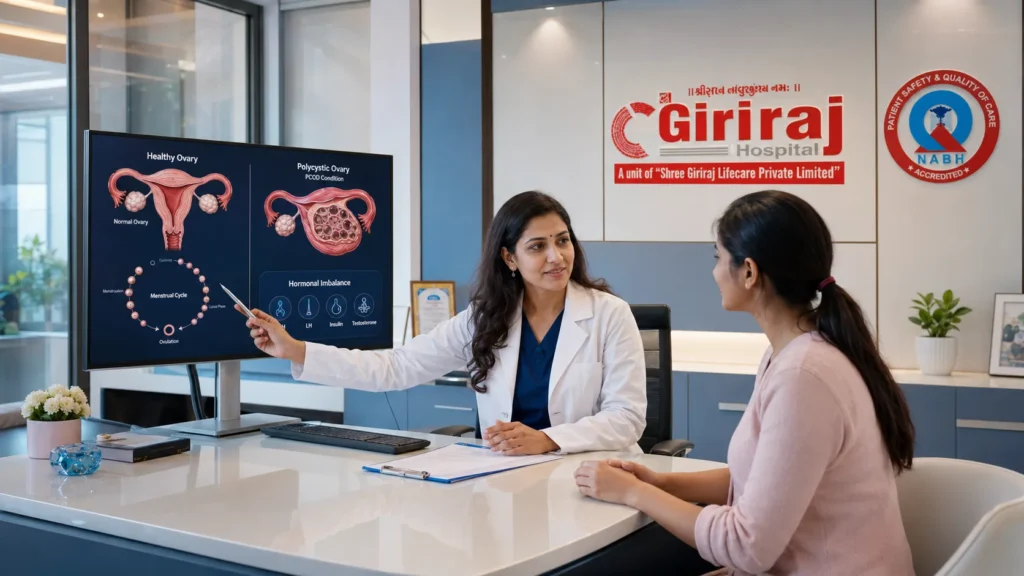
PCOD stands for Polycystic Ovarian Disease. It is a hormonal condition in which the ovaries release eggs that are immature or only partially developed, instead of one healthy, mature egg each month. Over time, these underdeveloped eggs can turn into small fluid-filled sacs on the ovaries.
This disruption interferes with ovulation – the release of a mature egg needed for a normal menstrual cycle and for conception. As a result, women with PCOD often experience irregular or missed periods, weight gain, acne, excess facial or body hair, and difficulty getting pregnant.
PCOD is one of the most common hormonal disorders among Indian women of reproductive age, and it usually begins soon after a girl’s first period. It can affect teenagers as well as women in their twenties, thirties, and forties.
PCOD is often confused with PCOS (Polycystic Ovary Syndrome), a related but more complex condition involving higher levels of androgens, or male hormones, along with insulin resistance. PCOD generally responds well to lifestyle changes and typically causes fewer long-term complications, while PCOS often needs more structured, ongoing management. Our Gynaecology & OBG specialists evaluate every patient individually to confirm which condition is actually present, because the treatment approach differs.
| Think of it this way Your ovaries work like a small assembly line that produces one finished egg every month. In PCOD, this line gets interrupted – eggs leave before they are fully developed, and instead of being released, they pile up as small cysts. The line keeps running, but nothing coming off it is “complete,” which is why periods become irregular and unpredictable. |
Warning Signs and Symptoms of PCOD
Early Warning Signs
- Periods that come later than 35 days apart, or fewer than 8 periods in a year
- Sudden or stubborn weight gain, especially around the abdomen
- Persistent acne along the jawline, chin, or back
- Excess hair growth on the face, chin, or chest (hirsutism)
- Thinning hair or noticeable hair fall from the scalp
- Oily skin that does not improve with regular skincare
- Ongoing fatigue despite adequate sleep
- Mood swings or anxiety around period time
Advanced or Serious Signs
- No periods for 3 months or longer (amenorrhea)
- Difficulty conceiving after 12 months of trying
- Dark, velvety patches of skin on the neck or underarms – a sign of insulin resistance
- Repeated miscarriages
- Loud snoring or pauses in breathing during sleep
- Persistent pelvic pain or heaviness
- Excessive thirst or frequent urination, which can signal prediabetes
| When to See a Doctor Immediately See a gynaecologist without delay if you have had no periods for 3 months or more, sudden severe pelvic pain, bleeding that soaks a pad every hour, or you have been trying to conceive for over a year without success. |
Hair thinning and dark neck patches are two of the most commonly ignored PCOD symptoms. Many women treat them as separate cosmetic issues for years before connecting them to a hormonal cause – delaying diagnosis and treatment.
Causes and Risk Factors
Common Causes
- Insulin resistance: When the body’s cells do not respond well to insulin, insulin levels rise. This pushes the ovaries to produce more androgens, disrupting ovulation.
- Hormonal imbalance: An imbalance between FSH and LH, two hormones that guide egg development, prevents follicles from maturing fully.
- Genetics: A family history of PCOD, PCOS, or type 2 diabetes increases your likelihood of developing it.
- Excess body weight: Extra fat tissue produces additional insulin and hormones that can worsen PCOD symptoms.
- Chronic stress and poor sleep: Ongoing stress raises cortisol levels, which can interfere with reproductive hormone balance.
- Sedentary lifestyle: Long desk hours and limited physical activity, common among working women in Rajkot, can worsen insulin resistance over time.
Who Is at Risk
- Women with a family history of PCOD, PCOS, or diabetes
- Those who gained weight rapidly during their teenage years
- Women with a largely sedentary daily routine
- Women whose regular diet includes fried and sugary foods, such as farsan, fafda, and sweets common across Gujarati households
- Women under chronic academic, family, or work-related stress
- Women with irregular sleep patterns or night shifts
PCOD is not caused by anything a woman did wrong. It develops from a mix of genetics, hormones, and lifestyle factors that are often outside a person’s direct control. Diet and activity changes help manage it – they are not a sign that a patient caused her own condition.
Types, Stages and Classification of PCOD
PCOD does not follow a strict stage 1, 2, 3 system the way some diseases do. Instead, doctors classify it by how severely it is affecting your ovulation, hormone levels, and metabolism. Understanding where you fall helps your Giriraj Hospital gynaecologist decide the right treatment plan.
| Severity | What It Means | Typical Symptoms | Fertility Impact |
|---|---|---|---|
| Mild PCOD | Occasional irregular cycles; only a few underdeveloped follicles on the ovaries | Slightly delayed periods, mild acne | Ovulation usually happens most months; conception rarely affected |
| Moderate PCOD | Frequent irregular cycles; hormonal symptoms more noticeable | Weight gain, persistent acne, excess hair growth | Ovulation becomes irregular; conception may take longer |
| Severe PCOD / PCOS overlap | Long gaps between periods, or periods stop altogether; high androgen and insulin levels | Significant weight gain, hirsutism, scalp hair thinning, dark skin patches | Ovulation is rare; fertility treatment is often needed |
Mild PCOD
For most patients, this means periods that are only slightly delayed and symptoms that are easy to manage with diet and activity changes alone.
Moderate PCOD
Symptoms start affecting daily confidence and comfort – acne, weight gain, and visible hair growth – and usually need medication alongside lifestyle changes.
Severe PCOD / PCOS Overlap
This stage needs closer monitoring, structured medical treatment, and sometimes a surgical option if fertility is a priority and medication alone is not restoring ovulation.
| Clinical insight The biggest misconception about PCOD staging is that it only gets worse with time. In reality, many women move from moderate to mild severity once insulin resistance, weight, and stress are addressed – PCOD severity can improve, not just progress. |
How Is PCOD Diagnosed?
Blood Tests
- LH and FSH levels: measures the balance of two hormones that control ovulation
- Testosterone and androgen levels: checks for excess male hormone that drives acne and hair growth
- Fasting insulin and glucose: screens for insulin resistance, a key driver of PCOD
- Thyroid profile (TSH): rules out thyroid problems that mimic PCOD symptoms
- Lipid profile: checks cholesterol levels, since PCOD can raise long-term heart risk
Imaging Tests
- Transvaginal or abdominal ultrasound: examines the ovaries for multiple small, underdeveloped follicles – sometimes described as a “string of pearls” pattern – and checks ovary size
Other Procedures
- Pelvic examination and BMI/waist measurement: assesses physical signs linked to PCOD
- Endometrial evaluation: recommended occasionally if periods have been absent for a long time, to confirm the uterine lining is healthy
Your results are reviewed together, not in isolation. One abnormal blood test alone does not confirm PCOD – our specialists on our doctors page match your symptoms, scan, and blood work before finalising a diagnosis.
Treatment Options for PCOD
PCOD treatment focuses on managing symptoms and restoring regular ovulation, rather than a single one-time cure. Your plan depends on your severity, symptoms, and whether you are trying to conceive.
Non-Surgical / Medical Management
- Lifestyle changes: Losing just 5 to 10% of body weight through diet and regular activity often restores ovulation on its own.
- Hormonal medication: Combined oral contraceptive pills help regulate periods and lower androgen levels.
- Anti-androgen medication: Reduces excess hair growth and acne over several months.
- Insulin-sensitising medication: Improves how the body uses insulin, which can restore more regular cycles.
- Ovulation induction: For women trying to conceive, medications stimulate the ovaries to release a mature egg.
Our High-Risk Gynaecology & Obstetrics department manages the majority of PCOD cases through this medical route, with regular monitoring to track your response.
Surgical / Procedural Treatment
- Laparoscopic Ovarian Drilling (LOD): A minimally invasive keyhole procedure considered when medication alone does not restore ovulation, particularly for women trying to conceive. Small, controlled punctures reduce androgen-producing tissue in the ovary and can help restore regular ovulation.
This procedure is performed at Shree Giriraj Hospital by our gynaecology surgical team, with backup support from our Laparoscopic & General Surgery department for any related surgical needs.
Advanced or Emerging Treatments
Structured nutrition counselling and physiotherapy-guided exercise plans support long-term hormone balance. For women whose fertility does not improve with ovulation induction or LOD, our team can guide referral for assisted reproduction such as IUI or IVF.
Patients treated under Ayushman Bharat PM-JAY may have eligible hospitalisation and surgical procedures, including laparoscopic ovarian drilling, covered under the scheme, subject to eligibility and medical necessity – our Ayushman Mitra desk can confirm your specific coverage before treatment begins.
Laparoscopic Ovarian Drilling: Procedure Step by Step
Before the Procedure
- Fasting for 6 to 8 hours before surgery, as advised by your anaesthetist
- Pre-anaesthesia blood tests and fitness check
- Informing the team of any existing medication or allergies
- Arranging a family member or caregiver to accompany you
- Signing informed consent after your surgeon explains the procedure in detail
- You are given general anaesthesia so you remain asleep and pain-free throughout.
- A small incision, usually near the navel, is made to insert a laparoscope – a thin tube with a camera.
- The surgeon views both ovaries in detail on a screen.
- Using controlled electrocautery or laser, a few small punctures are made on each ovary to reduce androgen-producing tissue.
- The entire procedure typically takes less than 60 minutes.
- Instruments are removed and the small incisions are closed with dissolvable stitches.
After the Procedure / Recovery Ward
You are moved to the recovery ward for monitoring as the anaesthesia wears off. Most patients are discharged within 24 hours, with mild soreness for 2 to 3 days that settles with prescribed medication. If your case involves other health conditions, our ICCU team remains on standby to provide extra monitoring and support.
At every step – before, during, and after your procedure – a dedicated specialist team stays with you, from your gynaecologist to our anaesthesia and nursing staff.
Recovery and Life After Treatment
Week 1
Rest as much as possible and avoid heavy lifting or strenuous activity. Light walking around the house is encouraged to prevent stiffness. Take prescribed pain relief and antibiotics exactly as directed. Watch the incision site for redness, swelling, or discharge, and report any of these to your doctor immediately.
Weeks 2 to 4
Gradually resume light daily activities, including short walks outdoors. Begin following the diet plan recommended by your gynaecologist, focused on whole grains, vegetables, and lean protein. Continue any prescribed hormonal or insulin-sensitising medication. Your first follow-up ultrasound is usually scheduled in this window to check ovarian response.
Month 2 to 3
Most women can resume regular exercise, including brisk walking, yoga, or swimming, by this stage. Track whether your periods are becoming more regular – this is often the clearest sign that treatment is working. A repeat blood test may be advised to check hormone and insulin levels.
Long-Term
Sustaining a healthy weight through diet and regular activity remains the single most effective long-term strategy for PCOD. Keep up periodic gynaecology follow-ups, even once symptoms improve. Manage stress through adequate sleep and relaxation practices. Our Physiotherapy team can design a structured, sustainable exercise routine suited to your daily schedule.
| A patient’s journey (representative example) Consider a working professional in her late twenties from Rajkot, who came in with irregular periods and rising weight. Over four months of guided diet changes, regular walks, and hormonal treatment, her cycles became predictable again, and her energy levels improved noticeably. Her experience reflects what consistent, guided PCOD management can achieve for many women – individual results vary. |
Cost of PCOD Treatment and Ayushman Card Coverage
The cost of PCOD treatment in India varies widely depending on whether you need only medical management or a surgical procedure like laparoscopic ovarian drilling. Diagnostic tests and medication-based treatment are generally more affordable, while surgical procedures involve additional costs for the operating room, anaesthesia, and hospital stay.
Several factors influence the overall cost, including the severity of your condition, the number of diagnostic tests required, whether surgery is needed, and the length of your hospital stay.
Is PCOD treatment covered under Ayushman Bharat PM-JAY? Yes – eligible hospitalisation and surgical procedures for PCOD, including laparoscopic ovarian drilling when medically necessary, can be covered under PM-JAY for beneficiary families, subject to scheme eligibility and prior authorisation. Routine outpatient consultations and medicines are generally outside PM-JAY’s hospitalisation-based coverage, so it is worth checking your specific benefits.
In Gujarat, eligible families can also access support through the state’s Mukhyamantri Amrutum (MA) Yojana and MA Vatsalya Yojana, which extend similar hospitalisation coverage to a wider income group.
Shree Giriraj Hospital’s dedicated Ayushman Mitra desk helps you check your eligibility, complete paperwork, and understand exactly what is covered before your treatment begins – so cost never becomes a barrier to getting care.
For a clear picture of what your Ayushman card covers, read our complete PM-JAY guide, or speak to our team for personalised guidance on your PCOD treatment cost.
PCOD Do’s and Don’ts
Small, consistent daily habits make a bigger difference to PCOD than any single medicine. Use this quick reference as a daily guide.
| Do This | Don’t Do This |
|---|---|
| Eat meals at consistent times, including a protein-rich breakfast | Skip meals or go long hours without eating, which worsens insulin spikes |
| Include more vegetables, salads, and whole grains like bajra and jowar in your daily thali | Rely heavily on fried snacks like fafda and gathiya, or sweets, as daily staples |
| Walk briskly for at least 30 minutes most days | Stay sedentary for long stretches, especially during desk-based work hours |
| Aim for 7 to 8 hours of consistent sleep | Stay up late on screens, which disrupts hormone balance |
| Track your periods using a calendar or app | Ignore missed periods for months without consulting a doctor |
| Take prescribed medication consistently, even once symptoms improve | Stop hormonal or insulin medication on your own without medical advice |
| Manage stress through yoga, walks, or hobbies | Let ongoing stress go unaddressed for months |
| Get annual health check-ups, especially blood sugar and cholesterol | Assume mild symptoms will resolve on their own without any monitoring |
Common Myths About PCOD
Misinformation about PCOD is common, and some myths can genuinely delay treatment. Here are the ones we hear most often from patients in Rajkot.
| Myth | Fact |
|---|---|
| “PCOD means I can never get pregnant.” | Most women with PCOD conceive successfully with the right treatment, from lifestyle changes to ovulation-inducing medication. |
| “Only overweight women get PCOD.” | PCOD affects women of all body types; being lean does not rule it out. |
| “PCOD always needs surgery.” | The majority of PCOD cases are managed successfully with lifestyle changes and medication alone; surgery is reserved for select cases. |
| “Birth control pills cure PCOD.” | Pills manage symptoms like irregular periods and acne, but they do not cure the underlying hormonal imbalance. |
| “PCOD and PCOS are the same, so treatment is identical.” | PCOD and PCOS are related but distinct conditions, and treatment plans differ based on which one you have. |
| “Once diagnosed, I’ll have PCOD forever with no improvement.” | With sustained lifestyle changes, many women see their symptoms and cycle regularity improve significantly over time. |
| “For proper PCOD treatment, you have to go to Ahmedabad or Mumbai.” | Shree Giriraj Hospital in Rajkot provides PCOD diagnosis, medical management, and surgical treatment to the same clinical standard as leading metro hospitals – close to home. |
Why Choose Giriraj Hospital for PCOD Treatment in Rajkot?
Once you understand your condition, the next step is choosing the right care team. Here is what that means for you as a patient at Shree Giriraj Hospital.
One Hospital, Complete PCOD Care
You do not need to shuttle between a gynaecologist, a diabetes specialist, and a diagnostic lab. Our High-Risk Gynaecology & Obstetrics department manages diagnosis, hormonal treatment, and surgical care for PCOD under one roof.
Backup Critical Care When It Matters
For patients with additional health complications, our ICCU is available around the clock, giving you and your family peace of mind during any procedure.
Support Beyond the Operating Room
Sustainable PCOD management depends on more than medication. Our Physiotherapy team helps design realistic, guided exercise routines that fit your daily schedule.
Care Without the Financial Stress
As a hospital empanelled under Ayushman Bharat PM-JAY, Shree Giriraj Hospital extends coverage support to eligible families for hospitalisation and eligible surgical procedures related to PCOD, along with support for Gujarat’s state health schemes.
Emergency-Ready, Always
Our 24×7 ambulance service ensures that if a PCOD-related complication needs urgent attention, help reaches you without delay.
A Campus Near You
Whether you are closer to Rajkot Main on 150 Ft Ring Road or our Kuvadva campus, you can access consistent, coordinated PCOD care at either location, with the same specialist standards. Meet our team on our doctors page to find the specialist right for you.
Book a consultation with our Gynaecology & OBG team today and take the first confident step toward regular cycles and better long-term health. Book an appointment here.
Frequently Asked Questions
What is the difference between PCOD and PCOS?
PCOD is a condition where ovaries release immature eggs that can become cysts, and it usually responds well to lifestyle changes. PCOS is a broader hormonal and metabolic syndrome involving higher androgen levels and insulin resistance, often needing more structured, long-term management.
Can PCOD be cured permanently?
PCOD is generally a manageable condition rather than a permanently curable one. With sustained lifestyle changes and appropriate medical treatment, most women achieve regular cycles and significant symptom relief.
What are the early signs of PCOD every woman should know?
Irregular periods, sudden weight gain, persistent acne, and excess facial or body hair are among the earliest and most common signs. Many women also notice fatigue and mood changes around their cycle.
Can I get pregnant if I have PCOD?
Yes, most women with PCOD can conceive with appropriate treatment, ranging from lifestyle changes to ovulation-inducing medication or, in select cases, minor surgical intervention.
Does PCOD always require surgery?
No. The majority of PCOD cases are successfully managed with lifestyle changes and medication. Surgery like laparoscopic ovarian drilling is reserved for cases that do not respond to other treatments.
What foods should I avoid if I have PCOD?
Limiting fried snacks, refined sugar, and heavily processed foods helps manage insulin resistance, a key driver of PCOD. Your gynaecologist or nutrition counsellor can guide a plan suited to your routine and preferences.
Is PCOD treatment covered under Ayushman Bharat PM-JAY at Giriraj Hospital?
Eligible hospitalisation and surgical procedures for PCOD can be covered under PM-JAY for beneficiary families, subject to eligibility. Our Ayushman Mitra desk can confirm exactly what your card covers before treatment begins.
How is PCOD diagnosed?
Diagnosis typically involves a combination of blood tests to check hormone and insulin levels, an ultrasound to examine the ovaries, and a physical examination, reviewed together by your gynaecologist.
How long does it take to see improvement after starting treatment?
Many women notice initial improvement in cycle regularity within 2 to 3 months of consistent treatment, though full hormonal balance can take longer depending on individual severity.
How do I book an appointment for PCOD treatment at Shree Giriraj Hospital?
You can book an appointment directly through our booking page, or contact us for guidance on choosing the right specialist for your case at either our Rajkot Main or Kuvadva campus.
Is PCOD dangerous if left untreated?
Untreated PCOD can raise long-term risks of diabetes, high cholesterol, and heart disease, in addition to fertility challenges, which is why early evaluation matters.
Can weight loss alone control PCOD?
For many women, losing even 5 to 10% of body weight meaningfully improves ovulation and symptoms, though some also need medication alongside lifestyle changes for full control.
Conclusion: Your Next Step
PCOD is common, manageable, and – with the right guidance – should never stand in the way of your health or your future plans, including starting a family. The most important step is simply not to ignore early signs like irregular periods or unexplained weight gain.
Our High-Risk Gynaecology & Obstetrics team at Shree Giriraj Hospital is here to guide you through diagnosis, treatment, and recovery, whether you visit us at Rajkot Main on 150 Ft Ring Road or at our Kuvadva campus.
Book a consultation with our Gynaecology & OBG team today, or contact us if you have questions about your symptoms or your Ayushman Bharat coverage. You deserve care that is thorough, nearby, and built around you.
Read more: Best Hospital in Rajkot: What to Look For and our complete guide to the Ayushman Bharat Health Card (PM-JAY).